
For enterprise organisations managing thousands of indexed URLs across multiple subdomains, regional markets, and product verticals, the technical health of a website is the single most important factor in how efficiently search engines discover, crawl, and rank your content. Most enterprise websites accumulate years of technical debt: orphan pages, broken redirect chains, inconsistent canonical tags, and bloated XML sitemaps that silently suppress organic performance. A professional enterprise technical SEO audit surfaces every one of these issues with a systematic, evidence-based diagnosis.
Consequently, large organisations that rely on content output and link-building alone without addressing technical foundations consistently underperform against smaller, technically healthier competitors. Search engines cannot rank pages they struggle to crawl and render correctly. Understanding what a thorough enterprise technical SEO audit examines, and why it matters at scale, is the first step toward restoring the full organic potential of your website.
What is an Enterprise Technical SEO Audit?
Direct Answer: An enterprise technical SEO audit is a comprehensive diagnostic examination of a large website’s crawlability, indexation, site architecture, Core Web Vitals performance, and on-page technical signals to identify every issue preventing search engines from efficiently discovering and ranking the site’s content.
According to Google’s official Search Central documentation on crawling and indexing, search engines must first be able to access, crawl, and render a page before it can be evaluated for ranking. At enterprise scale, even a single misconfigured robots.txt directive or incorrectly applied noindex tag can suppress thousands of pages simultaneously.
An enterprise technical SEO audit differs from a standard site audit in four important ways:
- Scale: Enterprise audits examine hundreds of thousands to millions of URLs rather than small-site samples
- Complexity: Multiple CMS platforms, subdomain architectures, international hreflang structures, and JavaScript-rendered content all require specialist analysis
- Stakeholder scope: Findings must be communicated to development teams, product managers, and C-suite executives simultaneously
- Business impact mapping: Every issue identified is mapped to a direct organic revenue or indexation consequence, not just a technical score
The goal of a professional enterprise technical SEO audit is not a checklist of issues. It is a prioritised remediation roadmap ordered by business impact.
Why Do Enterprise Websites Need a Dedicated Technical SEO Audit?
Direct Answer: Enterprise websites accumulate technical SEO debt faster than smaller sites because more teams, more CMS updates, more regional deployments, and more platform integrations introduce new technical issues continuously without any centralised governance or visibility.
According to Ahrefs’ research on enterprise website crawlability, a significant proportion of enterprise websites contain large volumes of URLs that are either duplicate, non-canonical, or returning incorrect HTTP status codes. Each of these issues consumes Googlebot’s crawl budget without delivering indexation value.
The table below outlines the most critical audit layers examined in a professional enterprise technical SEO audit and the primary business KPI each layer protects.
| Audit Layer | Key Diagnostic Focus | Primary Business KPI |
|---|---|---|
| Crawlability Audit | robots.txt directives, crawl depth, crawl budget waste, log file analysis | Pages crawled per Googlebot session |
| Indexation Audit | noindex tags, canonical conflicts, URL parameter duplication, sitemap accuracy | Indexed URL count vs. target URL count |
| Site Architecture Audit | Internal link depth, orphan pages, hub-and-spoke structure, breadcrumb markup | Average click depth from homepage |
| Core Web Vitals Audit | LCP, INP, CLS failures by page template, TTFB, render-blocking resources | Core Web Vitals field data score (GSC) |
| On-Page Technical Audit | Title tag duplication, missing H1 tags, broken canonical chains, structured data errors | Coverage errors in Google Search Console |
| International SEO Audit | hreflang implementation, regional subdomain/subdirectory structure, geotargeting | Organic traffic by target market |
| JavaScript Rendering Audit | Content visible in raw HTML vs. requiring JavaScript execution, crawl rendering gaps | Googlebot render coverage |
| Backlink and Redirect Audit | Redirect chain length, broken inbound links, disavow file health | Link equity flow to priority pages |
In addition, a professional enterprise technical SEO audit establishes a performance baseline that allows ongoing monitoring. Without a baseline, it is impossible to measure whether subsequent SEO investments are working or whether new technical regressions have been introduced by platform migrations, CMS updates, or third-party integrations.
How Do You Identify the Most Damaging Technical SEO Issues on an Enterprise Website?
Direct Answer: The most damaging enterprise technical SEO issues are identified through a combination of Google Search Console Coverage data, Googlebot server log analysis, large-scale site crawl data, and Core Web Vitals field data from real users.
According to Google Search Console’s Index Coverage report documentation, the Coverage report reveals exactly which pages Google has attempted to index, which were successfully indexed, and which were excluded and why. This report is the starting point for every enterprise technical SEO audit because it shows the real-world outcome of all technical decisions made on the site.
Below are the most common high-impact technical SEO issues discovered during enterprise-scale audits:
| Issue Category | Technical Cause | Business Impact | Recommended Fix |
|---|---|---|---|
| Canonical Tag Conflicts | Self-referencing canonicals pointing to wrong URLs, or canonical and noindex applied simultaneously | Entire page groups excluded from index | Audit all canonical attributes for consistency across templates |
| Crawl Budget Waste | Faceted navigation, session ID parameters, and tracking tags generating millions of duplicate URLs | Priority commercial pages crawled infrequently | Implement robots.txt parameter exclusions and URL normalisation |
| Redirect Chains | Multi-hop 301 redirects losing link equity across each hop | Backlink value diluted before reaching target pages | Consolidate all chains to single direct 301 redirects |
| Orphan Pages | High-value pages with zero internal links invisible to Googlebot | Revenue pages not discovered or indexed | Add contextual internal links from hub pages and XML sitemap |
| JavaScript Rendering Gaps | Critical content, navigation, and internal links only rendered after JavaScript execution | Googlebot cannot extract content within crawl timeout | Migrate critical content to server-side rendered initial HTML |
| hreflang Errors | Missing return tags, incorrect language codes, or hreflang pointing to non-canonical URLs | International content competing against itself in wrong markets | Full hreflang audit with return tag verification |
| Core Web Vitals Failures | LCP over 2.5s, INP over 200ms, or CLS over 0.1 on key commercial templates | Direct negative ranking signal from Google page experience update | Template-level Core Web Vitals remediation |
Sample Diagnostic Preview: What Does an Actionable Enterprise Website SEO Audit Report Look Like?
Direct Answer: An actionable enterprise website seo audit report provides prioritized, developer-ready remediation tickets, Core Web Vitals telemetry, and crawl budget metrics directly tied to commercial revenue outcomes.
Enterprise engineering teams do not need a 150-page PDF report filled with generic definitions. They need clear architectural schematics, reproducible code snippets, and prioritized Jira tickets that can be integrated directly into development sprints.
The visual preview below illustrates the executive diagnostic telemetry delivered within our comprehensive enterprise website seo audit report:
Enterprise Website SEO Audit Report: Technical Preview
Real-world diagnostic telemetry analyzing Core Web Vitals, crawl budget allocation, and schema integrity.

Need an enterprise website seo audit report for your domain?
Our senior technical architects analyze server logs, JavaScript rendering latency, and generative AI search footprints.
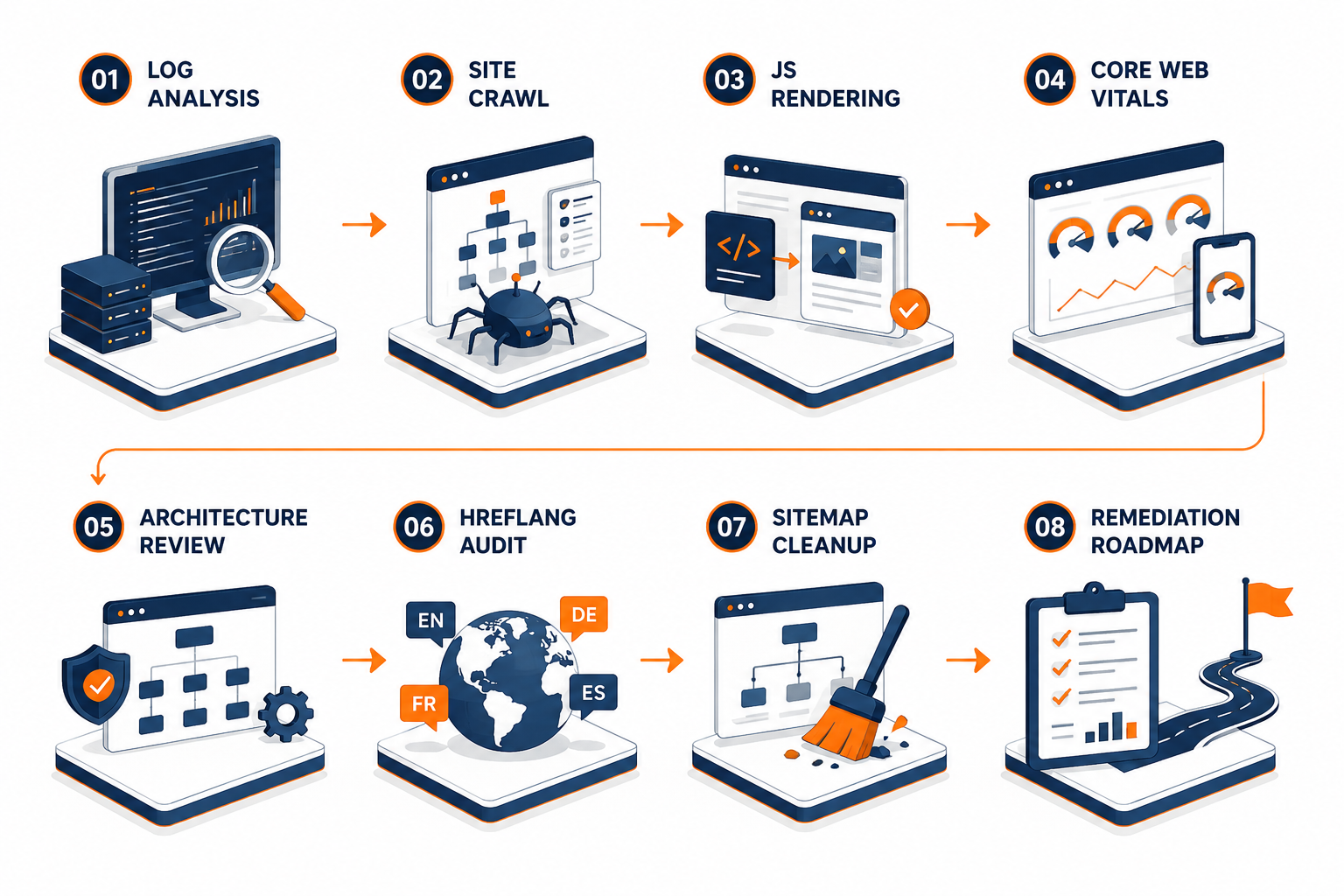
What is the Step-by-Step Process for an Enterprise Technical SEO Audit?
Direct Answer: A professional enterprise technical SEO audit follows an eight-stage process from data collection through prioritised remediation roadmap delivery, with each stage building on the diagnostic outputs of the previous one.
Below is the exact framework followed by our enterprise technical SEO engineers:
- Google Search Console and Analytics Data Collection: Pull Coverage report data, Core Web Vitals field data, crawl stats, and organic performance data across all properties. Identify which URL segments have indexation errors, excluded pages, or significant organic traffic gaps.
- Server Log File Analysis: Extract and parse Googlebot access logs to identify which URL segments receive the highest crawl frequency, which priority pages are under-crawled, and how crawl budget is currently being distributed across the site.
- Large-Scale Site Crawl: Run a full-site crawl using Screaming Frog SEO Spider or Sitebulb configured to mirror Googlebot’s crawl behaviour. Capture all HTTP status codes, canonical attributes, noindex tags, title tags, H1 tags, and internal link structures.
- JavaScript Rendering Audit: Compare the raw HTML response of key page templates against the fully rendered DOM to identify content, navigation, and internal links that only appear after JavaScript execution. Use Google’s Rich Results Test and Chrome DevTools to verify what Googlebot actually sees.
- Core Web Vitals Field Data Review: Analyse Google Search Console Core Web Vitals report by URL group to identify which page templates fail LCP, INP, or CLS thresholds in real-user field data. Supplement with PageSpeed Insights lab diagnostics for root cause identification.
- Site Architecture and Internal Linking Analysis: Map click depth from the homepage to every priority commercial page. Identify orphan pages, pages buried beyond three clicks, and internal linking imbalances where low-priority pages receive more links than high-priority revenue pages.
- International SEO and hreflang Verification: Audit all hreflang annotations for correct language and region codes, verify that every hreflang tag has a corresponding return tag on the target page, and confirm that hreflang URLs are canonical, indexable, and returning HTTP 200 status codes.
- Prioritised Remediation Roadmap Delivery: Compile all findings into a business-impact-ranked remediation roadmap categorised into critical, high, medium, and low priority tiers. Each issue is documented with its root cause, the affected URL volume, the business impact, and step-by-step fix instructions for the development team.
What Are the Pros and Cons of a Professional Enterprise Technical SEO Audit?
Direct Answer: The primary benefits are a clear prioritised roadmap for organic growth, faster Googlebot crawl efficiency, elimination of indexation suppressors, and a measurable performance baseline. The main limitation is that audit findings require engineering resources to implement, which introduces dependency on development team capacity.
Pros of a Professional Enterprise Technical SEO Audit
- Reveals hidden indexation suppressors: Issues like canonical conflicts and noindex misapplications that silently exclude entire page groups from Google are invisible without an audit
- Prioritises work by revenue impact: Engineering effort is directed toward fixes that unlock organic revenue first, rather than chasing arbitrary technical scores
- Establishes a repeatable performance baseline: Enables ongoing measurement of whether subsequent SEO and development work is improving or regressing technical health
- Accelerates new content indexation: Fixing crawl budget waste and internal link gaps means newly published pages are discovered and indexed faster
- AI search eligibility foundation: Per Google’s Search Central guidance, pages must be indexed and snippet-eligible to appear in AI Overviews, with technical health serving as the primary prerequisite
- Cross-team alignment: A structured audit report gives development, product, and marketing teams a shared source of truth for prioritisation decisions
Cons of a Professional Enterprise Technical SEO Audit
- Implementation dependency: Audit findings are only valuable if development resources are available to execute the recommended fixes within a reasonable timeframe
- Snapshot in time: A point-in-time audit becomes outdated as the site evolves. Continuous monitoring is required to maintain technical health after initial remediation
- Enterprise CMS limitations: Some technical fixes (canonical tag restructuring, JavaScript rendering changes) require platform-level changes that can take months to clear through enterprise change management processes
- Large URL volumes require prioritisation: Enterprise sites with millions of URLs cannot fix every issue simultaneously. Triage decisions require experienced SEO judgement to avoid spending engineering time on low-impact fixes
What Are the Most Common Enterprise Technical SEO Mistakes Large Organisations Make?
Direct Answer: The most frequent enterprise technical SEO mistakes are allowing faceted navigation to generate millions of duplicate URLs without parameter controls, applying noindex tags inconsistently across templates, and failing to verify canonical tag implementation after CMS migrations or platform updates.
- Allowing faceted navigation to run unconstrained: E-commerce and B2B product catalogue platforms with filter-driven UX generate millions of near-identical URL variants. Each variant consumes Googlebot crawl budget. Without canonical tags or robots.txt parameter exclusions, priority category and product pages receive insufficient crawl visits.
- Applying noindex and canonical tags inconsistently: A page that has a self-referencing canonical tag but also carries a noindex meta robots directive sends contradictory signals. Googlebot must waste multiple crawl visits re-evaluating the page before resolving the conflict.
- Ignoring JavaScript rendering gaps: Enterprise teams that migrate to React, Next.js, or Vue-based front-ends often assume Googlebot renders JavaScript identically to a browser. According to Google’s JavaScript SEO documentation, Googlebot renders JavaScript in a secondary wave with a significant delay. Critical content placed exclusively in JavaScript is frequently missed.
- Submitting bloated XML sitemaps: Sitemaps containing redirected, noindexed, canonicalised-away, or error-status URLs cause Googlebot to waste crawl requests following dead ends. Per Google’s sitemap documentation, sitemaps should contain only canonical, indexable URLs returning HTTP 200 status codes.
- Neglecting internal link depth at scale: As enterprise websites grow, new content is published without updating internal linking structures. Revenue-generating pages published six months ago become buried at four or five clicks from the homepage, starving them of crawl frequency and PageRank flow.
- Running one-time audits without ongoing monitoring: Enterprise websites are not static. Platform migrations, CMS plugin updates, A/B testing tool implementations, and marketing campaign landing pages continuously introduce new technical issues. A one-time audit without continuous monitoring loses its value within 90 days.
- Treating all hreflang errors as equal: Hreflang configuration errors range from minor (a missing x-default tag) to catastrophic (all regional variants canonicalising to the wrong locale). Enterprise teams often batch all hreflang errors together rather than triaging by traffic and revenue impact.
How Do You Ensure AI Search Crawlers Can Access Your Enterprise Technical SEO Content?
Direct Answer: AI search crawler access requires explicitly allowing specific search-retrieval bots in robots.txt and verifying that CDN, WAF, and authentication layers do not block them, because technical crawlability is a prerequisite for AI Overview and ChatGPT Search eligibility independent of your content quality.
According to Google’s Search Central guidance on AI Overviews, pages must be indexed and snippet-eligible to appear as supporting links in AI-generated answers. A well-optimised enterprise page that blocks the wrong crawlers receives zero benefit from its technical improvements in AI search.
The table below separates AI search-retrieval bots (which must be allowed for live AI citation eligibility) from model training scrapers (which are a discretionary business decision with no impact on search retrieval):
| Bot | Engine | Role | Recommendation |
|---|---|---|---|
| OAI-SearchBot, ChatGPT-User | OpenAI | ChatGPT Search live indexation and retrieval | Allow – required for ChatGPT Search inclusion |
| PerplexityBot, Perplexity-User | Perplexity | Perplexity search indexing (not model training) | Allow |
| Claude-SearchBot, Claude-User | Anthropic | Claude search indexing | Allow |
| Googlebot | Core Google index, AI Overviews, AI Mode | Allow – mandatory | |
| GPTBot | OpenAI | Model training only – does not affect search | Discretionary |
| ClaudeBot | Anthropic | Model training only – does not affect search | Discretionary |
In addition, verify that all AI-targeted pages carry the correct meta robots tag (index, follow, max-snippet:-1, max-image-preview:large, max-video-preview:-1), that critical body text is present in the raw initial HTML response rather than rendered via JavaScript only, and that CDN cache configurations do not return stale or error responses to bot user-agents.
Case Study: How a Global B2B SaaS Platform Recovered 28% of Lost Organic Traffic Through an Enterprise Technical SEO Audit
Direct Answer: A global B2B SaaS platform recovered 28% of suppressed organic traffic and re-indexed over 11,000 previously excluded commercial pages within 60 days of implementing the priority findings from a structured enterprise technical SEO audit.
The client, a cloud security software vendor with over 800,000 indexed URLs across 14 regional subdirectories, had experienced a 19% decline in organic impressions over two quarters following a platform migration. Internal teams attributed the decline to algorithm updates. The actual cause was identified within the first week of the audit.
The audit identified four root causes responsible for over 90% of the organic decline:
- Canonical Tag Misfire Post-Migration: A misconfigured template applied a canonical tag pointing all product feature pages to the homepage during the migration. Over 11,000 commercial pages were silently excluded from the index within 30 days of go-live.
- JavaScript Navigation Rendering Gap: The new React-based site placed the primary navigation and all internal links inside a client-side rendered component. Googlebot could not extract internal links during its first-wave crawl pass, effectively severing crawl depth beyond the homepage.
- Sitemap Containing 190,000 Non-Canonical URLs: The migrated XML sitemap was auto-generated and included all parameter variants, paginated URLs, and redirected legacy URLs. Googlebot was spending the majority of its crawl allocation following sitemap entries that led to redirects and canonical conflicts.
- Regional hreflang Returning Wrong Locale Variants: Seven of the fourteen regional subdirectories had hreflang tags pointing to the US English variant rather than the local language version, causing Google to collapse international rankings into a single locale.
60-Day Outcomes After Priority Fix Implementation:
- Commercial pages re-indexed: 11,400
- Organic impressions recovery: +28% vs. decline baseline
- Sitemap cleaned from 190,000 URLs to 62,000 canonical, indexable URLs
- Internal link depth restored to maximum three clicks for all priority pages
- Regional organic traffic recovery: +41% across the seven affected subdirectories
How Do You Choose the Right Partner for an Enterprise Technical SEO Audit?
Direct Answer: The right enterprise technical SEO audit partner must demonstrate experience analysing large-scale URL architectures, JavaScript rendering environments, international hreflang structures, and server log data, delivering findings as a business-impact-ranked roadmap rather than a raw issue list.
According to Google Search Console documentation, Core Web Vitals field data and Coverage report errors are the authoritative signals Google uses for ranking and indexation decisions. Any audit partner that does not work from these data sources as their primary diagnostic inputs is not conducting a genuine enterprise technical SEO audit.
Use the checklist below to evaluate any prospective enterprise technical SEO audit provider before engagement:
- Do they request Google Search Console access before beginning any analysis?
- Can they parse and interpret Googlebot server log data, not only crawler tool outputs?
- Do they have demonstrated experience with JavaScript-rendered front-end frameworks (React, Next.js, Vue)?
- Can they audit hreflang implementation at scale across multi-region subdirectory and subdomain structures?
- Do they deliver findings ranked by business impact rather than by technical severity score alone?
- Can they provide verified case studies showing indexation recovery and organic traffic outcomes?
- Do they address AI search crawler access as a separate technical consideration from traditional Googlebot access?
Key Takeaways
- Technical health is the prerequisite for everything else: Content and links cannot overcome crawlability and indexation failures at enterprise scale. A professional enterprise technical SEO audit identifies and removes the barriers search engines face before content quality is ever evaluated.
- Google Search Console field data is the authoritative diagnostic source: Coverage errors and Core Web Vitals field data from Google Search Console reflect real-world Google decisions, not simulated scores.
- JavaScript rendering gaps are the most underestimated enterprise risk: Migrating to a JavaScript-heavy front-end without verifying Googlebot’s rendering capability is one of the fastest ways to suppress organic traffic at scale.
- Canonical tag errors at template level cause mass indexation failures: A single misconfigured canonical template can suppress thousands of commercial pages simultaneously. Canonical audits must be conducted at both the template and individual URL level.
- AI search eligibility requires the same technical foundation as traditional SEO: Allow OAI-SearchBot, PerplexityBot, Claude-SearchBot, and Googlebot. Ensure pages are indexed, snippet-eligible, and rendering correctly in the initial HTML response.
- One-time audits without ongoing monitoring lose value within 90 days: Enterprise websites change continuously. Technical health governance must be treated as an ongoing programme, not a project with an end date.
- Off-page brand mentions correlate with AI visibility at r = 0.664 for web and r = 0.740 for YouTube, per Ahrefs’ 75,000-brand AI Overview study. These are observed correlations, not proven causation.
Frequently Asked Questions
What is an enterprise technical SEO audit and how is it different from a standard site audit?
An enterprise technical SEO audit examines crawlability, indexation, site architecture, Core Web Vitals, JavaScript rendering, and international SEO across websites with hundreds of thousands to millions of URLs, with findings prioritised by business revenue impact. A standard site audit typically covers smaller URL volumes, relies primarily on crawler tool scores rather than Google Search Console field data, and does not address JavaScript rendering gaps or international hreflang structures at enterprise scale.
How long does an enterprise technical SEO audit take to complete?
Enterprise technical SEO audits for large websites (100,000 to 1 million+ URLs) typically require four to eight weeks from data collection through prioritised roadmap delivery, depending on the number of subdomains, international subdirectories, CMS platforms, and JavaScript rendering frameworks involved. Implementation of the audit findings by the development team is a separate timeline dependent on engineering capacity and change management processes.
How quickly can you see results after fixing enterprise technical SEO issues?
Results from enterprise technical SEO fixes become visible in Google Search Console Coverage data within 14 to 28 days of implementing canonical tag corrections, sitemap cleanup, and robots.txt changes, as Googlebot re-crawls affected URL segments. Organic traffic recovery linked to re-indexation of suppressed commercial pages typically follows within 30 to 90 days, depending on the crawl frequency Googlebot assigns to the site and the volume of pages affected.
