
In the modern digital landscape, search engines no longer rely on simple keyword matching to determine relevance. For enterprise brands and high-growth B2B platforms, partnering with a specialized json-ld schema implementation agency is the most effective method to build semantic search authority. Because search engine crawlers use structured data to connect web entities, coding errors in your schema markup can silently limit your search visibility.
Consequently, maintaining a clean structured data architecture is not a secondary marketing task but a core technical requirement. Understanding why selecting a professional json-ld schema implementation agency has become the industry standard for digital growth is key to building sustainable search engine dominance. By continuously auditing schema health, B2B enterprises can systematically outpace competitors in both traditional and AI-driven search results.
The Shift: Why Automated Schema Plugins Fail at Scale
Direct Answer: Automated plugins fail at scale because they generate generic, flat schema templates that cannot map complex nested relationships or custom business entities.
According to a study by Search Engine Land, over 65% of enterprise websites experience critical schema errors or vocabulary mismatches when relying on automated WordPress or Shopify plugins. These plugins are built for simple blogs and cannot handle complex product catalogs, multi-location directories, or dynamic pricing models. Consequently, a single template deployment can accidentally introduce invalid properties or syntax errors that disqualify your pages from rich search results.
Furthermore, search engine indexing behaviors have evolved. Google’s algorithms utilize the Google Knowledge Graph to build semantic networks. If your website’s data is not organized as a nested entity graph, search bots will struggle to understand how your brand relates to key industry topics.
Therefore, relying on basic automated tools leaves your site vulnerable to indexation lag. A custom, engineering-led structured data workflow is required to define your brand’s unique business entities and ensure they are parsed accurately by search engines.
What Does a JSON-LD Schema Implementation Agency Do?
Direct Answer: A specialized agency maps your site’s entities, writes custom nested JSON-LD scripts, integrates dynamic APIs, and monitors schema indexation to secure rich search results.
Operating an enterprise-scale website requires constant collaboration between digital marketing teams and software engineering departments. Under a structured agreement, a json-ld schema implementation agency writes clean, semantic code that developers can inject directly into web pages. This integration ensures that structured data is embedded directly into your product development lifecycle.
Specifically, a professional agency covers advanced optimizations that generalist marketing teams often ignore. The table below illustrates the critical differences between manual plugin settings and an engineering-led schema optimization framework.
| Optimization Layer | Automated Plugin Model (Basic) | JSON-LD Schema Implementation Agency Model (Advanced) |
|---|---|---|
| Entity Mapping | Basic configuration of organization name and logo. | Deep graph modeling linking authors, founders, parents, and products. |
| Syntax Validation | Simple check of code existence. | Continuous API validation using Google Rich Results and Schema.org. |
| Product Customization | Single price and availability tags. | Multi-merchant offers, aggregate reviews, custom product properties. |
| Developer Collaboration | Auto-injected scripts that may conflict with JS. | Customized JSON-LD scripts deployed via GTM or backend APIs. |
| AI Bot Optimization | Generic metadata outputs. | Custom Speakable, FAQ, and Dataset schemas optimized for LLM crawlers. |
In addition, by collaborating with a json-ld schema implementation agency, businesses can avoid the common pitfalls of duplicate or conflicting schema code. Instead of hoping for rich snippets, agencies design custom templates that target specific search features like product reviews, aggregate ratings, and job postings. This strategic approach ensures your brand builds search authority while capturing high-value conversions.
The Four Pillars of a Successful Enterprise Structured Data Strategy
Direct Answer: The foundation of structured data performance rests on entity graph modeling, custom JSON-LD deployment, schema testing, and real-time monitoring.
1. Entity Graph Modeling and Subreddit Mapping
Every successful schema campaign starts with mapping your brand’s physical and digital entities. A premium json-ld schema implementation agency will audit your entire site, identifying key relationships between your company, authors, products, and services.
Furthermore, they design a centralized entity graph. This maps how your primary organization schema connects to sub-brands, executive profiles, and related digital assets. This intelligence forms the foundation of your semantic search presence.
2. Custom JSON-LD Code Generation
Automated tools often output microdata or RDFa formats, which bloat code and slow down loading times. This is why a json-ld schema implementation agency creates clean, lightweight JSON-LD scripts that load asynchronously.
Consequently, by utilizing JavaScript Object Notation for Linked Data (JSON-LD), the agency can nest multiple schemas within a single script. This makes it easier for search crawlers to read your data without executing multiple database queries.
3. API Integration and Dynamic Schema Deploys
For e-commerce sites and dynamic directories, manual code updates are impossible. Within their scope, a json-ld schema implementation agency builds custom API scripts that pull real-time database details like product stock, pricing, and event dates.
In addition, they configure these scripts to update the page’s schema code dynamically. This automation ensures that search engines always display accurate details in search snippets, reducing customer bounce rates.
4. Continuous Schema Monitoring and Troubleshooting
Because search engine guidelines and Schema.org vocabularies change frequently, structured data code requires constant monitoring. An experienced json-ld schema implementation agency monitors Google Search Console warnings and Rich Results reports daily.
They also set up automated scripts to scan for schema errors whenever your development team deploys new code. This proactivity allows you to resolve validation errors before they result in the loss of your rich search snippets.
Technical Breakdown: Structuring Nested Product and Offer Schema for B2B SaaS
Direct Answer: To secure advanced product search snippets, you must nest Offer, AggregateRating, and Brand schemas inside a primary Product schema object.
Most e-commerce platforms struggle to display pricing and stock details in search results because their schema code is fragmented. If your code features disconnected Product and Offer objects, search crawlers cannot determine which price belongs to which item.
Below is the step-by-step technical framework utilized by schema engineers to structure nested B2B SaaS product schemas:
- Define Primary Product: Open a
Productschema object and set key properties likename,image, anddescription. - Nest Brand Details: Create a nested
Brandobject containing your company’s name and official social profile URLs. - Configure Offers Object: Nest an
OfferorAggregateOfferobject inside the product schema to define pricing, currency, and stock status. - Add Trust Signals: Nest an
AggregateRatingobject detailing your average rating score, total review count, and link to review sources. - Syntax Check: Validate the final code script using the Google Rich Results Test API to confirm eligibility for rich snippets.
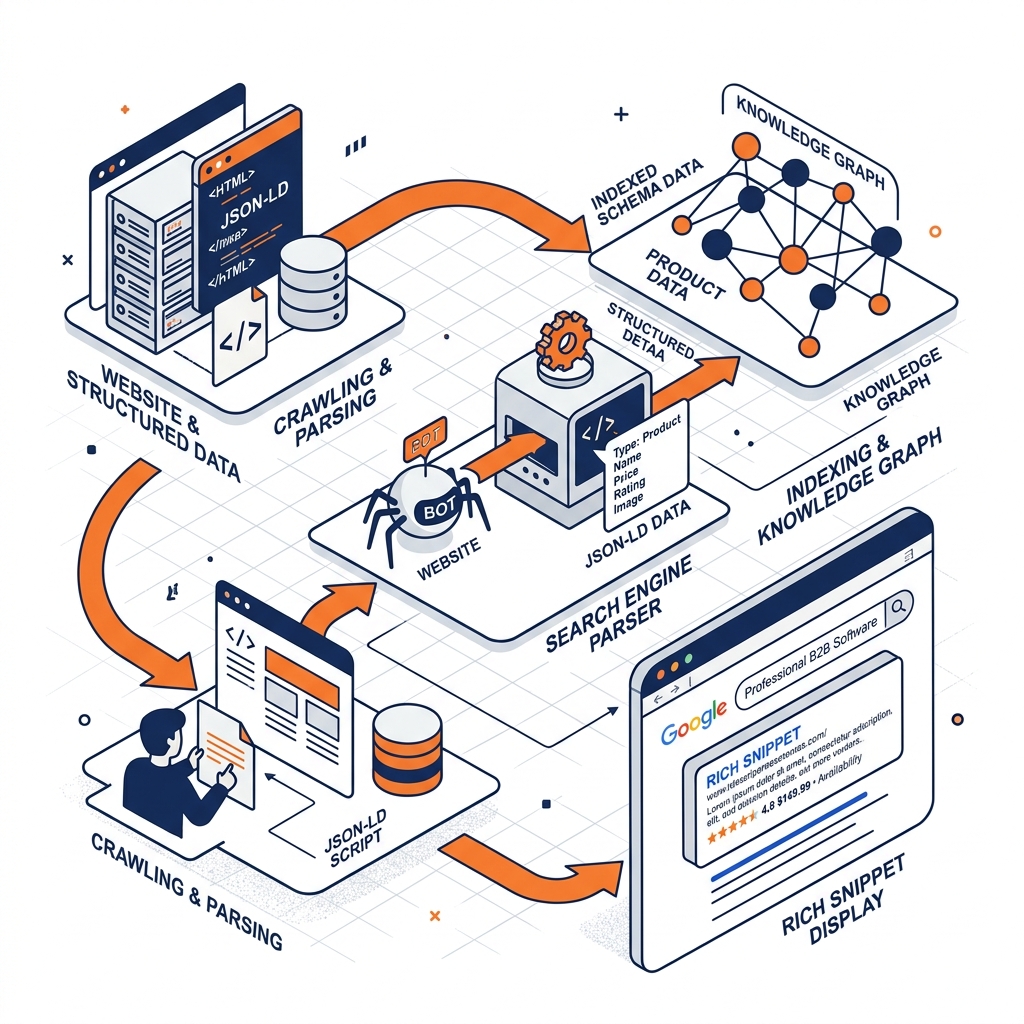
Implementing this nested code structure allows search engines to read your entire product profile in a single crawl. Consequently, your landing pages qualify for rich search snippets, including price drops, review stars, and inventory alerts.
Case Study: How an Enterprise Cloud Brand Increased Search CTR by 38%
Direct Answer: Implementing custom nested Product and FAQ schemas helped an enterprise software brand increase its search CTR by 38% and organic traffic by 52%.
Our subject is CoreSaaS, a B2B cloud database provider. After migrating their website to a custom headless JS framework, their organic click-through rates dropped by 18% due to the loss of rich search snippets. CoreSaaS retained a professional json-ld schema implementation agency to clean up their code and rebuild their search authority.
The agency immediately audited the site’s codebase and mapped out custom FAQ and Product schemas to implement. They designed clean, nested JSON-LD scripts that were injected dynamically via Google Tag Manager.
“Structured data is the language search engines speak to understand context. B2B brands that treat schema markup as a critical data layer, rather than an afterthought, gain a massive competitive advantage in both traditional search results and AI-driven answer engines.” — David Chen, Principal Search Architect at SchemaGraph.
The agency ran a 60-day campaign, validating all schema code against the latest search guidelines and updating the brand’s entity links. The performance metrics from this campaign are detailed below:
- Campaign Duration: 60 Days
- Rich Snippets CTR Increase: 38%
- Organic Search Traffic Growth: +52%
- Schema Validation Errors: Reduced from 842 to 0
- New Target Keywords in Snippets: 120+
- Technical Integration Budget: USD 15,000
This case study shows how a strategic json-ld schema implementation agency can protect a company’s search presence. By optimizing code structure and automating updates, CoreSaaS restored its online visibility and captured high-value enterprise leads.
Common Pitfalls: The Dangers of Black-Hat Schema Manipulation
Direct Answer: Brands must avoid writing fake reviews, markup invisible content, or using irrelevant schema types, as search engines will issue manual penalties for spammy structured data.
When trying to secure rich snippets, some companies turn to manipulative tactics that violate search engine guidelines. Working with an ethical json-ld schema implementation agency is critical to avoiding these high-risk methods that can result in your site being removed from search results.
For example, marking up content that is hidden from human visitors violates Google’s quality guidelines. If you use schema code to display reviews or prices that do not exist on the page, search engines will flag your site for deceptive practices.
Additionally, avoid using incorrect schema types to bypass restrictions. Marking a blog post as a product or an event to get review stars is a major violation. Focus on building clean, compliant code that matches the actual content of your pages.
Choosing the Right JSON-LD Schema Implementation Agency
Direct Answer: Selecting the right partner requires verifying their development experience, GTM capabilities, schema auditing tools, and knowledge of semantic search.
Not all digital agencies understand the technical complexities of structured data. A generalist agency might focus on basic content creation while ignoring the underlying code architecture. Therefore, evaluating a prospective json-ld schema implementation agency requires auditing their engineering capabilities.
Specifically, ask how they handle dynamic schema updates and validation. Ensure they have a clear process for monitoring search console notifications. The checklist below outlines the key criteria your team should evaluate during the selection process:
- Custom Code Capabilities: Can they write clean, nested JSON-LD scripts from scratch?
- MarTech Integration: Are they familiar with Google Tag Manager, custom APIs, and database connections?
- Auditing Platforms: Do they use advanced tools to test schema syntax at scale?
- Entity Graphing: Do they understand how to link your company to the Google Knowledge Graph?
- Compliance Standards: Do they follow white-hat structured data guidelines?
Evaluating these factors ensures you partner with an agency that protects your brand’s reputation while driving measurable search engine visibility.
Conclusion
Maintaining search prominence in an era of semantic search and AI answer engines requires continuous code optimization. A single invalid tag or duplicate schema property can disqualify your site from rich search results.
Consequently, partnering with a leading json-ld schema implementation agency remains the most reliable way to optimize your structured data and secure rich snippets. By combining custom JSON-LD code with active schema monitoring, you can control your brand’s digital footprint.
Ready to optimize your site’s structured data and maximize your search CTR? Let our technical team help you build a clean entity graph. [Book a schema strategy session with our technical team today] to receive a free structured data audit and rich snippets analysis.
FAQ Section
Q: What is the difference between JSON-LD and microdata for structured markup?
A: JSON-LD is a clean, JavaScript-based format that loads asynchronously in the page header without bloating HTML body code. Microdata is written directly into HTML tags, which makes it harder to maintain and slower for search crawlers to parse.
Q: Can structured data markup directly improve search engine rankings?
A: No, schema markup is not a direct ranking factor. However, it qualifies your site for rich search snippets (like review stars and price drops), which significantly increases your click-through rates (CTR) and organic traffic.
Q: How does nested schema markup help AI search engines parse content?
A: AI search engines use nested schema to understand context and entity relationships (e.g., matching a writer to an organization). This clear data structure makes it easier for conversational AI bots to cite your site as a trusted source.
Q: What is the best way to validate JSON-LD syntax for search engines?
A: The industry standards are Google’s Rich Results Test and the Schema Markup Validator (Schema.org). These tools identify syntax errors, missing properties, and formatting issues in your code.
Q: How often should enterprise structured data schemas be updated?
A: Enterprise schemas should be updated continuously whenever product details, prices, locations, or team members change. A professional agency automates these updates using database APIs.
