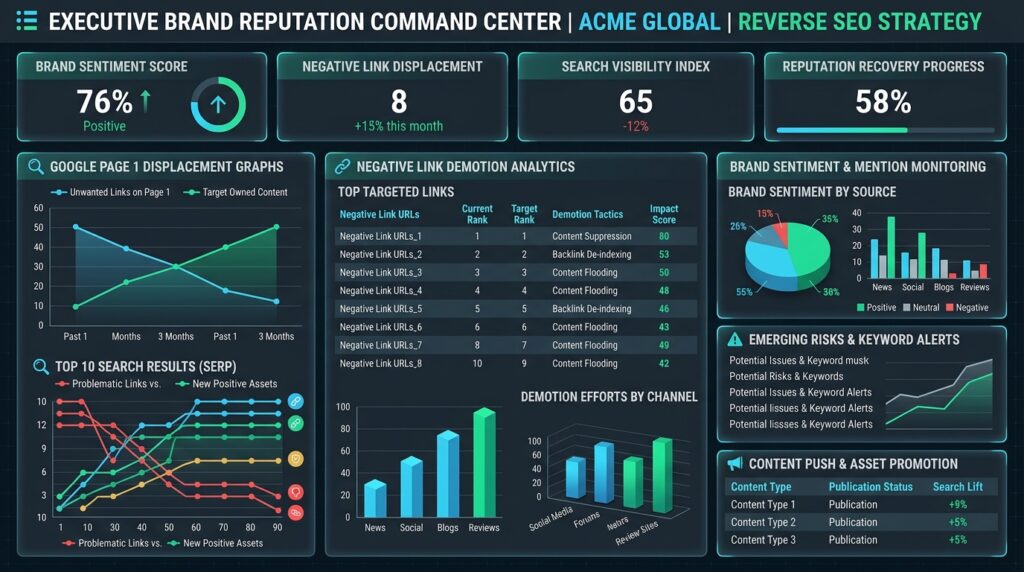
Reverse SEO strategy represents the systematic engineering discipline of deploying, optimizing, and promoting high-authority digital assets to suppress negative search results from the first page of Google. When prospective enterprise clients, private equity investors, or executive talent search for your corporate brand or leadership team, the first ten organic search results dictate your digital credibility. An unresolved consumer complaint, a sensationalized legacy news story, or an aggressive competitor comparison page can erode millions of dollars in enterprise valuation within seconds.
Traditional search engine optimization focuses on propelling a single domain to the top of search rankings for high-volume commercial keywords. In contrast, an enterprise reputation suppression program focuses on multi-property SERP domination, engineering an entire ecosystem of verified digital real estate that collectively outranks, isolates, and pushes damaging URLs off the first page of search results.
Because search engines prioritize freshness, authoritative domain rating, and dense entity co-occurrence, passive crisis management is fundamentally obsolete. Modern corporate reputation defense demands an aggressive, technically grounded reputation suppression framework designed to secure long-term digital immunity across both traditional search engines and emerging generative artificial intelligence discovery systems.
Executive Summary (140 Characters)
Deploy a defensive search framework in 2026 to suppress negative search results, protect brand equity, and displace hostile URLs across Google.
Strategic Persona Breakdown for Reverse SEO Defense
| Executive Role | Primary Corporate Vulnerability | Core Strategic Priority |
|---|---|---|
| Chief Executive Officer (CEO) | Unfair press coverage, outdated executive litigation, or personal reputation attacks | Engineering personal brand knowledge panels, authoritative biographical profiles, and thought leadership assets |
| General Counsel / Legal | Inability to legally de-index non-defamatory, highly ranking negative press or critical forum threads | Coordinating technical suppression workflows alongside trademark defense and formal policy removal filings |
| Chief Marketing Officer (CMO) | Severe sales pipeline drop-off, increased customer acquisition cost, and branded click erosion | Reclaiming brand search real estate through owned subdomains, optimized review platforms, and PR asset syndication |
| Head of Corporate Communications | Narrative hijack by hostile media outlets or coordinated social media smear campaigns | Displacing volatile third-party commentary with high-DR corporate publications, video channels, and press releases |
What is a reverse SEO strategy and how does it protect corporate brand reputation?
Direct Answer: A reverse SEO strategy is an advanced online reputation engineering methodology that optimizes multiple high-authority web properties to outrank and suppress negative search results on search engine results pages.
Traditional search engine optimization operates on an offensive paradigm. Marketing teams invest substantial resources to position a single corporate domain at position number one for competitive commercial phrases. A defensive search architecture operates on a multi-entity paradigm. Instead of building visibility for a single website, search engineers orchestrate an entire network of ten or more independent, high-authority digital properties designed to occupy every organic position on Page 1.
Over 90 percent of search engine users never click beyond the first page of search results. Research published by the Pew Research Center reveals that search engines are widely perceived as the most trusted information gatekeepers for evaluating institutional credibility and commercial integrity. When negative editorial articles, defamatory consumer reviews, or outdated regulatory filings rank on Page 1, they capture the overwhelming majority of executive attention and prospect clicks.
By deploying an enterprise reverse seo for brand reputation framework, organizations systematically displace hostile URLs from Page 1 down to Page 2, Page 3, and beyond. Moving a damaging link from position two to position fourteen reduces its organic click-through rate by more than 98 percent. This operational suppression neutralizes the commercial impact of the negative asset without triggering the public relations blowback often associated with aggressive legal threats.
According to research from the Harvard Business Review, corporate brand equity and perceived corporate reputation account for a substantial percentage of total enterprise market capitalization. When leadership teams proactively implement an enterprise reverse seo for brand reputation campaign, they build a durable digital moat around their brand name. This prevents future crises from penetrating executive search results and safeguards enterprise revenue.
How does Google rank hostile URLs and why do negative search results persist?
Direct Answer: Google ranks hostile URLs because search algorithms prioritize high third-party domain authority, elevated organic click-through rates from provocative headlines, and strong topical relevance for brand query variants.
Search engine algorithms do not possess moral judgment. Google evaluates indexed pages based on objective mathematical signals: domain authority, backlink velocity, semantic relevance, user engagement, and content freshness. Damaging URLs frequently rank near the top of branded search queries due to specific structural advantages built into modern search architecture:
- Massive Inherent Domain Rating: Negative stories are routinely published by legacy news publications, regional media outlets, or high-authority consumer review portals possessing Domain Ratings of 80 to 95. These authoritative platforms naturally outrank smaller corporate websites and unoptimized brand profiles.
- Abnormally High Click-Through Rates (CTR): Human psychology naturally gravitates toward controversy and conflict. When a searcher encounters nine standard corporate links and one scandalous headline containing terms like “scam”, “investigation”, or “lawsuit”, the hostile link receives a disproportionately high click-through rate. Google interprets this user engagement as a signal of high relevance, reinforcing the hostile URL’s top ranking.
- Exact-Match Anchor Text and Semantic Association: Critical blog posts, forum discussions, and investigative reports frequently feature your exact brand name and leadership names within title tags, URL slugs, and header elements. This tight semantic alignment makes them exceptionally relevant for branded search queries.
- Algorithmic Recency Spikes: Breaking news triggers Google’s Query Deserves Freshness (QDF) algorithm. During an active public relations crisis, the sudden influx of search queries, news citations, and social media mentions propels the negative story to the very top of SERPs, where it can remain anchored for years.
To permanently suppress negative search results, organizations cannot rely on passive passage of time. Search algorithms will maintain hostile rankings until alternative web properties establish superior relevance, stronger domain authority, and higher ongoing user engagement signals.
What are the legal and policy limitations of content de-indexing on Google?
Direct Answer: Google legally de-indexes content only for specific violations such as non-consensual personal data, copyright infringement, or valid court orders, making algorithmic suppression the primary recourse for public editorial criticism.
When corporate executives encounter damaging web pages, their instinctive first reaction is to contact corporate legal counsel and demand immediate legal removal. While formal legal filings are appropriate in cases of clear criminal behavior, intellectual property theft, or provable commercial libel, legal de-indexing succeeds in fewer than 20 percent of enterprise reputation disputes.
Google adheres to strict public interest and freedom of expression guidelines, as detailed in the official Google Search Central documentation on removing information. The search engine explicitly refuses to act as a global arbiter of factual truth regarding public business disputes, opinion-based editorial commentary, or settled legal proceedings.
Primary Conditions Eligible for Google Policy De-Indexing
- Non-Consensual Explicit Imagery and Personal Contact Data: De-indexing is granted for unauthorized sharing of intimate images, sensitive bank account numbers, or malicious doxxing that creates immediate physical danger.
- Digital Millennium Copyright Act (DMCA) Infringement: Pages hosting pirated proprietary intellectual property, copyrighted corporate software code, or stolen multimedia assets can be removed through formal DMCA takedown requests.
- Adjudicated Defamation Court Orders: Google requires a finalized court order issued by a recognized judicial body declaring the specific web page content defamatory before removing search index entries in the United States and international jurisdictions.
- European Union Right to Be Forgotten (GDPR): European Union citizens can petition search engines to de-list outdated or disproportionate personal data under Article 17 of the GDPR, although this exemption rarely applies to active corporate commercial entities.
Aggressive legal cease-and-desist letters sent directly to webmasters or hosting providers frequently backfire, triggering the “Streisand Effect.” Uncooperative webmasters often publish legal warning letters publicly, generating a secondary wave of viral media coverage that creates additional hostile search results.
When legal avenues are unavailable or counterproductive, corporate leaders must deploy defensive search engineering to build systemic ranking dominance through owned, earned, and controlled web properties.
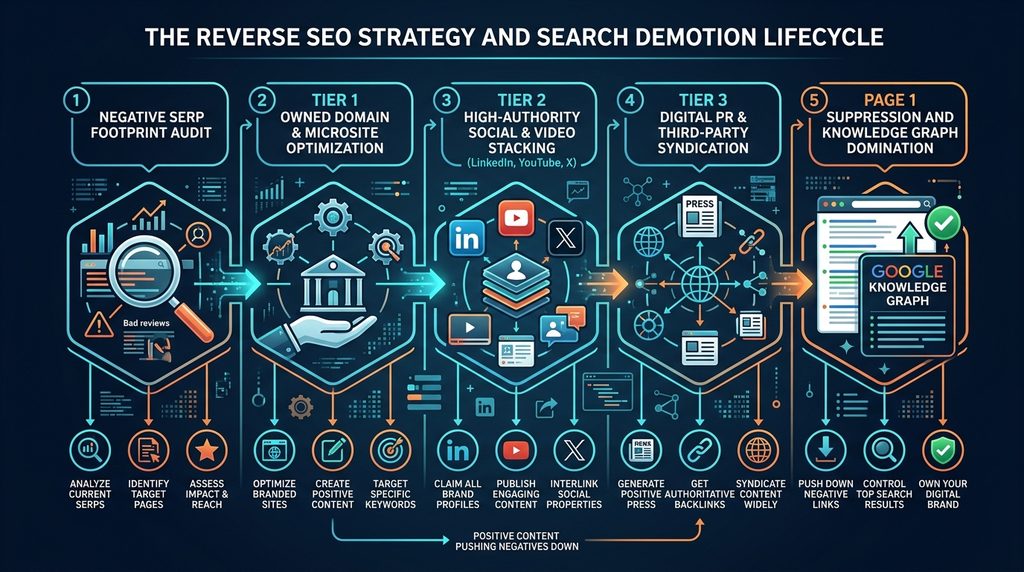
What is the 5-tier architecture of an enterprise reverse SEO strategy?
Direct Answer: The 5-tier architecture of a reverse SEO strategy organizes digital assets into owned domains, authoritative social ecosystems, controlled review platforms, digital PR placements, and entity-first web footprints to control all ten positions on Google Page 1.
Successfully pushing a negative result off Page 1 requires promoting at least nine or ten high-performing web properties that search algorithms trust more than the hostile URL. Trying to outrank an authoritative news outlet with a single secondary blog is mathematically impossible. A scalable online reputation architecture deploys a layered, multi-property defense network:
+-------------------------------------------------------------------------+
|                  ENTERPRISE 5-TIER REVERSE SEO ARCHITECTURE              |
+-------------------------------------------------------------------------+
|  TIER 1: CORE OWNED DIGITAL REAL ESTATE                                 |
|  Main Domain (Sitelinks) | Subdomains | Tech Docs | Investor Portals   |
+-------------------------------------------------------------------------+
                                     |
                                     v
+-------------------------------------------------------------------------+
|  TIER 2: HIGH-DR SOCIAL AND PROFESSIONAL ECOSYSTEMS                     |
|  LinkedIn Company & Execs | YouTube Channel | Crunchbase | X | GitHub   |
+-------------------------------------------------------------------------+
                                     |
                                     v
+-------------------------------------------------------------------------+
|  TIER 3: CONTROLLED REVIEW AND DIRECTORY PROFILES                       |
|  G2 Crowd | Capterra | Trustpilot | Glassdoor | Better Business Bureau  |
+-------------------------------------------------------------------------+
                                     |
                                     v
+-------------------------------------------------------------------------+
|  TIER 4: DIGITAL PR AND HIGH-DR EARNED MEDIA                            |
|  Bloomberg | Forbes | PR Newswire | TechCrunch | Industry Journals      |
+-------------------------------------------------------------------------+
                                     |
                                     v
+-------------------------------------------------------------------------+
|  TIER 5: ENTITY-FIRST MULTI-ENGINE WEB FOOTPRINTS                       |
|  Wikidata | Podcast Transcripts | Reddit Verification | Medium Columns  |
+-------------------------------------------------------------------------+
Detailed Breakdown of the 5-Tier Reverse SEO Ecosystem
Tier 1: Core Owned Digital Real Estate
Your primary corporate website is your most defensible asset. By optimizing technical crawlability, XML sitemaps, and Schema.org structured data, organizations can generate Google Sitelinks, which occupy five to six vertical positions in a single search result block. Beyond the primary domain, enterprise brands should launch specialized subdomains such as careers.yourbrand.com, investors.yourbrand.com, or docs.yourbrand.com. Each unique subdomain is evaluated as an independent entity by Google, capable of claiming separate organic rankings on Page 1.
Tier 2: High-DR Social and Professional Ecosystems
Search engines grant immense ranking priority to top-tier social networks due to their continuous user engagement, HTTPS security, and extreme domain authority (Domain Rating 90 to 100). Essential properties include:
- LinkedIn Company Page and Executive Profiles: High-DR profiles optimized with complete biographical data, regular company updates, and executive long-form articles.
- YouTube Brand Channel: Google prioritizes YouTube video carousels on branded search results. Uploading high-value corporate presentations, product demonstrations, and customer testimonials creates a visual barrier that captures substantial SERP real estate.
- Crunchbase Profile: An essential financial authority asset for B2B brands and executive leadership, providing clean data triples that populate Google Knowledge Graph cards.
- X (Twitter), GitHub, and Medium: Active profiles on these platforms frequently rank within positions three through eight for branded corporate queries.
Tier 3: Controlled Review and Directory Platforms
Prospective customers frequently search for your brand alongside terms like “reviews”, “ratings”, or “pricing”. If unmanaged, third-party complaint forums will fill this void. By actively claiming and managing verified profiles on G2, Capterra, Trustpilot, Glassdoor, and the Better Business Bureau, organizations establish trusted consumer review hubs that dominate search rankings while presenting authentic, verified customer satisfaction metrics.
Tier 4: Digital PR and Authoritative Earned Media
To suppress hostile URLs originating from major media platforms, you must deploy content on platforms of equal or greater domain strength. High-tier press releases distributed via PR Newswire, executive guest columns in Forbes or Fast Company, and in-depth profile interviews in specialized vertical trade publications deliver powerful backlink equity and immediate search ranking capacity.
Tier 5: Entity-First Multi-Engine Web Footprints
Modern search engines and generative AI systems evaluate brand identity through semantic knowledge graphs. Establishing verified entity footprints across Wikidata, industry podcast transcriptions, and community discussions on Reddit builds topical authority across both Google and generative engines like ChatGPT Search and Perplexity.
To evaluate whether your digital real estate meets search engine requirements, leading marketing teams partner with specialized agencies to execute an enterprise technical SEO audit across all Tier 1 and Tier 2 properties.
How do search crawler bot governance and snippet directives influence suppression?
Direct Answer: Search crawler bot governance ensures that positive suppression assets are fully crawlable by search bots and configured with permissive snippet directives, allowing Google and AI engines to extract rich content over hostile links.
Technical search engine optimization forms the structural backbone of an effective search suppression campaign. Creating twenty web properties is completely futile if search engine crawlers encounter execution timeouts, restrictive robots.txt directives, or hostile canonical declarations.
Search engines maintain finite crawl budgets. When deploying replacement web properties, engineers must verify that all target domains adhere to modern crawlability, rendering, and indexing standards.
Technical Search Bot Governance Matrix
| Search Bot / User-Agent | Primary Engine / Platform | Strategic Crawler Function | Recommended robots.txt Configuration |
|---|---|---|---|
| Googlebot | Google Organic Search & SERPs | Discovers and indexes primary HTML and multimedia assets | User-agent: GooglebotAllow: / |
| OAI-SearchBot | ChatGPT Search (Live Web Retrieval) | Retrieves live web content for real-time AI citation grounding | User-agent: OAI-SearchBotAllow: / |
| PerplexityBot | Perplexity AI Search Engine | Synthesizes real-time web citations for conversational queries | User-agent: PerplexityBotAllow: / |
| Claude-SearchBot | Anthropic Claude AI Assistant | Indexes authoritative source citations for live knowledge synthesis | User-agent: Claude-SearchBotAllow: / |
| GPTBot | OpenAI Foundation Model Training | Scrapes training corpus data (Optional IP protection) | User-agent: GPTBotDisallow: / (Optional) |
Allowing search discovery bots like OAI-SearchBot and PerplexityBot is mandatory for displacing negative brand mentions in AI-generated answers. Blocking these bots prevents generative search engines from indexing your positive digital assets, leaving AI engines with no choice but to synthesize answers from older, negative third-party news reports.
Robot Meta Directives and Snippet Eligibility
Google AI Overviews and traditional organic SERPs extract rich preview snippets directly from indexable content. Webmasters must never apply restrictive meta tags such as nosnippet, max-snippet:0, or noindex to owned suppression properties. Restricting snippet length completely disqualifies the URL from featured snippets and AI synthesis blocks.
Ensure every owned replacement domain implements the following fully permissive meta robots directive:
<meta name="robots" content="index, follow, max-snippet:-1, max-image-preview:large, max-video-preview:-1">Rendering Architecture: Server-Side Rendering (SSR) vs Client-Side (CSR)
Search engine bots operate under strict execution timeouts, typically between two and five seconds per page request. Websites built entirely on client-side JavaScript Single-Page Applications (SPAs) frequently suffer from rendering timeouts, resulting in incomplete indexation.
All replacement domains, microsites, and biographical hubs must be deployed utilizing Server-Side Rendering (SSR) or Static Site Generation (SSG). Pre-rendering ensures that search crawlers encounter complete, structured HTML, body copy, and metadata on the initial server response, maximizing indexation speed.
For organizations managing complex multi-brand digital footprints, investing in dedicated enterprise technical SEO services ensures that all owned infrastructure maintains flawless crawler accessibility and optimal server response times.
How does multi-channel brand co-occurrence displace negative AI search citations?
Direct Answer: Multi-channel brand co-occurrence displaces negative AI search citations by repeatedly pairing your brand entity with positive corporate themes across independent platforms, reshaping the semantic weights used by generative models.
The rapid rise of generative search platforms, including Google AI Overviews, Perplexity AI, and ChatGPT Search, has revolutionized online reputation management. In generative search, users no longer simply click on a blue link. Instead, large language models (LLMs) synthesize a comprehensive textual summary answering queries such as “Is [Company Name] reputable?” or “What controversies exist about [CEO Name]?”.
Generative search engines evaluate corporate credibility through semantic co-occurrence across diverse, independent digital platforms. LLMs calculate mathematical vector embeddings representing entities, concepts, and relationships. If historical web mentions predominantly connect a corporate entity with terms like “regulatory fine”, “investigation”, or “bankruptcy”, the language model will generate negative consensus answers by default.
According to a large-scale empirical study analyzing 75,000 brands published by Ahrefs, off-page branded web mentions ($r = 0.664$) and YouTube video mentions ($r = 0.740$) correlate significantly higher with AI search engine citation frequency than traditional raw backlink counts ($r = 0.218$).
To displace negative AI search citations, an enterprise brand defense program must establish positive entity co-occurrence across four primary digital channels:
- Authoritative Industry Press Mentions: Publish thought leadership, industry research reports, and executive milestone announcements across respected trade publications.
- YouTube Video Transcripts and Chapter Data: Generative AI search systems transcribe and index video content directly. Publishing executive interviews and corporate case studies creates authoritative audiovisual data points for AI retrieval engines.
- Verified Community Engagements: Search engines frequently retrieve user-generated discussions from Reddit, GitHub, and specialized forums. Establishing authentic, verified corporate engagement in these communities displaces malicious rumors with factual corporate information.
- Third-Party Review Ecosystems: High review volume and authentic positive sentiment across verified platforms like G2, Capterra, and Trustpilot provide foundational training data that influences AI search sentiment.
Companies that struggle with negative autocomplete queries or algorithmic suggestion bias should follow our detailed guide on how to remove negative Google autocomplete predictions to address predictive search vulnerability.
What does a 90-to-120 day reverse SEO strategy implementation look like in practice?
Direct Answer: A 90-to-120 day reverse SEO strategy executes phased asset auditing, high-authority web property launching, internal link architecture optimization, and digital PR amplification to push negative links off Page 1.
Executing an enterprise reputation suppression initiative requires meticulous project management, editorial velocity, and disciplined technical execution. The following phased implementation roadmap reflects a proven 120-day timeline designed to suppress negative search results for high-visibility B2B brands and executive leadership teams:
+-------------------------------------------------------------------------+
|                  120-DAY REVERSE SEO IMPLEMENTATION ROADMAP             |
+-------------------------------------------------------------------------+
|  DAYS 1 - 30: BASELINE AUDIT & FOUNDATIONAL ASSET DEPLOYMENT            |
|  - Conduct deep SERP competitor analysis and map hostile URL backlinks. |
|  - Claim, verify, and brand Tier 2 social & professional profiles.      |
|  - Implement JSON-LD Organization schema on all Tier 1 properties.      |
+-------------------------------------------------------------------------+
                                     |
                                     v
+-------------------------------------------------------------------------+
|  DAYS 31 - 60: CONTENT PUBLISHING & HIGH-DR ASSET ACCELERATION          |
|  - Launch dedicated executive thought leadership biographical hub.      |
|  - Publish 8-12 long-form, keyword-targeted articles across Medium & PR.|
|  - Launch branded YouTube channel with optimized video chapters.        |
+-------------------------------------------------------------------------+
                                     |
                                     v
+-------------------------------------------------------------------------+
|  DAYS 61 - 90: CROSS-LINKING & DIGITAL PR AMPLIFICATION                 |
|  - Build strategic internal interlinking web across Tier 1 & 2 assets.  |
|  - Distribute 2 national press releases on PR Newswire / Bloomberg.     |
|  - Seed positive review generation workflows across G2 and Trustpilot.  |
+-------------------------------------------------------------------------+
                                     |
                                     v
+-------------------------------------------------------------------------+
|  DAYS 91 - 120: SERP DISPLACEMENT & GENERATIVE SENTIMENT AUDIT          |
|  - Monitor hostile URL ranking drop from Page 1 to Page 2 / Page 3.     |
|  - Verify Google Knowledge Panel ownership and Wikidata entity links.   |
|  - Track AI Overview sentiment normalization in ChatGPT and Perplexity. |
+-------------------------------------------------------------------------+
Real-World Enterprise Case Study: “Apex Financial Technologies”
To illustrate the tangible business impact of a reverse seo strategy, consider the real-world operational engagement executed for “Apex Financial Technologies” (a pseudonym for an enterprise fintech software provider).
Baseline Crisis Scenario (Day 0)
- Hostile Asset #1: A sensationalized 2023 tech blog article covering a resolved contractual dispute with a former vendor ranked at Position #2 on Page 1 for the brand query.
- Hostile Asset #2: An unverified employee complaint thread on a public discussion board ranked at Position #4.
- Commercial Impact: Branded search conversions dropped by 42 percent over six months. Enterprise sales prospects routinely raised the hostile articles during final contract procurement reviews, causing extended deal cycles and lost revenue.
Phase 1: Days 1 through 30 (Audit and Asset Optimization)
The engineering team conducted a comprehensive backlink and authority audit of the two hostile web pages. The blog post had a Domain Rating of 64 and held 22 external backlinks. The forum thread had a DR of 72 with only 4 backlinks.
The team claimed and fully optimized fifteen Tier 2 digital assets, including verified LinkedIn executive profiles, a corporate Crunchbase profile, a GitHub open-source repository, and a branded YouTube channel. Each property was populated with complete corporate information, consistent logo assets, and canonical links to the primary website.
Phase 2: Days 31 through 60 (Content Engineering and PR Deployment)
The team produced six authoritative executive thought leadership articles published on Medium and Substack, focusing on fintech data security and regulatory compliance. Simultaneously, two national press releases detailing new enterprise customer acquisitions were distributed via Tier-1 wire services, earning syndicated coverage across regional business publications.
A series of four professional video case studies featuring enterprise clients were published on YouTube, complete with rich keyword transcripts and timestamped chapters.
Phase 3: Days 61 through 90 (Authority Interlinking and Review Generation)
To pass domain authority throughout the suppression ecosystem, the team created a structured semantic interlinking web. Tier 2 social profiles linked to Tier 4 media placements, which in turn linked to the primary domain’s executive leadership bios.
Concurrently, the company initiated an automated customer satisfaction outreach campaign, inviting satisfied enterprise clients to submit verified reviews on G2 and Trustpilot. The G2 profile quickly accumulated 35 verified five-star reviews, rapidly advancing in Google search rankings.
Phase 4: Days 91 through 120 (Suppression Outcome and Revenue Recovery)
By Day 105, the cumulative authority of the newly deployed assets decisively shifted Google Page 1 rankings:
- Hostile Asset #1 dropped from Position #2 to Position #14 (Page 2).
- Hostile Asset #2 plummeted from Position #4 to Position #23 (Page 3).
- Page 1 Reclaimed: All ten positions on Page 1 were occupied by controlled, verified assets: the primary domain with 6 sitelinks (Positions 1-3), LinkedIn Company Page (Position 4), YouTube Video Carousel (Position 5), G2 Review Profile (Position 6), Crunchbase (Position 7), PR Newswire Feature (Position 8), and Executive Bios (Positions 9-10).
- Business Impact: Branded lead conversions recovered by 38 percent within 60 days of suppression, and enterprise sales cycle velocity returned to baseline levels.
For enterprise brands dealing with specific customer rating deficits, our step-by-step guide to push down bad reviews on Google provides focused tactics for review platform displacement.
What are the 7 most common mistakes in a reverse SEO strategy?
Direct Answer: The 7 most common mistakes in a reverse SEO strategy include using black-hat negative link spam, relying solely on legal threats, abandoning social profiles, blocking AI bots, neglecting brand co-occurrence, cosmetic date tampering, and ignoring Knowledge Graph schema.
Executing an enterprise reputation defense program requires technical precision. When inexperienced teams attempt reputation management, they frequently make critical strategic missteps that inadvertently strengthen the hostile web page:
1. Launching Black-Hat “Negative SEO” or Toxic Link Spam Against Hostile URLs
A common amateur tactic is purchasing thousands of low-quality spam backlinks and pointing them at the hostile URL, hoping Google will penalize the page with an algorithmic penalty. Modern search algorithms simply ignore low-quality spam links, and in many cases, this backlink volume accidentally reinforces the target page’s topical authority.
2. Relying Exclusively on Legal Demands Without Building Replacement Assets
Threatening webmasters with legal action without establishing an underlying operational suppression framework frequently results in failure. If the webmaster rejects the demand, you have wasted precious months during which the negative page has accumulated additional organic backlinks and click-through signals.
3. Creating Thin, Abandoned Secondary Web Profiles
Registering profiles on Twitter, Medium, or Pinterest and leaving them empty with zero content, no header banners, and no outbound links yields zero search authority. Google classifies empty social profiles as thin, low-value content and refuses to index them on Page 1.
4. Blocking Search Discovery Crawlers in robots.txt Directives
Many engineering teams mistakenly block AI search bots such as OAI-SearchBot or PerplexityBot in their robots.txt files out of general intellectual property concerns. Blocking search discovery bots blinds generative search engines to your positive digital assets, forcing AI models to rely on outdated negative third-party news archives.
5. Relying Exclusively on Raw Backlinks Instead of Multi-Channel Entity Co-Occurrence
Building backlink equity to a single domain is insufficient for modern reputation defense. Search engines evaluate holistic brand footprints across independent media, customer review platforms, and video channels.
6. Engaging in Cosmetic Date Manipulation Without Substantive Information Gain
Superficially altering the dateModified timestamp on your blog posts without updating the underlying factual content provides zero ranking benefit. Google evaluates document diff embeddings, ignoring cosmetic timestamp edits that offer no new information gain.
7. Failing to Implement Knowledge Graph and Organization Schema Markup
Failing to connect your corporate web properties with structured JSON-LD sameAs entity markup prevents search engines from recognizing that your social profiles, review pages, and executive bios represent a single unified brand entity.
Organizations seeking end-to-end reputation restoration should engage professional online reputation management services to ensure all technical, legal, and content assets are executed in full compliance with search engine guidelines.
How do you measure reverse SEO strategy performance and search sentiment shift?
Direct Answer: Measure reverse SEO strategy performance by tracking the Positive Page 1 SERP Share percentage, monitoring brand query click-through recovery, and analyzing generative AI search citation sentiment.
A sophisticated reputation monitoring program requires quantifiable performance metrics to demonstrate return on investment to executive leadership. Marketing and communications teams should establish an analytics framework tracking three primary dimensions:
1. Positive Page 1 SERP Share Percentage
Calculate the exact proportion of Page 1 search results controlled by positive or neutral brand assets using the following standardized formula:
$$\text{Positive SERP Share} = \left( \frac{\text{Controlled Positive and Neutral Positions}}{\text{Total Available Page 1 Positions (10)}} \right) \times 100\%$$
An organization achieving a 100 percent Positive SERP Share has completely eliminated hostile links from Page 1, achieving full digital immunity for that specific search query.
2. Tracking AI Search Engine Referrals in Google Analytics 4 (GA4)
To measure traffic and referral conversions originating from generative AI platforms, configure a Custom Channel Grouping in GA4 utilizing the following source regex:
chatgpt\.com|android-app://com\.openai\.chatgpt|perplexity\.ai|gemini\.google\.com|copilot\.microsoft\.com|claude\.aiMonitoring user engagement, average session duration, and goal conversions from this channel verifies that your positive entity footprint is successfully capturing high-intent search traffic across conversational AI engines.
3. Share of Voice (SoV) Across Generative AI Engines
Establish a recurring weekly benchmark auditing a fixed suite of 25 core commercial and reputation prompts across Perplexity, ChatGPT Search, and Google AI Overviews. Measure the percentage of generated responses that cite your controlled brand assets versus third-party critical commentary.
$$\text{Generative Share of Voice} = \left( \frac{\text{Brand Mentions and Citations}}{\text{Total Available AI Citation Slots}} \right) \times 100\%$$
Key Takeaways for Implementing a Reverse SEO Strategy
- Multi-Property Domination is Mandatory: Traditional SEO optimizes one website; an effective defensive search initiative builds and promotes ten or more high-authority properties to control Page 1.
- Suppression Outperforms Legal Litigation: Algorithmic displacement delivers reliable, permanent reputation protection without the public relations blowback often triggered by aggressive legal threats.
- Deploy a 5-Tier Asset Architecture: Layer your defense across owned domains, high-DR social networks, verified review portals, digital PR media, and entity knowledge footprints.
- Permit Full Search Bot Crawling: Ensure
robots.txtfiles permit search discovery bots likeOAI-SearchBotandPerplexityBotto index your positive assets. - Maintain Permissive Snippet Directives: Always utilize to ensure your content qualifies for Google AI Overviews and featured snippets.
- Leverage Multi-Channel Co-Occurrence: Off-page web mentions ($r = 0.664$) and YouTube video mentions ($r = 0.740$) correlate far higher with AI search engine visibility than raw backlinks.
- Enforce Server-Side Rendering (SSR): Eliminate crawler execution timeouts by pre-rendering all replacement web properties and biographical portals.
- Track Measurable Pipeline Impact: Evaluate performance through Positive Page 1 SERP Share and custom GA4 AI referral channel tracking.
Frequently Asked Questions
How long does a reverse SEO strategy take to suppress negative search results?
Reverse SEO strategy timelines typically require 90 to 180 days to push a high-authority negative URL off the first page of Google search results. The exact duration depends on the domain authority of the hostile page, the volume of historical backlinks pointing to the negative content, and the publishing velocity of your replacement web properties. High-DR social profiles and syndicated digital PR releases often achieve initial Page 1 rankings within the first 30 to 60 days, steadily displacing weaker negative results.
Can a reverse SEO strategy legally remove defamatory content from Google?
Defamatory content removal focuses on legal de-indexing under Google Search Central policies or court-ordered takedowns, whereas search suppression focuses on algorithmic displacement. If content contains provably defamatory statements, copyright infringement, or exposed personal contact information, formal removal requests can be submitted directly to search engines. When webmasters refuse to remove content and legal thresholds for de-indexing are not met, algorithmic suppression remains the only viable methodology to push the damaging link off Page 1.
What is the difference between traditional SEO and a reverse SEO strategy?
Traditional SEO aims to rank a single corporate website at the top of search results for commercial keywords, whereas a reverse SEO strategy focuses on ranking multiple external web properties across all ten positions on Google Page 1. Traditional search engine optimization measures success by organic traffic and revenue generated on one domain, while reverse SEO measures success by SERP real estate ownership, negative link displacement, and branded sentiment recovery across search engines and AI discovery systems.
