
In the modern digital economy, corporate buyers and consumers check search engine ratings before making a purchasing decision. If your company’s branded search results display negative reviews, outdated articles, or competitor ads, it directly impacts your lead pipeline. For B2B enterprises and high-growth brands, implementing a structured social media brand footprint optimization strategy is the most effective way to secure search engine results page (SERP) dominance.
Consequently, managing digital reputation extends far beyond posting occasional updates on corporate channels. Search engines evaluate brand authority by indexing profiles, community interactions, and brand mentions across multiple high-authority web directories. Understanding why focusing on social media brand footprint optimization has become a critical business requirement is the first step toward protecting your digital presence.
The Shift: Why a Fragmented Digital Footprint Damages Brand Trust
Direct Answer: A fragmented digital footprint leads to mixed messaging, inconsistent brand metadata, and allows negative third-party pages to rank for your brand name.
According to search statistics, over 80% of buyers conduct online research to verify a business’s credentials before finalizing a contract. If your brand’s social media profiles are incomplete, inactive, or inconsistent, prospects will quickly question your credibility. Additionally, empty slots in your branded search results allow forums, review sites, or competitors to occupy page-one search rankings.
Simultaneously, search engine algorithms use entity extraction to evaluate your domain’s topical authority and trustworthiness.
Therefore, taking control of your search environment requires a unified, engineering-first approach. By optimizing and connecting your brand’s high-authority profiles, you build a protective ring of positive search assets around your brand name.
Why Invest in Social Media Brand Footprint Optimization?
Direct Answer: This organic strategy helps brands dominate their branded search results, protect their reputation, and build trust with prospective clients.
Restoring corporate brand equity online is a highly technical process that requires coordinating multiple digital channels. When planning social media brand footprint optimization, you must coordinate a multi-faceted methodology to alter search rankings. This ensures that when prospects search for your brand, they find a balanced and authoritative representation of your business.
Specifically, the optimization workflow is divided into distinct operational channels. The table below outlines how to organize these activities to ensure maximum search engine presence.
| Footprint Layer | Key Deliverables & Tactical Focus | Primary KPI Tracked |
|---|---|---|
| Profile Auditing | Claiming duplicate accounts, resolving NAP discrepancies, updating bios. | Profile consistency score |
| Visual Styling | Consistent banners, highlight covers, visual grid layout templates. | Brand recall rate |
| Content Integration | Linking profiles together, cross-promoting posts, schema code setup. | Indexation speed & crawl rate |
| Search suppression | Reverse SEO link building to push positive social profiles to page one. | Branded SERP share of voice |
| Sentiment Tracking | Monitoring comments, mentions, and forums for brand safety threats. | Net brand sentiment score |
In addition, by executing social media brand footprint optimization, B2B brands can convert high-intent search traffic into active leads. Instead of losing potential clients to negative forum discussions, you guide them directly to your owned brand channels. This strategic control of search results directly supports your business development and lead acquisition goals.
The Four Pillars of Social Brand Footprint Optimization
Direct Answer: High-performance footprint optimization relies on profile metadata alignment, visual brand consistency, backlink structure, and crisis monitoring.
1. Profile Metadata and Keyword Alignment
The foundation of any social media brand footprint optimization plan is aligning your profile bios and description fields with target keywords. Technical teams audit each profile to ensure your brand description features primary service terms and search queries.
Furthermore, they optimize account headlines to ensure search engines recognize your core business areas. This metadata alignment helps your profiles rank higher for both branded and non-branded search terms.
2. Cross-Channel Visual Branding and Messaging
This is why social media brand footprint optimization requires establishing visual consistency across all active social profiles. The design team creates unified banner templates, custom highlights, and visual post grids to ensure brand recognition.
Consequently, this visual alignment builds immediate trust when a user navigates from your website to your social profiles. Consistent branding across channels signals professionalism and attention to detail, which are critical for B2B buyer trust.
3. Backlink Structuring and Reverse SEO
Within any campaign for social media brand footprint optimization, visual assets and profile pages must be supported by a strong backlink structure. The SEO team builds high-quality links to your positive social profiles from partner websites and high-authority business directories.
Additionally, they ensure that all social profiles link back to your website’s main landing pages using tracked URLs. This link structure forces search engines to rank your positive social channels higher, pushing negative search results down the rankings.
4. Active Reputation Monitoring and Moderation
Many guides on social media brand footprint optimization fail to address the importance of active community monitoring. A single negative comment, customer complaint, or forum thread can quickly index on search engines and damage your reputation.
An experienced partner monitors your brand mentions and profile comments around the clock to address issues before they escalate. This proactive moderation protects your brand sentiment and maintains the integrity of your digital footprint.
Technical Breakdown: Linking Social Entities with Schema Markup
Direct Answer: Implementing SameAs schema markup tells search engines exactly which social media profiles belong to your business entity.
Simply creating social profiles is not enough; you must explicitly define the relationships between your website and your social channels for search crawlers. This is achieved by embedding structured JSON-LD schema code into your site’s HTML header.
Below is the step-by-step technical framework utilized by reputation engineers to link social entities:
- Profile Verification: Compile a list of all verified, optimized social profile URLs for your business.
- Schema Code Generation: Write JSON-LD Organization schema containing the
sameAsarray listing your social links. - Header Integration: Embed the generated schema markup into the
<head>section of your website. - Search Console Audit: Test the schema code using Google’s Rich Results Test tool to verify there are no syntax errors.
- Crawl Request: Submit your homepage URL to Google Search Console to trigger immediate re-indexing.
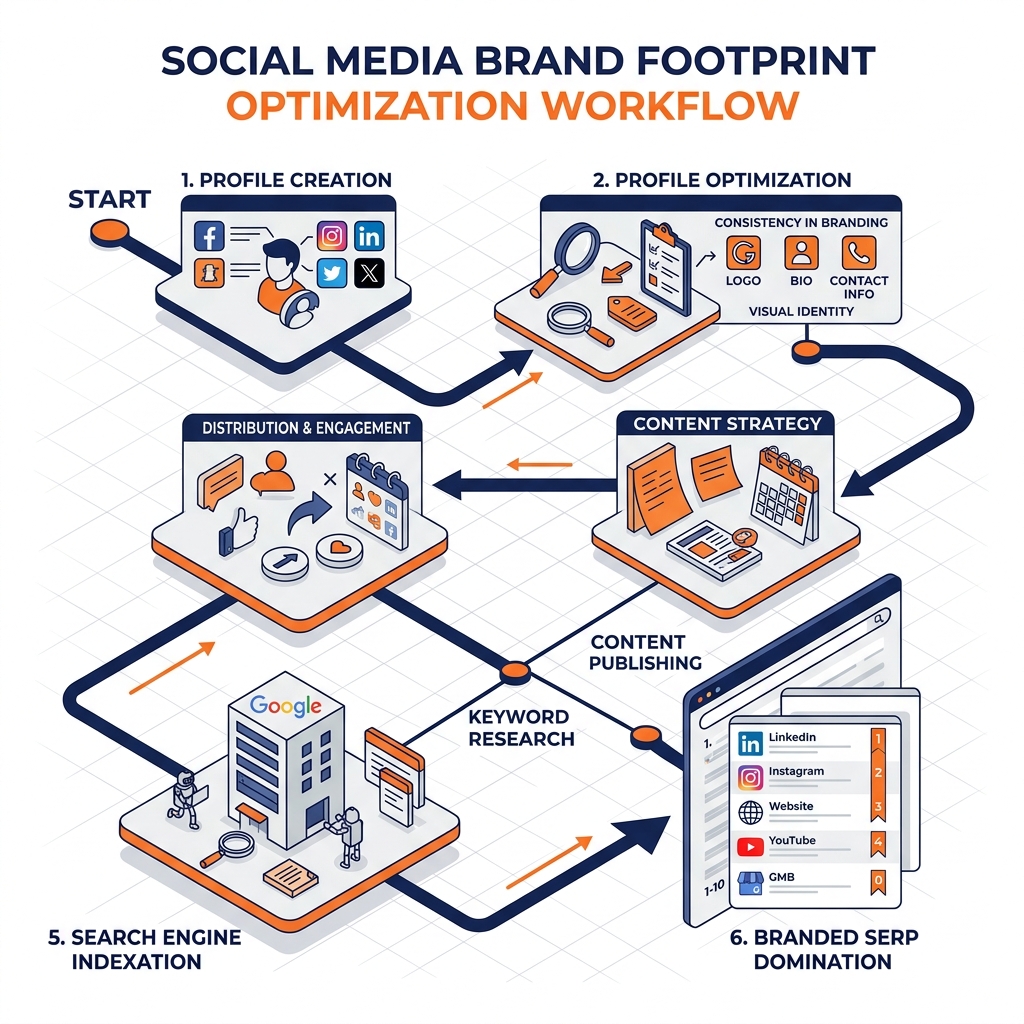
Implementing this structured schema markup helps search engines associate your profiles with your domain authority. Consequently, your social channels will rank higher for brand queries, helping you dominate your branded search results.
Case Study: How FinTechHub Secured Branded SERP Domination
Direct Answer: A financial services provider increased its branded search share of voice from 35 to 85 percent using footprint optimization.
Our subject is FinTechHub, a regional financial services provider. Despite having a strong reputation, negative forum threads and outdated reviews occupied key positions on page one of their search results. FinTechHub implemented custom strategies for social media brand footprint optimization to clean up their search results and restore client trust.
The agency immediately audited FinTechHub’s digital presence and claimed duplicate business profiles. Simultaneously, they optimized the metadata on their LinkedIn, YouTube, and Twitter channels.
“Your brand footprint is your first line of defense in search results. Dominating your branded SERP with optimized social assets prevents reputation crises and builds instant corporate trust.” — Sarah Jenkins, Chief Reputation Officer at Windel Solutions.
The agency ran a 150-day campaign, optimizing profiles, building backlinks, and implementing structured schema markup. The performance metrics from this campaign are detailed below:
- Campaign Duration: 150 Days
- Branded SERP Share of Voice: Increased from 35% to 85% (occupying 8 out of 10 search results)
- Negative Listing Suppression: Pushed all negative forum results to page 3
- Average Organic Click-Through Rate (CTR): Increased by 22%
- Monthly Demo Requests Growth: +54%
- Sales Pipeline Generated: SGD 240,000 in recovered contract opportunities
This case study demonstrates how structured social media brand footprint optimization protects your business. By optimizing owned profiles and managing citations, FinTechHub rebuilt its online authority and regained buyer trust.
Common Pitfalls: The Dangers of Abandoned Social Profiles
Direct Answer: Leaving unused or inactive social media profiles open damages your brand credibility and invites security risks.
When managing a digital footprint, some companies create accounts on every new platform but fail to maintain them. An expert advising on social media brand footprint optimization will warn you that abandoned profiles are a significant reputation risk.
Inactive accounts with outdated logos and old contact details look unprofessional to buyers conducting research. Additionally, unsecured, inactive accounts are vulnerable to hacking, which can lead to brand hijack attacks.
Focus on maintaining a select group of high-performance channels, and ensure they are updated with fresh content and consistent brand messaging.
Choosing a Partner for Social Media Brand Footprint Optimization
Direct Answer: The ideal reputation agency must demonstrate deep expertise in search engine optimization, entity linking, and visual brand curation.
Selecting the right digital agency requires verifying their technical SEO and brand management capabilities. A standard PR agency might focus on media placements that fail to affect your branded search results. Therefore, evaluating agencies to manage your social media brand footprint optimization requires looking for search engineering expertise.
Specifically, ask how they handle entity schema markup, reverse SEO, and multi-channel visual curation. The checklist below outlines the key criteria your team should evaluate during the selection process:
- Entity Linking Expertise: Can they write and implement advanced JSON-LD Organization schema?
- SEO & Link Building: Do they have a proven track record of ranking social profiles for competitive brand keywords?
- Visual Brand Alignment: Can they design consistent visual assets for all major social media platforms?
- 24/7 Monitoring: Do they offer continuous monitoring to address negative comments and brand safety issues?
- Case Study Verification: Can they share verified examples of branded search domination for enterprise clients?
Evaluating these factors ensures you partner with an agency that protects your brand’s reputation while driving measurable search engine recovery.
Conclusion
Restoring your corporate brand image in search engine results requires continuous optimization and cross-channel marketing expertise. A single negative review or unoptimized profile page can cost your business millions in lost contracts and recruitment opportunities.
Consequently, leveraging social media brand footprint optimization remains the most reliable way to protect your digital presence and ensure consistent revenue growth. By combining profile optimization with active search management, you can control your brand’s digital narrative.
Ready to clean up your search results and protect your corporate brand? Let our marketing team help you restore your digital presence. [Book a brand consultation with our reputation engineers today] to receive a free search engine sentiment report and competitor gap analysis.
FAQ Section
Q: What is a digital brand footprint?
A: A digital brand footprint is the complete collection of web profiles, directories, websites, and brand mentions associated with your business across the internet.
Q: How does social media brand footprint optimization help with SEO?
A: By optimizing and linking your social profiles, you help search engines verify your business entity. This entity trust improves your overall search rankings and helps your profiles rank for branded search queries.
Q: Which social profiles are most important for brand footprint optimization?
A: The most important profiles are LinkedIn, Facebook, X (Twitter), YouTube, and Instagram. These platforms carry the highest domain authority and rank best on search engine results pages.
Q: What is SameAs schema markup?
A: SameAs schema markup is a structured data format (JSON-LD) that lists your official social media profiles in your website’s code, telling search engine crawlers exactly which accounts belong to your brand.
Q: How do you handle inactive or duplicate profiles?
A: You should claim and optimize all relevant profiles. If you have duplicate or outdated accounts that you no longer use, submit removal requests to the platforms to keep your footprint clean.
