
Direct Answer: To push down bad reviews on Google, combine formal policy removal appeals via the official Google Business Profile Review Management Tool with an automated customer feedback loop and a multi-platform reverse SEO campaign. Because Google rarely deletes reviews that do not violate explicit terms of service, pushing negative search results below the fold onto Page 2 using high-authority web assets remains the most dependable recovery strategy.
A single negative Google review sitting at the top of your Business Profile or branded search results costs real revenue. When a prospective client searches your company name, an unanswered one-star complaint or an unverified customer attack creates immediate friction before your sales team ever speaks with them.
Why Deleting Bad Google Reviews Fails 90% of the Time
Google is an advertising and search engine platform, not an arbitration court. Business owners often expect Google support representatives to evaluate whether a customer review is factually accurate. Google explicitly refuses to mediate factual disputes between businesses and consumers.
Google only removes a review if it violates specific Google Maps user-contributed content policies:
- Clear Conflict of Interest: Reviews posted by competitors, disgruntled ex-employees, or business owners reviewing their own establishment.
- Off-Topic and Political Commentary: Rants discussing social viewpoints, political debates, or general platform grievances rather than a genuine service experience.
- Harassment, Hate Speech, and Doxxing: Reviews displaying personal employee names, private phone numbers, home addresses, or profane attacks.
- Fake Engagement and Spam Networks: Bot-generated text, mass one-star review attacks, or accounts posting duplicate text across multiple locations.
According to research from BrightLocal, 87% of consumers evaluate online reviews for local companies, and over 70% avoid businesses displaying negative sentiment across Page 1. If an unfair review does not violate explicit policy grounds, requesting deletion leads to rejection. This makes strategic search suppression your primary path to brand recovery.
Stage 1: The Formal Google Review Dispute and Appeal Protocol
Never rely on simply clicking the three dots next to a review and choosing “Report review.” That generic queue is heavily automated and rejects most requests within 48 hours without human inspection.
Follow this evidentiary process:
Step 1: Submit via the Official Review Management Tool
Open the dedicated Google Business Profile Review Management Workflow. Sign into the Google account managing your listing. The tool lists your most recent reviews alongside their current moderation status.
Step 2: Select the Exact Policy Category
Select the problematic review and submit a formal removal request. Choose the most defensible category:
- “Conflict of interest” if left by a former employee or competitor.
- “Spam and fake content” if the reviewer has no transaction record and posts identical reviews elsewhere.
- “Off-topic” if the review discusses another company or global events.
Step 3: File the One-Time Evidentiary Appeal
If Google’s automated filter denies your initial report, the Review Management Tool unlocks an “Appeal” button. This opens a manual review ticket with a human policy specialist.
Upload objective documentation:
- Proof that the reviewer never existed in your CRM, booking software, or billing logs.
- Screenshots proving competitor affiliation or employee termination letters.
- Timestamp evidence showing a coordinated burst of fake accounts.
Keep your appeal concise, calm, and tied directly to Google’s published guidelines. Avoid emotional arguments.
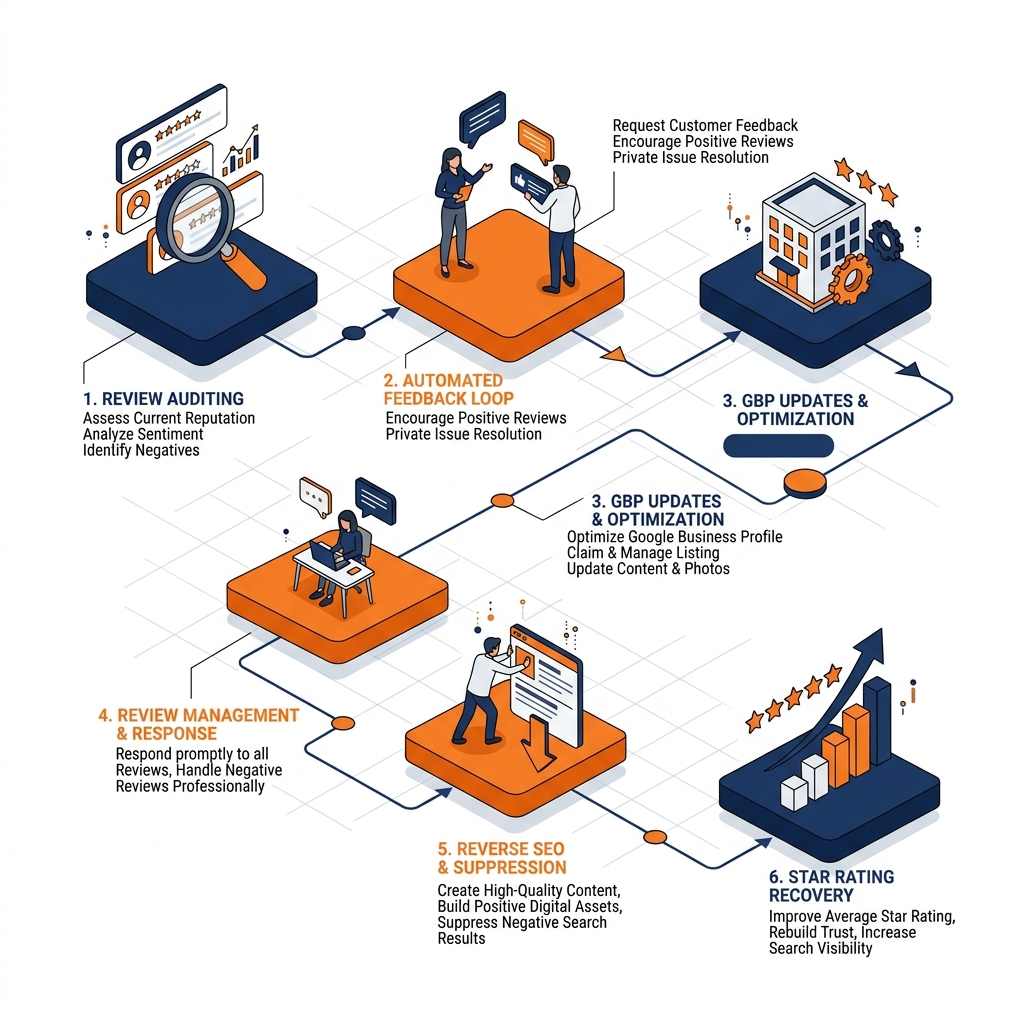
Stage 2: How to De-Rank Negative Reviews Inside Your Profile
Google Business Profiles do not sort reviews in chronological order by default. Google defaults to sorting by “Most Relevant.” Understanding the factors behind “Most Relevant” allows you to bury a one-star review below the fold without deleting it.
The Google “Most Relevant” Sorting Formula:
- Image Attachments: Reviews containing real customer photos are granted top visual priority.
- Detail and Word Count: In-depth, multi-paragraph reviews detailing specific services rank higher than short star-only ratings.
- Local Guide Level: Reviews submitted by established Level 5+ Google Local Guides receive higher algorithmic weight.
- “Helpful” Upvotes: Positive reviews receiving user engagement upvotes move toward the top of the feed.
Tactical Action Plan to Re-Order the Default View:
- Request Photo-Rich Feedback: Prompt satisfied clients to upload a photo of your office, their finished project, or delivered software dashboard when submitting feedback.
- Encourage Service Keywords: Ask clients to mention the specific service they received (such as enterprise cloud migration or commercial reputation repair). Google extracts these keywords into the top profile navigation pills.
- Engage with Positive Reviews: Have staff and satisfied customers click the “Helpful” button under detailed 5-star reviews. As positive reviews accumulate engagement signals, Google’s sorting algorithm pushes negative reviews down to lower positions.
Stage 3: Building a Compliant Automated Review Acquisition Loop
Manual review collection is slow and inconsistent. Unhappy customers write reviews unprompted; satisfied customers move on with their day unless prompted at the moment of highest satisfaction.
Technical Workflow for Operations Teams:
- CRM Trigger: Configure HubSpot, ActiveCampaign, or your POS system to fire an automated webhook 24 to 48 hours after project completion or product delivery.
- Direct Review Link Generator: Never send customers to your homepage or expect them to find your listing manually. Generate your profile’s direct short link from your Google Business Profile dashboard:
https://g.page/r/[Your-Unique-ID]/review - SMS Outperforms Email: SMS messages generate open rates above 90% within 15 minutes. A single-click SMS text with your direct review link consistently out-converts email campaigns by 300%.
Important Compliance Note (FTC 16 CFR Part 464): In late 2024, the Federal Trade Commission enacted formal regulations regarding consumer reviews. The rule prohibits deceptive review practices, including paying for reviews, fabricating testimonials, or using conditional gating that blocks dissatisfied customers from public forums under threat. Ensure your automated system asks all verified purchasers for honest feedback, directing everyone to your public channels while offering an immediate internal escalation path for dissatisfied clients.
Stage 4: Reverse SEO (Pushing Negative Search Results to Page 2)
When a bad review appears not just inside Google Maps, but on a third-party website ranking in Google search results (such as Ripoff Report, Trustpilot, Glassdoor, or a negative blog post), review generation alone will not solve the problem.
You need our reverse SEO strategy to build an impenetrable digital shield around your brand keywords.
To permanently push negative search results off Page 1, engineer and optimize high-authority third-party web assets:
1. High-Authority Profile Stacking
Search engines assign massive domain authority to established platforms. Create, verify, and interlink these digital assets:
- Professional Networks: LinkedIn Company Profile, LinkedIn Showcase Pages, and Crunchbase.
- Developer and Technical Repositories: GitHub organization pages and ProductHunt profiles.
- Video Authority: YouTube channel and structured videos targeting [Brand Name] Reviews or [Brand Name] Customer Case Studies. Google consistently rewards YouTube videos with dedicated rich-snippet video carousels on branded search results.
2. Strategic Forum and Community Authority
Google prioritizes discussions on community platforms like Reddit in modern search results. Using our Reddit marketing services, companies create transparent, authoritative reference posts answering technical questions and addressing product features. When executed ethically, positive community discussions outrank negative complaint threads.
3. Entity-Driven Schema Optimization
Deploy detailed Organization and ProfessionalService schema markup across your primary site. Linking your verified social and corporate profiles inside the sameAs schema property signals Google’s Knowledge Graph that these high-authority assets belong to your official corporate entity.
For large-scale websites managing thousands of pages, pairing this with an enterprise technical SEO audit ensures your owned pages maintain maximum crawl priority over third-party complaint boards.
Comparing Reputation Recovery Channels
| Recovery Method | Execution Timeline | Success Rate | Primary Consideration |
|---|---|---|---|
| Google Policy Flagging | 3 to 7 Days | 15% to 25% | Only succeeds if explicit policy violations are documented. |
| Evidentiary Appeal | 10 to 20 Days | 30% to 45% | Requires concrete proof (CRM records, competitor metadata). |
| Automated Review Loops | 30 to 60 Days | 85%+ | Dilutes overall negative rating and re-orders “Most Relevant”. |
| Reverse SEO Suppression | 60 to 120 Days | 90%+ | Pushes third-party complaint URLs off Page 1 onto Page 2. |
How to Respond Professionally to a Live Bad Review
Every response you write is read more closely by prospective buyers than by the reviewer themselves. Your response demonstrates your company culture and problem-solving maturity.
The 4-Part Response Formula:
- Acknowledge without defensiveness: “Thank you for your feedback, [Name]. We hold our service standards to high benchmarks and take your comments seriously.”
- Clarify policy or context calmly: “Our operational records indicate your account was processed under our standard technical maintenance schedule.”
- Move communication offline immediately: “We want to investigate this directly. Please contact our leadership desk at [email protected] or call +1 (401) 422-5395 so we can resolve this.”
- Never mention your brand name or keywords in negative responses: Do not write “Windel Solutions apologizes for bad service.” Search crawlers associate your brand name with the negative keywords in that response.
Frequently Asked Questions
Can you pay Google to remove bad reviews?
No. Google does not accept payment, advertising spend, or sponsorships to remove reviews. Anyone offering guaranteed paid deletions from Google Maps is utilizing black-hat tactics that risk complete listing suspension.
How long does reverse SEO take to push down bad search results?
A properly executed reverse SEO campaign typically displaces negative search listings within 60 to 120 days. The timeline depends on the domain authority of the negative URL and the publishing frequency of your positive replacement assets.
Is buying positive Google reviews legal?
Buying positive reviews violates Google Business Profile policies and directly violates FTC truth-in-advertising guidelines. Google regularly purges fake review networks and marks penalized profiles with public consumer warning badges.
How do I track when new negative reviews appear?
Configure real-time Google Alerts for your brand name and key executives. For enterprise organizations, pairing automated CRM notifications with continuous search monitoring detects negative sentiment before it indexes on Page 1.
Secure Your Search Presence with Windel Solutions
Leaving negative search results unaddressed damages conversion rates and erodes prospective client trust. Whether you are dealing with coordinated review spam on Google Maps or an outdated third-party complaint thread dominating Page 1, our technical search specialists build the digital infrastructure needed to protect your brand equity.
Request Your Free Reputation Gap Audit
