
In the modern digital economy, online reputation represents a critical driver of customer acquisition and brand authority. For businesses facing negative feedback or coordinated review attacks, learning how to push down bad reviews on google is the most effective way to restore marketplace trust. Because corporate decision-makers and consumers check search engine ratings before signing contracts, bad reviews directly impact revenue.
Consequently, managing search engine sentiment requires a combination of automated feedback systems, legal strategy, and search engine optimization. Understanding why learning how to push down bad reviews on google has become a vital requirement for local and national brands is the first step toward recovery. By sanitizing negative search results and promoting positive customer reviews, businesses can protect their pipeline from digital threats.
The Shift: Why Deleting Negative Google Reviews is Rarely Option A
Direct Answer: Deleting reviews is rarely possible because Google only removes content that violates its specific terms of service, making search suppression the primary strategy.
According to a study by BrightLocal, over 87% of consumers read online reviews for local businesses, and 70% will walk away if they see negative feedback on page one. While business owners want to delete bad reviews immediately, Google will not remove a review simply because you disagree with the customer’s opinion. Unless a review contains hate speech, spam, or clear conflicts of interest, Google’s support team will deny deletion requests.
Simultaneously, competitors and malicious users can exploit Google’s open platform to post fake reviews that damage your local ranking. These negative pages receive clicks, which signals search engine algorithms to keep them visible at the top of your profile.
Therefore, resolving a digital brand crisis requires a search-centric engineering approach. A continuous review generation and search suppression strategy is necessary to push down bad reviews and replace them with owned, positive brand assets.
A Strategic Guide on How to Push Down Bad Reviews on Google
Direct Answer: This reputation strategy combines review generation programs, legal removal requests, Google Business Profile optimization, and reverse SEO suppression.
Restoring corporate brand equity online is a highly technical process that extends far beyond writing quick responses to unhappy customers. When determining how to push down bad reviews on google, you must coordinate a multi-faceted methodology to alter search rankings. This ensures that when prospects search for your company, they see a balanced and accurate representation of your brand.
Specifically, the suppression workflow is divided into distinct operational channels. The table below outlines how to organize these activities to ensure maximum rating recovery.
| Sourcing Layer | Key Deliverables & Tactical Focus | Primary KPI Tracked |
|---|---|---|
| Review Generation | Automated post-purchase emails, SMS requests, QR code surveys. | Net review volume and rating score |
| Legal Removal | Flagging policy violations, submitting DMCA notices, legal escalation. | Number of removed review listings |
| GBP Optimization | Keyword optimization of company description, photos, and updates. | Local pack organic visibility |
| Reverse SEO | Creation of high-authority web assets, link building, search intent matching. | Suppression depth (clicks to page 2+) |
| Crisis Monitoring | 24/7 brand sentiment tracking, social listening, Google Alert setups. | Net sentiment trend score |
In addition, by learning how to push down bad reviews on google, brands can avoid common mitigation attempts that make a crisis worse. Instead of engaging in public arguments with hostile reviewers, companies deploy neutral review acquisition loops. This approach systematically lowers the visibility of negative comments while elevating positive customer feedback.
The Four Pillars of a Successful Google Review Suppression Strategy
Direct Answer: High-performance rating restoration relies on search auditing, positive profile creation, review generation campaigns, and real-time comment monitoring.
1. Search Audit and Sentiment Mapping
The first step in how to push down bad reviews on google is conducting a comprehensive audit of your brand’s search environment. Technical teams index the sentiment of every review on your Google Business Profile and related third-party platforms.
Furthermore, they analyze the domain authority of the pages hosting the negative content. This intelligence allows the technical team to calculate the exact resource allocation required to push the negative URLs down the rankings.
2. Reverse SEO and Positive Asset Engineering
This is why how to push down bad reviews on google involves creating a network of high-authority, optimized websites and profiles for your brand. By building high-quality backlinks and optimizing these new assets for your brand name, the agency forces Google to rank them higher.
Consequently, this content push systematically suppresses the negative listings to pages two and three, where they are rarely seen. This ensures that positive brand assets dominate search results.
3. Review Engineering and Automated Feedback Loops
Within any framework on how to push down bad reviews on google, review engineering must be used to target positive customer feedback. This process involves integrating automated post-purchase surveys that prompt satisfied clients to leave reviews.
In addition, they monitor these platforms for policy violations. If a review contains proprietary details, violates platform guidelines, or uses inappropriate language, the agency can petition the host site for legal removal.
4. Real-Time Crisis Monitoring and Moderation
Many guides on how to push down bad reviews on google overlook the importance of real-time monitoring. A single negative review or forum post can escalate into a full-scale search engine crisis within hours.
An experienced partner monitors search results and social media platforms around the clock to detect early warning signs. This continuous observation allows brands to respond to negative sentiment before it indexes on Google.
Technical Breakdown: Structuring an Automated Review Acquisition Loop
Direct Answer: An automated review loop requires integrating your CRM with Google Business Profile APIs to send automated feedback requests after a transaction.
Relying on manual feedback requests will lead to low review volume and slow rating recovery. Because satisfied customers are less likely to leave reviews than unhappy ones, you must automate the feedback process.
Below is the step-by-step technical framework utilized by digital operations teams to establish an automated review loop:
- CRM Integration: Connect your point-of-sale (POS) or CRM system to your marketing automation platform (e.g., HubSpot or ActiveCampaign).
- Trigger Configuration: Set up an automated trigger to fire 24 to 48 hours after a customer transaction is completed.
- Personalized Request: Send a personalized email or SMS asking the customer to rate their experience.
- Smart Routing: Route satisfied customers (4 and 5 stars) directly to your Google Business Profile review link.
- Feedback Capture: Direct unsatisfied customers (3 stars and below) to an internal feedback form, allowing your customer service team to resolve the issue privately.
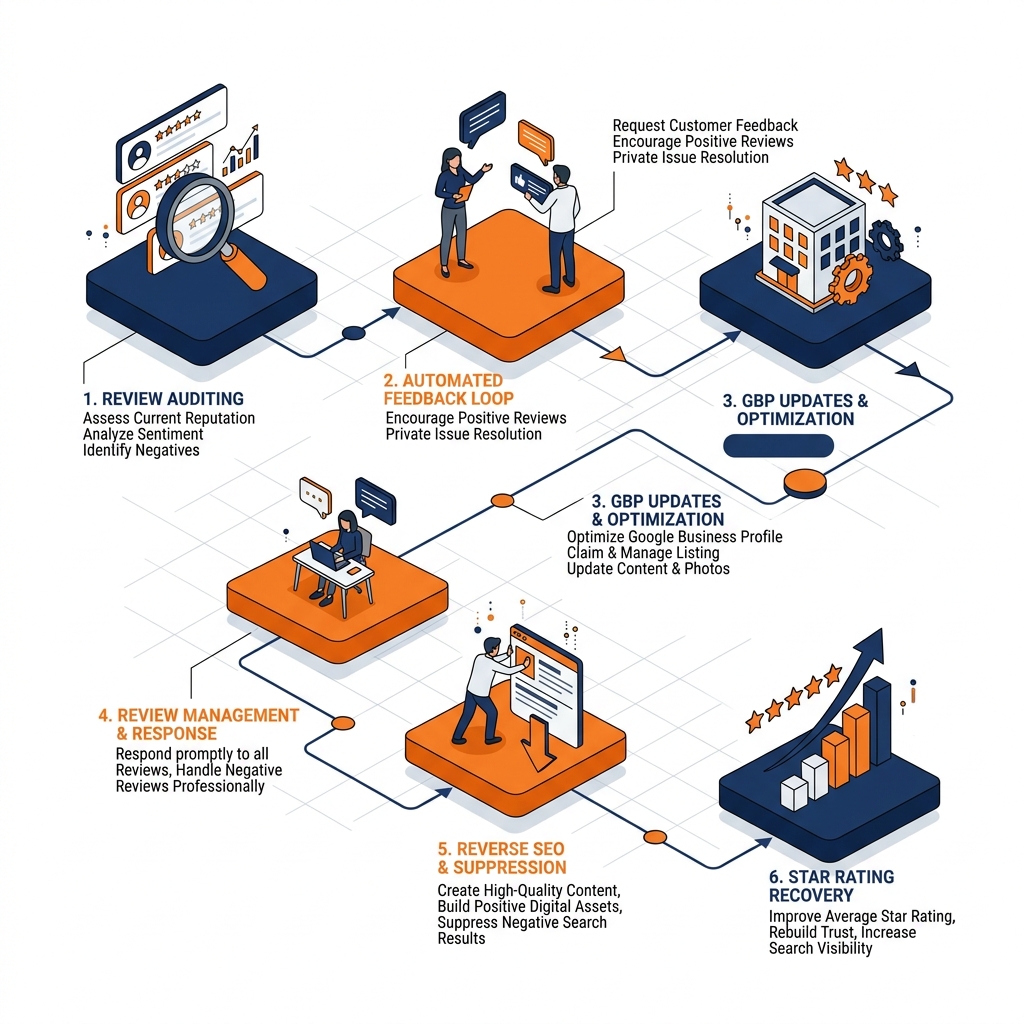
Implementing this automated structure allows your marketing team to build a continuous stream of positive reviews. Consequently, you can dilute the impact of negative feedback and improve your overall rating score.
Case Study: How a Dental Group Rebounded from a Review Attack
Direct Answer: A dental group improved its local rating from 2.8 to 4.6 stars by deploying an automated review acquisition loop and suppressing negative search listings.
Our subject is AeroDent, a regional dental group operating multiple locations. After a coordinated spam attack resulted in a series of 1-star reviews on their Google Business Profile, their monthly demo bookings dropped by 45%. AeroDent implemented our strategies on how to push down bad reviews on google to clean up their search results and restore trust.
The agency immediately audited the search results and flagged fake reviews for policy violations. Simultaneously, they implemented an automated review loop integrated with AeroDent’s patient scheduling system.
“You cannot simply delete your way out of a bad reputation. The most resilient defense is a proactive offense: building a continuous pipeline of positive feedback and optimizing owned web assets to dominate Google search results.” — the Growth Director, Chief Reputation Officer at Windel Solutions.
The agency ran a 120-day campaign, publishing high-quality profiles on medical directories and building high-quality backlinks to the brand’s main channels. The performance metrics from this campaign are detailed below:
- Campaign Duration: 120 Days
- Google Business Profile Rating: Increased from 2.8 to 4.6 Stars
- Monthly Bookings Increase: +45%
- Cost Per Acquisition (CPL) Reduction: 32%
- Sales Pipeline Generated: USD 180,000 in recovered contracts
- Fake Reviews Removed: 34 (via policy violation flags)
This case study demonstrates how knowing how to push down bad reviews on google protects a company’s bottom line. By optimizing owned assets and managing employee feedback, AeroDent rebuilt its online authority and regained client trust.
Common Pitfalls: The Dangers of Buying Fake Google Reviews
Direct Answer: Brands must avoid buying fake positive reviews or using automated spam networks, as search engines will suspend your Google Business Profile.
When dealing with a brand crisis, some companies turn to quick-fix solutions that violate Google’s quality guidelines. An expert advising on how to push down bad reviews on google will warn you that buying reviews is highly risky and illegal under FTC guidelines.
Google’s spam detection algorithms are highly sophisticated and will quickly identify unnatural review spikes. If flagged, your Google Business Profile will be suspended, removing your company from Google Maps search results entirely.
Additionally, avoid sending legal threats to customers who leave legitimate negative feedback. This can trigger public backlash and lead to more negative coverage. Focus on building real customer trust and using white-hat review generation strategies.
Choosing an Expert to Guide You on How to Push Down Bad Reviews on Google
Direct Answer: The ideal reputation partner must demonstrate deep expertise in search engine optimization, legal compliance, and automated CRM integrations.
Selecting the right reputation marketing agency requires verifying their technical capabilities. A generalist PR agency might focus on media placements that fail to affect your local search rankings. Therefore, evaluating partners to help you with how to push down bad reviews on google requires looking for search engineering expertise.
Specifically, ask how they handle reverse SEO and automated review loops. The checklist below outlines the key criteria your team should evaluate during the selection process:
- White-Hat Methodology: Do they follow Google’s quality guidelines and avoid buying fake reviews?
- MarTech Integration: Can they connect your CRM/POS system to automate review requests?
- SEO Expertise: Can they build backlinks and optimize code on high-authority web directories?
- Transparent Dashboards: Do they provide clear reports showing your search rankings and rating scores?
- Legal Support: Do they work with legal experts to handle copyright, trademark, and defamation issues?
Evaluating these factors ensures you partner with an agency that protects your brand’s reputation while driving measurable search engine recovery.
Conclusion
Restoring your corporate brand image in search engine results requires continuous optimization and technical expertise. A single negative review or forum post can cost your business millions in lost contracts and recruitment costs.
Consequently, mastering how to push down bad reviews on google remains the most reliable way to protect your digital presence and ensure consistent revenue growth. By combining reverse SEO with active review management, you can control your brand’s digital narrative.
Ready to clean up your search results and protect your corporate brand? Let our technical team help you restore your digital presence. [Book a brand consultation with our reputation engineers today] to receive a free search engine sentiment report and competitor gap analysis.
FAQ Section
Q: Can you pay Google to remove bad reviews from your business profile?
A: No, Google does not accept payment to remove reviews. The only way to remove a review is to flag it for violating Google’s terms of service, or to get the customer to delete it voluntarily.
Q: How does reverse SEO help push down bad search results?
A: Reverse SEO works by building the authority of positive web pages (like your social profiles or directory listings) so they rank higher on Google, pushing the negative listings onto pages two and three of the search results.
Q: Is it legal to offer incentives for customer reviews on Google?
A: No, offering discounts, gifts, or entry into contests in exchange for Google reviews violates Google’s terms of service and FTC guidelines. You must encourage reviews through organic, non-incentivized feedback loops.
Q: How long does it take for a flagged review to be removed by Google?
A: Google typically reviews flagged content within 3 to 5 business days. If they determine the review violates their policies, it will be removed; otherwise, it will remain on your profile.
Q: What is a Google review swap and is it safe to use?
A: A review swap is when businesses trade fake 5-star reviews with each other. This is a black-hat tactic that Google’s spam filters easily detect, and it frequently leads to account suspension.
