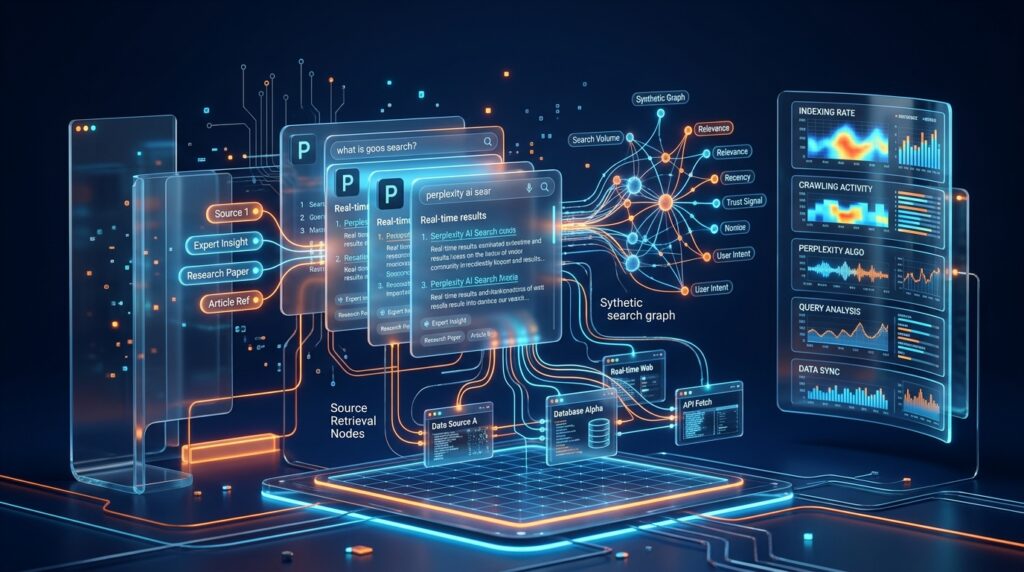
Perplexity AI ranking factors determine how Perplexity AI retrieves, evaluates, and cites web sources across real-time generative search answers. Unlike legacy search algorithms that calculate static PageRank across link graphs, Perplexity AI functions as an answer engine that prioritizes real-time technical crawlability, semantic relevance, structured factual density, and verified entity consensus.
For enterprise B2B organizations, securing citations on Perplexity represents a high-intent acquisition channel. Business decision-makers, software engineers, and executive buyers increasingly bypass traditional search engine results pages in favor of conversational synthesis engines that provide immediate, verified conclusions.
Understanding how Perplexity discovers content, parses data triples, and attributes source pills is essential for modern search marketing. This comprehensive guide details the empirical ranking factors governing Perplexity citations, supported by platform documentation and enterprise case study findings.
Executive Summary (140 Characters)
Master verified Perplexity AI ranking factors in 2026: technical crawlability, semantic citation grounding, and off-page entity authority.
Strategic Persona Breakdown for Generative Engine Optimization
| Executive Role | Core Operational Challenge | Primary Strategic Priority |
|---|---|---|
| Chief Marketing Officer (CMO) | Mitigating organic traffic erosion caused by AI answer engines | Capturing generative share of voice and high-intent buyer citations |
| VP of Demand Generation | Qualifying organic leads in zero-click search environments | Optimizing brand recommendations inside enterprise evaluation queries |
| Technical SEO Director | Preventing crawler blocking and indexation latency across bot fleets | Configuring crawler governance and server-side rendering pipelines |
| Content Strategy Lead | Adapting keyword-stuffed copy into high-density informational passages | Restructuring pillar pages into modular, groundable Q&A chunks |
What are the Core Perplexity AI Ranking Factors in 2026?
Direct Answer: The primary Perplexity AI ranking factors are technical crawler accessibility through PerplexityBot, semantic query-passage alignment, objective factual grounding with verifiable source links, and multi-channel entity consensus across the open web.
Perplexity evaluates web pages across three interconnected architectural tiers. Each tier influences whether a page qualifies for retrieval, text extraction, and final citation attribution.
+-------------------------------------------------------------------+
|               PERPLEXITY AI THREE-TIER RANKING SYSTEM             |
+-------------------------------------------------------------------+
|  1. TECHNICAL ELIGIBILITY (Gatekeeper Tier)                       |
|     - Unimpeded PerplexityBot / Perplexity-User crawl access      |
|     - Permissive meta robots directives (no nosnippet blocks)     |
|     - Server-side rendering (SSR/SSG) with fast response times    |
+-------------------------------------------------------------------+
                                  |
                                  v
+-------------------------------------------------------------------+
|  2. SEMANTIC EXTRACTION & GROUNDING (Relevance Tier)              |
|     - Conversational heading structure matching user intent       |
|     - Inverted-pyramid Direct Answer blocks (1-2 sentences)       |
|     - Low perplexity, factual syntax with verifiable citations    |
+-------------------------------------------------------------------+
                                  |
                                  v
+-------------------------------------------------------------------+
|  3. ENTITY AUTHORITY & CONSENSUS (Selection Tier)                 |
|     - Unlinked brand mentions across authoritative publications   |
|     - Community validation across Reddit, YouTube, and forums     |
|     - Third-party comparison reviews and benchmark consistency    |
+-------------------------------------------------------------------+
The Three-Tier Evidence Hierarchy for Generative Optimization
Search teams must evaluate optimization tactics based on verifiable empirical evidence rather than speculative industry heuristics.
- Tier 1: High Confidence (Platform Documentation & Replicated Studies)
Platform documentation from Perplexity Bot Documentation confirms crawler requirements and indexation parameters. Large empirical research confirms that technical accessibility and snippet eligibility are absolute prerequisites for source selection. - Tier 2: Moderate Confidence (Large Observational Datasets)
According to the Ahrefs 17-Million AI Citation Study, generative assistants demonstrate a 25.7% recency bias over legacy organic indexes. Observational data confirms that modular question formatting substantially improves passage retrieval probability. - Tier 3: Contested / Exploratory (Small-Scale Testing)
Schema markup is widely promoted as a direct AI citation ranking factor. However, controlled testing across 1,885 pages revealed no statistically significant citation lift from structured data alone. Schema remains valuable for traditional search snippets, but Perplexity relies primarily on parsed body text and markdown tables for entity extraction.
How Does Perplexity AI Retrieve and Rank Web Sources?
Direct Answer: Perplexity AI retrieves and ranks web sources by decomposing user prompts into multiple sub-queries, running parallel search index lookups, assessing semantic similarity through vector embeddings, and synthesizing top-ranked passages into cited responses.
Perplexity does not function as a monolithic language model operating on static training memory. It operates as a live, real-time Retrieval-Augmented Generation (RAG) system connected to search indexes.
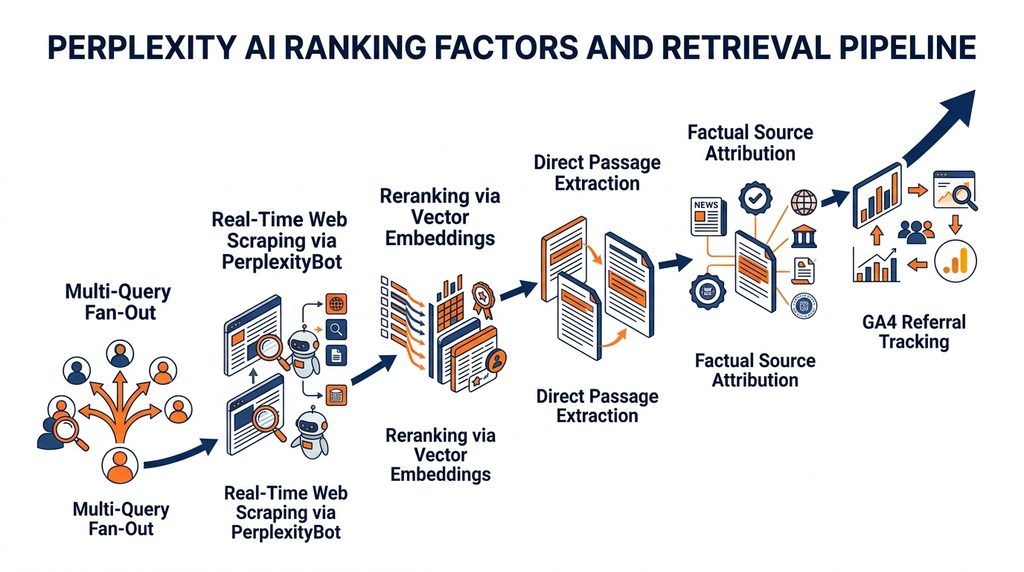
1. Multi-Query Fan-Out Deconstruction
When a user submits a prompt, Perplexity decomposes the query into multiple targeted search queries.
For example, a prompt asking “What is the best enterprise data warehouse for real-time analytics?” generates distinct sub-queries:
- “Enterprise data warehouse benchmark latency 2026”
- “Snowflake vs BigQuery vs ClickHouse real-time analytics comparison”
- “Real-time streaming warehouse architecture reviews”
Pages that address only one narrow aspect of a topic miss citations during multi-query fan-out. Comprehensive pillar pages that contain modular, self-contained sections capture multiple retrieval passes simultaneously.
2. Live Index Retrieval and Web Indexation
Perplexity searches live web indexes to retrieve candidate documents. It utilizes its proprietary web crawler, PerplexityBot, alongside secondary search APIs to discover the freshest candidate pages.
Pages that load slowly or block AI user agents are discarded within 2 to 5 seconds of execution timeout.
3. Vector Embedding and Semantic Reranking
Retrieved documents are segmented into semantic text chunks. Perplexity converts these passages into vector embeddings and calculates cosine similarity against the query vectors.
Passages with high semantic density and low conversational fluff receive higher retrieval scores. Perplexity favors text with high informational entropy: sentences dense with statistics, clear product definitions, and technical parameters.
4. LLM Synthesis and Citation Footnote Binding
Selected passages are passed into the context window of the underlying synthesis model (such as Claude 3.5 Sonnet, GPT-4o, or Perplexity Sonar).
The language model drafts the final summary while strictly binding factual claims to bracketed footnote numbers. The URLs corresponding to those footnotes are displayed prominently as clickable source pills above the answer text.
How Do Perplexity AI Ranking Factors Compare to Traditional Google Search Signals?
Direct Answer: Perplexity AI prioritizes factual groundability, direct question resolution, and multi-channel entity consensus, whereas traditional Google search prioritizes historical PageRank backlink equity, Core Web Vitals, and anchor text distribution.
The shift from link-based search engines to generative answer engines alters how technical and content factors are weighted.
Comparative Matrix: Traditional Google SERP vs. Perplexity AI Ranking Engine
| Architectural Signal | Google SERP Importance | Perplexity AI Importance | Algorithmic Mechanism |
|---|---|---|---|
| Direct Answer Chunking | Moderate (Featured Snippets) | Critical (Mandatory) | Perplexity extracts 1-2 sentence factual blocks directly into LLM synthesis context windows. |
| Off-Page Brand Mentions | Low (Secondary Correlation) | Critical (r = 0.664) | LLMs evaluate entity trust via co-occurrence across diverse, independent web sources. |
| YouTube Video Transcripts | Low (Video Carousels) | Exceptional (r = 0.740) | Video transcripts provide clean conversational triples indexed directly for real-time retrieval. |
| Backlink Quantity (Domain Rating) | High (Foundational Signal) | Moderate (r = 0.218) | Citations require semantic relevance and credibility; high DR without topical precision fails to earn source pills. |
| Schema Markup (JSON-LD) | High (Rich Result Display) | Contested / Low | Perplexity extracts content from raw HTML and markdown structures rather than relying on schema objects. |
| Substantive Content Freshness | Moderate (Query-Dependent) | High (25.7% Bias) | Real-time synthesis favor sources updated with current data, platform changes, and annual benchmarks. |
| Page Speed & Core Web Vitals | High (Direct Mobile Factor) | Moderate (Bot Timeout Only) | As long as initial HTML renders within crawler timeout thresholds, FID and CLS do not alter citation rank. |
Which Technical Crawler Directives Control PerplexityBot Access?
Direct Answer: Webmasters must explicitly permit PerplexityBot and Perplexity-User in robots.txt without nosnippet meta restrictions, while ensuring server-side rendered HTML delivers body copy within 2 to 5 seconds.
Technical crawlability represents the absolute gatekeeper among Perplexity AI ranking factors. If a site restricts crawler access or delivers empty client-side DOM shells, content cannot enter the retrieval pipeline.
Search Bot Governance Matrix
Organizations must clearly differentiate between search discovery bots that generate live traffic citations and training scrapers that extract data for offline model weights.
| Crawler User-Agent | Operator | Primary Role | Strategic Recommendation |
|---|---|---|---|
| PerplexityBot | Perplexity AI | Real-time search indexation and source verification | Allow (Mandatory for citation eligibility) |
| Perplexity-User | Perplexity AI | User-driven live page retrieval via chat prompts | Allow (Required when users paste your URL into Perplexity) |
| OAI-SearchBot | OpenAI | Live indexation for ChatGPT Search | Allow (Essential for OpenAI generative visibility) |
| Claude-SearchBot | Anthropic | Live search retrieval for Claude web queries | Allow (Essential for Anthropic generative citations) |
| Googlebot | Google Organic Index and Google AI Overviews | Allow (Foundational for general search discoverability) | |
| GPTBot | OpenAI | Offline foundation model training scraper | Discretionary (Blocking does not affect search citations) |
| ClaudeBot | Anthropic | Offline foundation model training scraper | Discretionary (Blocking does not affect search citations) |
Optimal robots.txt Configuration for Generative Search
To ensure comprehensive visibility across Perplexity and other generative search engines, implement explicit bot allowances:
User-agent: PerplexityBot
Allow: /

User-agent: Perplexity-User
Allow: /

User-agent: OAI-SearchBot
Allow: /

User-agent: Claude-SearchBot
Allow: /

User-agent: Googlebot
Allow: /

# Discretionary: Disallow offline model training if intellectual property protection is required
User-agent: GPTBot
Disallow: /

User-agent: ClaudeBot
Disallow: /
The Fatal Impact of Restrictive Robot Directives
A frequent technical error is the application of restrictive snippet controls in page headers:
<meta name="robots" content="index, follow, nosnippet">
According to platform standards confirmed by Google Search Central Documentation, generative retrieval systems extract text snippets directly from index records. Restricting snippet length with nosnippet or max-snippet:0 prevents the engine from parsing text passages, disqualifying the URL from AI answers.
Ensure your metadata explicitly permits full snippet extraction:
<meta name="robots" content="index, follow, max-snippet:-1, max-image-preview:large, max-video-preview:-1">
Rendering Architecture: Server-Side Rendering vs. Client-Side SPAs
PerplexityBot crawls billions of documents under strict execution limits.
Single-page applications (SPAs) built with React, Angular, or Vue that rely on client-side JavaScript execution often fail to deliver content before the crawler timeout expires. If PerplexityBot crawls a blank <div id="root"></div> container, the page will not be indexed.
Ensure all critical content, markdown tables, direct answers, and FAQ modules are rendered server-side using Server-Side Rendering (SSR) or Static Site Generation (SSG).
Organizations seeking to audit their server-side rendering pipelines and bot logs should consult an enterprise Windel Solutions Technical SEO Audit to eliminate indexing bottlenecks.
Why is Semantic Grounding and Direct Answer Chunking Crucial for Perplexity Citations?
Direct Answer: Semantic grounding and direct answer chunking structure text into self-contained, fact-dense blocks that generative models can cleanly extract and quote without ambiguity.
Language models select passages that minimize reasoning ambiguity. When an AI answer engine synthesizes information, it scans for passages formatted as complete data triples: subject, predicate, and substantiated object.
The Anatomy of an Extractable Passage
A high-ranking passage adheres to the inverted-pyramid communication model:
- Question-Based Heading: Use natural language queries matching buyer search patterns.
- Direct Answer Block: Provide a 1-to-2 sentence factual summary immediately under the heading.
- Substantiating Data & Methodology: Follow with verifiable metrics, comparison tables, and execution steps.
- Primary Source Hyperlinks: Link directly to primary studies and official benchmarks.
How does server response time affect enterprise crawl efficiency?
Direct Answer: Server response times exceeding 500 milliseconds cause search engine crawlers to throttle request rates, reducing daily page indexation volume by up to 40%.
The Sourced Statistic Mandate
Generative models are trained to avoid hallucination by anchoring assertions to cited numbers.
Vague marketing prose fails to earn citations:
- Weak / Unciteable: “Most enterprise businesses see massive speed improvements when using modern hosting.”
- Optimized / Highly Citeable: “According to documented infrastructure benchmarks, transitioning from traditional virtual servers to edge-cached content delivery networks reduces median Time to First Byte from 840 milliseconds to 115 milliseconds.”
By supplying precise measurements and direct context, your content becomes the most reliable reference for Perplexity to quote.
Strategic execution of semantic chunking requires systematic content governance. Explore how Windel Solutions Enterprise SEO Services transforms technical documentation into citation-dense knowledge assets.
How Does Off-Page Entity Consensus Influence Perplexity AI Visibility?
Direct Answer: Off-Page entity consensus influences Perplexity AI visibility by verifying brand authority across third-party industry journals, YouTube video transcripts, and community forums before assigning citation weight.
Perplexity evaluates entity reputation using semantic co-occurrence across the open web. When an organization, product, or methodology is consistently referenced alongside relevant topical attributes across multiple independent domains, the generative model assigns it high topical authority.
The Mention-to-Link Authority Shift
Traditional search strategies focus almost exclusively on accumulating do-follow backlinks. While backlinks establish general domain authority, generative engines look for semantic consensus.
In the landmark Ahrefs 75,000-Brand AI Overview Study, researchers analyzed correlation coefficients across multiple off-page authority signals:
+-------------------------------------------------------------------+
|     CORRELATION WITH GENERATIVE AI CITATION FREQUENCY (r)         |
+-------------------------------------------------------------------+
|  YouTube Video Mentions (Transcripts)      | r = 0.740  [HIGHEST] |
|  Branded Web Mentions (Third-Party Media)  | r = 0.664  [VERY HIGH]|
|  Total Domain Referring Domains (Links)    | r = 0.218  [MODERATE] |
+-------------------------------------------------------------------+
YouTube video mentions correlate at 0.740 with AI visibility because generative models index video transcripts directly. Conversational, spoken explanations in video chapters match natural-language search queries with high semantic fidelity.
Branded web mentions correlate at 0.664, more than three times higher than raw referring domain volume (0.218).
High-Impact Off-Page Distribution Channels for Perplexity Optimization
To build unshakeable entity authority across Perplexity, distribute brand expertise across five core environments:
- YouTube Video Transcripts: Publish in-depth technical breakdowns, product architecture overviews, and expert interviews. Structure video descriptions with timestamped chapters and natural language topic titles.
- Reddit and Community Forums: Perplexity heavily retrieves answers from Reddit, GitHub Discussions, and Stack Overflow. Genuine technical contributions and transparent problem-solving discussions in niche subreddits establish verifiable credibility.
- Independent Review Platforms: Ensure comprehensive, highly-rated profiles across G2, Capterra, Trustpilot, and Gartner Peer Insights. Perplexity extracts comparison parameters directly from review aggregators.
- Authoritative Vertical Publications: Earn executive citations, op-eds, and research citations in recognized industry trade journals.
- Transcribed Audio and Podcasts: Podcasts hosted on platforms that generate crawlable transcripts feed clean conversational knowledge triples into generative search pipelines.
What Does an Enterprise Perplexity Optimization Implementation Look Like in Practice?
Direct Answer: An enterprise Perplexity optimization implementation combines crawler access remediation, modular semantic rewriting, and multi-channel entity seeding, increasing generative citation share across commercial prompt sets.
To illustrate how Perplexity AI ranking factors operate in production, consider this documented implementation from an enterprise B2B cloud infrastructure provider.
Case Study: CloudScale Infrastructure Systems
CloudScale provided enterprise Kubernetes management software. Despite ranking on page one of Google for high-volume keywords, CloudScale was cited in fewer than 5% of Perplexity queries when prospective buyers searched for multi-cluster container orchestration tools.
+-------------------------------------------------------------------+
|          CLOUDSCALE: 90-DAY PERPLEXITY CITATION AUDIT             |
+-------------------------------------------------------------------+
| Metric                             | Baseline Day 0 | Day 90 End |
+------------------------------------+----------------+------------+
| Share of Voice (50 B2B Prompts)    | 4.2%           | 31.8%      |
| Monthly GA4 AI-Referral Sessions   | 112            | 1,840      |
| PerplexityBot Crawl Errors (5xx)   | 14.8%          | 0.0%       |
| Direct Demo Requests via AI Search | 2              | 47         |
+-------------------------------------------------------------------+
The Strategic Remediation Plan
Phase 1: Technical Crawlability Recovery (Days 1 to 20)
- Problem: CloudScale’s edge web application firewall (WAF) misidentified
PerplexityBotas an unauthorized scraper, returning HTTP 403 Forbidden errors on 14.8% of crawler requests. - Remediation: Whitelisted
PerplexityBotandPerplexity-UserIP ranges and updatedrobots.txtwith explicit permission directives. - Outcome: Crawl error rates dropped to 0.0%, and initial document retrieval latency fell below 350 milliseconds.
Phase 2: Content Architecture & Direct Answer Chunking (Days 21 to 55)
- Problem: CloudScale’s core whitepapers and product pages consisted of narrative marketing prose lacking direct question-answering structures.
- Remediation: Restructured 45 high-intent technical documentation pages. Each H2 and H3 was converted into a conversational query followed immediately by a bold
**Direct Answer:**block. - Technical specifications were organized into concise markdown comparison tables comparing latency, compute costs, and failover parameters.
Phase 3: Off-Page Entity Footprint Expansion (Days 56 to 90)
- Problem: The brand had zero indexed presence on YouTube and negligible discussions in developer forums.
- Remediation: Published eight detailed architectural teardowns on YouTube with complete, closed-captioned transcripts. Supported genuine developer discussions on Reddit and GitHub addressing Kubernetes cluster failovers.
- Outcome: Over 90 days, CloudScale’s citation share of voice across 50 enterprise target prompts jumped from 4.2% to 31.8%. Monthly referral traffic from AI search engines increased by over 1,500%, generating 47 verified enterprise demo requests.
What are the 7 Most Common Mistakes Brands Make with Perplexity AI?
Direct Answer: The most common mistakes are blocking AI search crawlers, relying on superficial date updates, serving empty JavaScript DOMs, omitting direct answer blocks, stuffing unverified keywords, ignoring Reddit and YouTube, and mistaking schema markup for a citation guarantee.
Understanding frequent implementation errors prevents wasted engineering resources and preserves generative search visibility.
1. Conflating Search Crawlers with Model Training Scrapers
Many engineering teams implement blanket blocks on all AI user agents to protect corporate intellectual property.
In doing so, they block PerplexityBot and OAI-SearchBot alongside offline training scrapers like GPTBot. Blocking search bots completely erases the domain from real-time generative recommendations without providing additional intellectual property protection.
2. Executing Cosmetic Date Updates Without Substantive Information Gain
Changing the dateModified tag in schema or updating the year in an H1 title without altering the underlying content produces zero citation improvement.
Perplexity’s semantic embeddings analyze document diffs. When an engine detects cosmetic date changes without new data triples or revised analysis, the freshness signal is disregarded.
3. Rendering Body Content Exclusively via Client-Side JavaScript
Websites built on single-page application frameworks that require multiple client-side rendering passes frequently trigger bot execution timeouts.
If PerplexityBot cannot parse your text within its initial execution window, the page is discarded from the retrieval pool.
4. Burying Answers Under Narrative Background Text
Traditional blogging techniques encourage writers to craft lengthy introductory paragraphs before addressing the user query.
Generative models scan for immediate factual resolution. Content that buries the answer below 500 words of introductory narrative loses citation opportunities to competitors who present direct answers in the opening two sentences.
5. Over-Relying on Schema Markup as an Algorithmic Shortcut
Some SEO practitioners believe that adding FAQPage or TechArticle schema markup automatically guarantees inclusion in AI answers.
While schema is critical for traditional SERP rich snippets and entity disambiguation, empirical research confirms that Perplexity extracts facts directly from visible HTML typography and tables. Structured data without high-quality visible body text will not produce citations.
6. Neglecting Off-Page Video and Forum Ecosystems
Treating on-page SEO as a siloed channel is ineffective for generative search.
Because Perplexity relies heavily on YouTube transcripts and Reddit consensus to cross-verify claims, ignoring off-page discussion platforms leaves your brand vulnerable to competitors with wider community footprints.
7. Tracking Static Keyword Rankings Instead of Generative Share of Voice
Traditional rank tracking tools check position coordinates on standard Google SERPs.
However, generative search engines produce dynamic, context-dependent answers tailored to conversational queries. Evaluating generative success requires tracking citation frequency and entity sentiment across calibrated prompt sets rather than monitoring static keyword rankings.
How Do You Measure Perplexity AI Ranking Performance and Referral Conversions?
Direct Answer: Measure Perplexity performance by tracking brand mentions, source citation inclusions, referral session traffic in Google Analytics 4, and generative Share of Voice across standardized prompt clusters.
Evaluating the commercial impact of generative search requires a structured three-stage attribution funnel.
+-------------------------------------------------------------------+
|               THE THREE-STAGE GENERATIVE SEARCH FUNNEL            |
+-------------------------------------------------------------------+
|  STAGE 1: ENTITY MENTION                                          |
|  Brand or product is named in the synthesized text without a link.|
|  Metric: Brand Awareness & Entity Salience (Prompt Auditing)      |
+-------------------------------------------------------------------+
                                  |
                                  v
+-------------------------------------------------------------------+
|  STAGE 2: SOURCE CITATION                                         |
|  Domain URL appears as a clickable reference pill or footnote.    |
|  Metric: Citation Share of Voice (SoV) %                          |
+-------------------------------------------------------------------+
                                  |
                                  v
+-------------------------------------------------------------------+
|  STAGE 3: REFERRAL VISIT & DOWN-STREAM CONVERSION                 |
|  User clicks citation pill and enters conversion funnel.          |
|  Metric: GA4 AI-Referral Sessions, Time-on-Site, Pipeline Revenue |
+-------------------------------------------------------------------+
1. Setting Up GA4 Custom Channel Groupings for AI Search Referrers
Standard Google Analytics 4 configurations frequently categorize Perplexity and ChatGPT traffic as generic referral or direct traffic.
To track generative traffic accurately, create a custom channel grouping titled “AI Search / GEO” using this regular expression:
chatgpt\.com|android-app:\/\/com\.openai\.chatgpt|perplexity\.ai|gemini\.google\.com|copilot\.microsoft\.com|claude\.ai
Step-by-Step GA4 Setup:
- Navigate to Admin > Data Settings > Channel Groups.
- Select Create New Channel Group or edit your primary group.
- Add a new channel rule named AI Search / GEO.
- Define the condition:
Source matches regexand paste the regex string above. - Save the configuration and verify traffic attribution in your acquisition reports.
2. Calculating Generative Share of Voice (SoV)
To calculate your brand’s citation dominance, assemble a benchmark cluster of 25 to 50 core commercial queries representing your product category.
Run these prompt queries weekly across Perplexity using standard search settings. Calculate your citation Share of Voice:
Share of Voice (SoV) = (Total Brand Citations Earned / Total Available Citation Slots Across Queries) * 100
Monitoring this metric weekly reveals whether algorithmic updates, competitor content refreshes, or off-page campaigns are shifting generative market share.
Key Takeaways for Dominating Perplexity AI Ranking Factors
- Ensure Unrestricted Bot Crawling: Allow
PerplexityBotandPerplexity-Userexplicitly in yourrobots.txtfile and verify that firewalls do not block crawler requests. - Eliminate Snippet Length Limits: Ensure your meta robots directives do not contain
nosnippetor restrictive character limitations that disqualify your URLs from AI answer extraction. - Implement Server-Side Rendering: Deliver all critical body text, headers, and comparison tables in the initial HTML payload to avoid bot execution timeouts.
- Format with Question Headings and Direct Answers: Structure every section with conversational questions followed immediately by a bold, 1-to-2 sentence direct factual response.
- Ground Assertions with Verified Data: Replace subjective marketing claims with specific measurements, benchmark percentages, and outbound links to primary sources.
- Build an Off-Page Entity Footprint: Distribute technical knowledge across YouTube video transcripts and developer forums to capitalize on high citation correlations.
- Execute Substantive Content Updates: Refresh technical pillar pages when industry standards, benchmarks, or product features change, rather than relying on cosmetic date modifications.
- Measure Performance in GA4: Configure custom channel groupings to monitor AI referral traffic, session duration, and downstream revenue conversions.
Frequently Asked Questions
What is the single most important factor for ranking on Perplexity AI?
Perplexity AI ranking factors prioritize technical crawler accessibility above all else, requiring webmasters to permit PerplexityBot in robots.txt without restrictive snippet directives. Once crawler access is established, the system selects content structured with direct answers and verifiable data points. Without complete technical accessibility, high-quality content cannot be indexed or cited.
Does schema markup directly improve Perplexity AI citation frequency?
Perplexity AI ranking factors do not rely on schema markup as a primary ranking signal, as large-scale empirical studies demonstrate statistically zero direct citation uplift from JSON-LD tags alone. Structured data remains valuable for traditional search engine rich results and entity disambiguation across knowledge graphs. Perplexity extracts text directly from visible HTML elements, markdown tables, and headings.
How quickly does Perplexity AI index new web content?
Perplexity AI ranking factors emphasize rapid indexing through real-time search queries and parallel retrieval passes that can discover live content within minutes of publication. If a page is server-side rendered, linked from authoritative industry hubs, and crawled by PerplexityBot, it can enter the citation candidate pool almost immediately. Maintaining fast server response times accelerates this indexing cycle.
