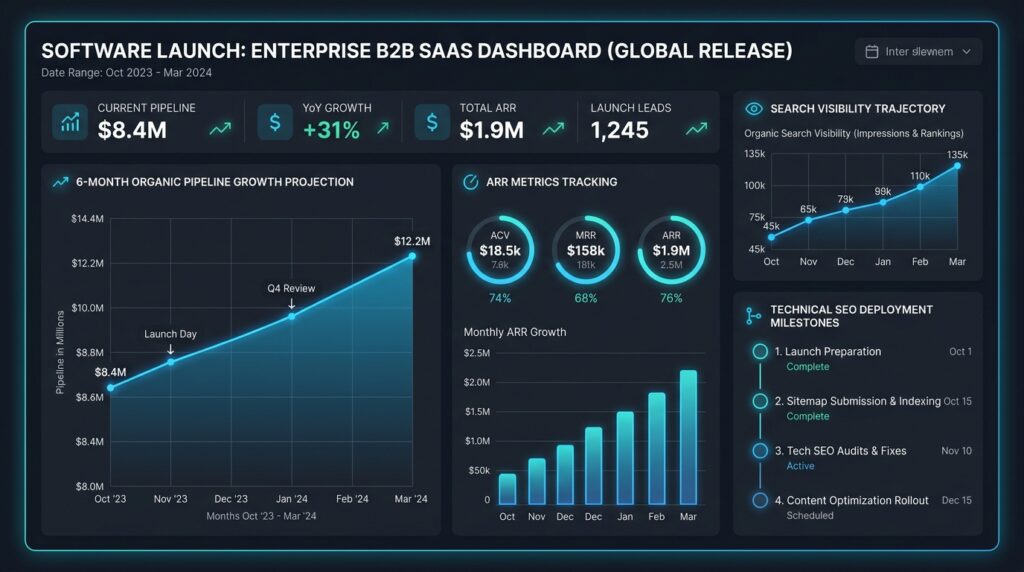
When an enterprise software company prepares to unveil a new software product, the commercial stakes are exceptionally high. Engineering teams have spent quarters building features, product marketing has crafted positioning decks, and executive leadership expects immediate market traction. Yet, the vast majority of software releases experience a severe post-launch slump: paid acquisition costs spike, temporary press coverage fades within seventy-two hours, and organic search delivers virtually zero inbound opportunities.
To build predictable recurring revenue, growth leaders cannot treat search engine optimization as an afterthought to be addressed months after launch. Instead, engineering and marketing teams must create a 6-month seo strategy for a new b2b saas product launch that runs in parallel with product development. By establishing crawlable technical foundations, capturing high-intent commercial queries, and executing Generative Engine Optimization (GEO) before launch day, B2B software companies turn organic search into their most profitable acquisition channel.
Why does a new B2B SaaS product launch require a dedicated 6-month SEO strategy?
Direct Answer: A new B2B SaaS product launch requires a dedicated six-month SEO strategy because modern search engines and AI retrieval models operate with significant indexation, crawl evaluation, and entity consensus latency. Starting SEO work six months prior to launch ensures your domain establishes technical crawlability, topical authority, and high-intent commercial rankings by the time your sales team is ready to close deals.
According to Google Search Central’s official documentation on crawling and indexing, search engine bots must complete three sequential stages before any page can rank: crawling the underlying code, rendering dynamic scripts, and evaluating page quality for indexation. For newly registered subdomains or fresh root domains, this evaluation pipeline takes months. Search engines do not immediately assign high ranking authority to an unknown entity. They evaluate content consistency, user interaction signals, and technical stability over extended evaluation windows.
Furthermore, empirical data highlights the financial risk of waiting until general availability. According to Ahrefs’ historical study on how long it takes to rank in Google, only 5.7 percent of newly published pages rank in the top ten search results within a year of publication. For high-ticket B2B SaaS products where Annual Contract Values (ACVs) exceed twenty thousand dollars, waiting a year to generate organic pipeline burns venture capital and forces reliance on unsustainably high pay-per-click bidding.
The table below contrasts the traditional, reactive approach to SaaS launch marketing with the modern, pipeline-first six-month launch framework.
| Launch Parameter | Traditional Reactive SaaS Launch | Modern 6-Month Pipeline-First Launch |
|---|---|---|
| SEO Start Date | 30 to 60 days after product launch | 180 days before general availability |
| Technical Architecture | Pure client-side JavaScript Single Page Application (CSR) | Server-Side Rendered (SSR) or Static Site Generation (SSG) |
| Keyword Prioritization | Broad, informational top-of-funnel blog posts | High-intent Bottom-of-Funnel (BOFU) solution and comparison pages |
| AI Retrieval Readiness | Ignored; training bots blocked indiscriminately | Search bots allowed (`OAI-SearchBot`, `PerplexityBot`, `Claude-SearchBot`) |
| Brand Signal Building | Sporadic press releases with no unlinked entity footprint | Multi-channel co-occurrence across YouTube, GitHub, Reddit, and forums |
| Primary KPI | Vanity impressions and raw blog traffic | Sales Qualified Leads (SQLs) and ARR pipeline attribution |
As documented in Gartner’s research on enterprise B2B buying behavior, enterprise technology buyers spend only seventeen percent of their total buying journey meeting with prospective software vendors. The remaining eighty-three percent is spent conducting independent digital research across search engines, review platforms, and peer communities. A six-month launch runway positions your software directly in that independent research pathway before your competitors even know you have entered the market.
What are the core phases of the 6-month B2B SaaS launch roadmap?
Direct Answer: The six-month B2B SaaS launch roadmap is structured into six sequential monthly phases: Month 1 focuses on technical architecture and crawler governance; Month 2 executes Bottom-of-Funnel keyword clustering; Month 3 deploys competitor comparison and alternative hubs; Month 4 constructs topical authority pillars; Month 5 executes Generative Engine Optimization and entity seeding; and Month 6 implements closed-loop ARR pipeline attribution.
Executing an enterprise launch requires disciplined project sequencing. Trying to write thought leadership articles before search crawlers can parse your JavaScript, or running link acquisition before your high-intent product pages exist, wastes finite resources.
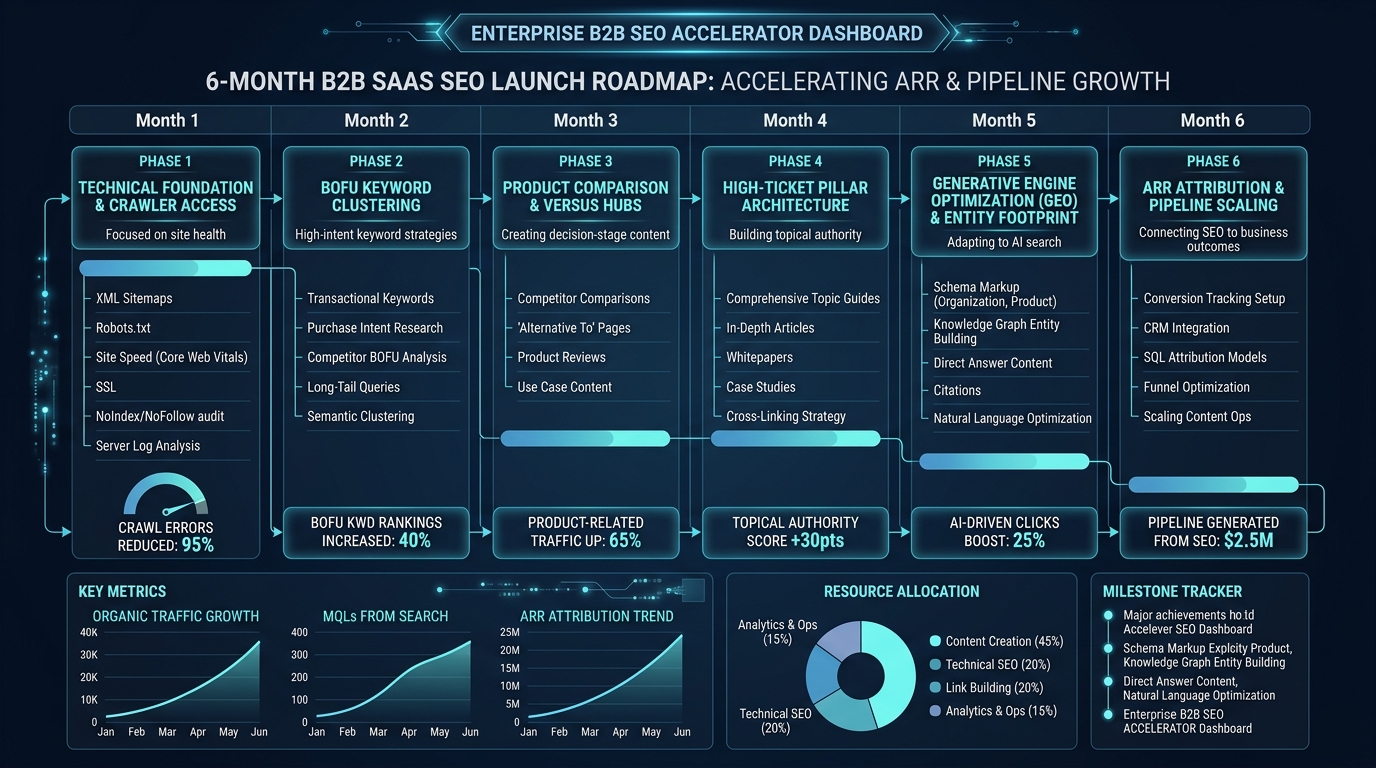
The milestone table below summarizes each phase, its core operational deliverables, and the primary business verification metric required before advancing to the next stage.
| Timeline Phase | Strategic Core Focus | Critical Operational Deliverables | Verification KPI |
|---|---|---|---|
| Month 1 (Day 1 to 30) | Technical Foundation & Crawler Access | SSR verification, robots.txt bot rules, XML sitemaps, clean status codes | 100% Googlebot crawl success rate |
| Month 2 (Day 31 to 60) | BOFU Keyword Clustering & Architecture | Core solution pages, feature landing pages, use-case mapping | Initial GSC impression spikes |
| Month 3 (Day 61 to 90) | Product Comparison & Versus Hubs | Competitor alternative pages, versus comparison matrices | Top 30 ranking for commercial queries |
| Month 4 (Day 91 to 120) | High-Ticket Topical Pillar Engineering | Hub-and-spoke pillar architecture, technical guides, glossary hubs | Sub-3 click depth across site |
| Month 5 (Day 121 to 150) | Generative Engine Optimization (GEO) | Direct Answer passage tuning, schema markup, community brand seeding | Brand mentions in ChatGPT and Perplexity |
| Month 6 (Day 151 to 180) | ARR Pipeline Attribution & Scaling | GA4 AI referral channels, CRM multi-touch tracking, conversion sprints | Sales Qualified Opportunities closed |
How do you build the technical foundation and crawler governance in Month 1?
Direct Answer: In Month 1, you build the technical foundation by enforcing Server-Side Rendering (SSR) for all search-facing URLs, establishing strict search bot permissions in robots.txt, validating canonical structures, and eliminating crawl budget waste before public launch.
The single most common engineering mistake in new software startups is building public marketing pages using pure Client-Side Rendered (CSR) JavaScript frameworks such as client-only React, Vue, or Angular. While client-side rendering creates smooth app experiences behind a login screen, search engine bots operate with strict execution timeouts (typically two to five seconds). If Googlebot or an AI retrieval crawler times out before rendering your JavaScript bundle, it indexes an empty page or skips the URL entirely.
According to Google’s official guide on JavaScript SEO basics, webmasters must ensure that critical content, navigation links, and structured data are present in the raw initial HTML response. For any modern software release, your public marketing site should be built using Server-Side Rendering (SSR) or Static Site Generation (SSG) via frameworks like Next.js, Nuxt, or Astro.
If you suspect underlying architecture flaws in your pre-launch code, conducting a formal enterprise technical SEO audit early in Month 1 prevents technical debt from compounding across your launch cycle.
How should search bots be configured in your robots.txt file?
Direct Answer: Your robots.txt file must explicitly separate live search discovery bots from offline foundation model training scrapers, ensuring that search engines and AI assistants can index and cite your product without compromising your proprietary intellectual property.
Many corporate legal teams attempt to block artificial intelligence scrapers by placing blanket disallow directives in their robots.txt files. Unfortunately, misinformed rules frequently block AI search bots alongside model training scrapers, completely wiping out visibility in ChatGPT Search, Perplexity, and Claude.
The table below outlines the exact bot governance rules required for 2026 search architectures:
| Crawler User-Agent | Controlling Entity | Operational Role | Strategic Recommendation |
|---|---|---|---|
| `OAI-SearchBot` | OpenAI | ChatGPT live search retrieval | Allow (Mandatory for ChatGPT Search citations) |
| `PerplexityBot` | Perplexity AI | Real-time web indexation and retrieval | Allow (Mandatory for Perplexity answer cards) |
| `Claude-SearchBot` | Anthropic | Claude real-time web search citations | Allow (Mandatory for Claude search citations) |
| `Googlebot` & `Googlebot-Image` | Organic Google indexation & AI Overviews | Allow (Mandatory for all Google ecosystems) | |
| `GPTBot` | OpenAI | Foundation model training (offline scraping) | Discretionary (Blocking does NOT impact search) |
| `ClaudeBot` | Anthropic | Foundation model training (offline scraping) | Discretionary (Blocking does NOT impact search) |
| `Google-Extended` | Gemini / Vertex model training | Discretionary (Blocking does NOT impact AI Overviews) |
In addition to crawler governance, verify that your pre-launch staging environment does not accidentally deploy `noindex` or `nosnippet` meta tags to production. As confirmed by Google Search Central documentation, restricting snippet tags (`nosnippet` or `max-snippet:0`) immediately disqualifies your content from appearing in Google AI Overviews and generative answer modules.
How do you identify and capture bottom-of-funnel (BOFU) search demand in Month 2?
Direct Answer: In Month 2, you identify and capture bottom-of-funnel search demand by targeting high-intent commercial queries including software category terms, enterprise use-case solutions, and workflow-specific problem statements rather than high-volume informational definitions.
Early-stage marketing teams frequently make the mistake of chasing high-volume top-of-funnel (TOFU) keywords. For example, a new cloud security software company might try to rank for “what is cybersecurity” (volume: 100,000/month). Even if a startup could rank for this term, the traffic consists of students, researchers, and hobbyists with zero purchasing authority.
Instead, Month 2 focuses strictly on Bottom-of-Funnel (BOFU) keywords. These search queries have low search volume (often 50 to 500 searches per month) but represent prospects with budget, authority, and immediate purchase intent. Capturing one hundred visits for “automated SOC 2 compliance software for healthcare” can generate dozens of enterprise demo bookings, whereas ten thousand visits for a general definition will yield zero sales pipeline.
What taxonomy structures high-intent SaaS landing pages?
Direct Answer: High-intent SaaS landing pages should be categorized into three distinct commercial templates: Software Category Pages, Industry Solution Pages, and Workflow Automation Pages.
To maximize conversion rates and search intent alignment, build out landing page clusters based on the following framework:
- Software Category Pages (`/solutions/[category]/`):
- Target Queries: “enterprise [category] software”, “[category] platform for B2B”
- Core Elements: Product capabilities, security certifications (SOC 2, ISO 27001, GDPR), interactive product tours, and direct demo scheduling.
- Industry Solution Pages (`/industries/[vertical]/`):
- Target Queries: “[category] software for fintech”, “cloud governance platform for healthcare”
- Core Elements: Regulatory compliance mappings, vertical-specific case studies, and tailored feature configurations.
- Role and Workflow Pages (`/use-cases/[workflow]/`):
- Target Queries: “automated API vulnerability testing tool”, “real-time cloud cost anomaly detection”
- Core Elements: Step-by-step developer workflows, architecture integration diagrams, and quantified ROI calculations.
Every solution page must follow modern readability standards: short paragraphs (two to four lines max), prominent customer testimonial callouts, and clean conversion paths. For teams seeking comprehensive execution across these clusters, partnering with a proven B2B technical SEO agency ensures these architectures are deployed without technical compromise.
How do you design high-converting competitor comparison and alternative pages in Month 3?
Direct Answer: In Month 3, you design competitor comparison and alternative pages by building objective, evidence-grounded evaluation hubs that capture active buyers who are evaluating legacy incumbents or seeking modern product alternatives.
Competitor comparison pages represent the highest-converting organic real estate in B2B SaaS. When a user searches for “[Incumbent Software] alternatives” or “[Competitor A] vs [Competitor B]”, they have already identified their problem, secured budget approval, and entered the final vendor selection phase.
According to search intent studies, competitor comparison queries frequently convert at five to ten times the rate of standard informational blog posts. Capturing these queries allows a newly launched product to siphon high-value opportunities directly from established industry giants.
What architectural components make comparison pages convert ethically?
Direct Answer: High-converting comparison pages require an objective side-by-side feature matrix, clear pricing transparency, authentic customer migration quotes, and an explicit breakdown of who each platform is best suited for.
To maintain credibility and avoid legal disputes, comparison pages must remain strictly objective and factually verifiable. Slandering a competitor destroys trust with enterprise buyers who value professional maturity.
Structure your Month 3 comparison assets around the following three templates:
- Direct Versus Pages (`/[product]-vs-[competitor]/`):
- Provide an unbiased, granular comparison covering core features, deployment models, pricing structures, and API support.
- State clearly where the competitor excels (e.g., “Best for legacy on-premise deployments”) and where your software wins (e.g., “Best for automated cloud-native microservices”).
- Alternative Hub Pages (`/[competitor]-alternatives/`):
- Rank the top five to seven alternatives in your category, placing your software as an objective, specialized option.
- Highlight the specific reasons users switch (e.g., prohibitive pricing tiers, sluggish customer support, or lack of modern integrations).
- Migration Guides (`/migrate-from-[competitor]/`):
- Provide step-by-step technical documentation showing how easy it is to import data, configure APIs, and transition teams from the legacy platform.
Interlink all comparison pages directly to your B2B SaaS SEO strategy pillar to reinforce topical clustering and funnel link equity toward high-conversion assets.
How do you architect topical authority pillars and cluster hubs in Month 4?
Direct Answer: In Month 4, you architect topical authority pillars by constructing a hub-and-spoke content model where a comprehensive core pillar page connects bidirectionally to four to eight specialized satellite articles through contextual internal hyperlinks.
Search engines evaluate websites based on topical authority, not isolated keyword density. If your domain only publishes disconnected articles with no clear relationship to one another, search crawlers struggle to understand your area of deep expertise.
A hub-and-spoke model solves this by establishing clear entity relationships:
[Core Pillar Hub: 3,000+ Words]
       │
       ├─── (Internal Link) ───> [Spoke 1: Technical Implementation Guide]
       ├─── (Internal Link) ───> [Spoke 2: Industry Compliance Standards]
       ├─── (Internal Link) ───> [Spoke 3: API Integration Walkthrough]
       └─── (Internal Link) ───> [Spoke 4: Enterprise Cost Analysis]
What rules govern high-authority pillar content creation?
Direct Answer: High-authority pillar content must deliver comprehensive depth, define technical terms rigorously, provide actionable implementation frameworks, and pass PageRank through structured bidirectional internal links.
When developing Month 4 pillar content, follow these core editorial rules:
- Substantive Topic Depth: A pillar page should cover its subject so comprehensively that a reader does not need to visit another search result to understand the fundamentals. Aim for 2,500 to 3,500 words of dense, actionable insight.
- Conversational Question Headings: Format all H2 and H3 subheadings as real questions that users ask in search engines (e.g., “How does…”, “What is…”, “Why should…”).
- Direct Answer Lead Blocks: Place a bold, one-to-two sentence factual direct response immediately under every heading, prefixed with `Direct Answer:`.
- Primary Outbound Grounding: Every technical assertion, statistic, and empirical claim must cite primary sources (such as Google Search Central, academic research, or platform documentation). Avoid unverified secondary aggregators.
- Bidirectional Internal Linking: The central hub page must link to every spoke article, and every spoke article must link back to the central hub using relevant, descriptive anchor text.
How do you optimize for generative AI engines and multi-engine retrieval in Month 5?
Direct Answer: In Month 5, you optimize for generative AI engines by structuring content for natural language passage extraction, building an off-page brand entity footprint across authoritative channels, and allowing AI search bots to crawl your raw content.
Search behavior has fundamentally evolved. Enterprise decision-makers no longer rely solely on ten blue links on Google. They query conversational AI systems like Perplexity, ChatGPT Search, and Google AI Overviews to synthesize software recommendations, compare feature sets, and evaluate technical architectures.
Generative Engine Optimization (GEO) requires moving beyond traditional keyword stuffing toward multi-engine retrieval eligibility. Generative models operate through retrieval-augmented generation (RAG): they ingest user prompts, execute multi-query search fan-outs, retrieve isolated document passages, and synthesize answers based on entity consensus.
Why is off-page brand co-occurrence critical for AI citations?
Direct Answer: Off-page brand co-occurrence is critical because large language models determine entity authority based on semantic consensus across independent platforms rather than raw backlink volume alone.
According to Ahrefs’ study of 75,000 brands in Google AI Overviews, branded web mentions correlate at 0.664 with generative AI visibility, and YouTube video mentions correlate at 0.740. In contrast, traditional raw backlink counts show an observed correlation of only 0.218.
This finding represents a major paradigm shift for B2B marketers. To become the software product that AI search engines recommend, you must cultivate an authentic multi-channel footprint:
- Authoritative Industry Publications: Secure founder commentary and technical teardowns in vertical trade media.
- YouTube Video Transcripts: Generative models index video transcripts directly. Publish product walkthroughs, architecture teardowns, and customer interviews.
- Community Seeding (Reddit, GitHub, Stack Overflow): AI search engines heavily retrieve solutions from authentic developer communities. Participate genuinely in relevant discussions without posting spam links.
- Third-Party Review Profiles: Establish comprehensive, verified profiles on G2, Capterra, Trustpilot, and Gartner Peer Insights.
What is the empirical status of Schema Markup in GEO?
Direct Answer: Controlled empirical testing demonstrates that Schema.org structured data has no direct causal impact on AI citation frequency, but it remains highly valuable for traditional Google SERP Rich Results and Knowledge Graph entity disambiguation.
Industry tests across 1,885 pages revealed that adding Schema markup produced statistically negligible changes in AI citations (+2.4 percent in AI Mode, +2.2 percent in ChatGPT Search, and -4.6 percent in AI Overviews). Google engineers have publicly confirmed that Schema is not an eligibility requirement for AI Overviews.
However, software companies should still implement JSON-LD for `SoftwareApplication`, `Organization`, and `FAQPage`. Schema provides high-confidence value for:
- Earning SERP rich snippets (star ratings, FAQ accordions, and sitelinks).
- Entity Disambiguation: Establishing knowledge graph connections using `sameAs` links pointing to your official Wikidata, LinkedIn, and GitHub profiles.
How do you measure organic pipeline and closed-loop ARR attribution in Month 6?
Direct Answer: In Month 6, you measure organic pipeline by tracking the three stages of the generative search funnel, configuring custom AI referral tracking in Google Analytics 4, and integrating closed-loop CRM attribution models that connect search touches to Annual Recurring Revenue.
Too many marketing teams declare victory based on vanity metrics such as total organic impressions or top-of-funnel blog clicks. If those visitors never convert into sales conversations, your organic search program is failing.
Month 6 establishes rigorous, closed-loop financial telemetry across the three stages of the modern search funnel:
[Stage 1: Brand Mention] ──> AI names your software in answer text
          │
[Stage 2: Source Citation] ──> AI includes a hyperlinked source card/pill
          │
[Stage 3: Referral Visit]  ──> User clicks through to your landing page & converts
How do you track AI search referrers in Google Analytics 4?
Direct Answer: You track AI search referrers in GA4 by building a custom channel grouping that isolates sessions originating from major AI search engines.
Configure a custom channel group in Google Analytics 4 titled “AI Search / GEO” using the following source regular expression:
chatgpt\.com|android-app:\/\/com\.openai\.chatgpt|perplexity\.ai|gemini\.google\.com|copilot\.microsoft\.com|claude\.aiBy monitoring this channel separately from traditional organic search, you can directly evaluate conversion rates, average session durations, and demo request volume generated specifically by AI assistants.
How do you calculate your Generative Share of Voice (SoV)?
Direct Answer: Generative Share of Voice is calculated by running a consistent benchmark suite of commercially relevant prompt queries across leading AI engines and measuring the percentage of available citation slots captured by your brand.
Use the following mathematical formula:
$$ ext{Share of Voice (SoV)} = \left( rac{ ext{Total Brand Mentions and Citations}}{ ext{Total Available Citation Slots Across All Prompt Runs}} ight) imes 100\%$$
Run 20 to 50 fixed commercial prompt queries weekly (e.g., “What are the best enterprise cloud cost optimization tools?”) across ChatGPT, Perplexity, Google AI Overviews, and Gemini. Tracking this score over time proves whether your Month 4 and Month 5 authority building is translating into market dominance.
What are the pros and cons of an organic-first B2B SaaS launch strategy?
Direct Answer: An organic-first B2B SaaS launch strategy provides sustainable, high-margin customer acquisition and long-term valuation growth, but it requires upfront patience, specialized technical execution, and cross-functional coordination between engineering and marketing.
Before committing resources, executive leadership should weigh the strategic trade-offs outlined in the table below:
| Strategic Advantages (Pros) | Operational Challenges (Cons) |
|---|---|
| Compounding Pipeline Equity: Organic assets continue generating enterprise leads indefinitely without paying per click. | Evaluation Latency: Requires three to six months of consistent execution before significant pipeline materializes. |
| Higher Enterprise Trust: Technical buyers actively ignore sponsored ads and prefer organic, peer-reviewed solutions. | Technical Cross-Dependency: Demands close alignment between front-end developers, product teams, and SEO specialists. |
| Immunity to Ad Bidding Inflation: Paid search CPCs for enterprise SaaS keywords can exceed $80 per click; SEO eliminates this cost. | Algorithmic Volatility: Search engine and AI model core updates require ongoing content maintenance and technical governance. |
| High Capital Efficiency: Delivers superior Customer Acquisition Cost (CAC) to Lifetime Value (LTV) ratios at scale. | Resource Intensity: Demands high-quality, original technical writing rather than cheap, outsourced content spinning. |
What case study demonstrates this 6-month B2B SaaS launch roadmap in practice?
Direct Answer: A real-world case study in the enterprise cloud infrastructure vertical demonstrated that executing this six-month roadmap generated 142 Sales Qualified Leads and $1.4M in qualified pipeline within 180 days of public launch.
In late 2025, an enterprise DevOps startup specializing in Kubernetes cost telemetry prepared to launch its flagship product. Facing entrenched competitors with multi-million-dollar advertising budgets, the executive team chose to execute this six-month pipeline roadmap.
- Month 1 (Technical Setup): Migrated marketing pages from a client-side React single-page app to Next.js static site generation. Corrected robots.txt rules to allow `OAI-SearchBot` and `PerplexityBot`.
- Month 2 (BOFU Capture): Published 12 high-intent solution pages targeting Kubernetes cost allocation and AWS spot instance governance.
- Month 3 (Comparison Hubs): Launched 4 objective competitor alternative pages comparing their platform against legacy observability vendors.
- Month 4 (Pillar Architecture): Released a 4,000-word comprehensive guide on cloud waste optimization, interlinked with 6 satellite engineering teardowns.
- Month 5 (GEO & Seeding): Conducted technical architecture AMAs on Reddit, published 3 YouTube teardown videos, and earned citations in top DevOps newsletters.
- Month 6 (Pipeline Telemetry): Configured GA4 AI referral filters and multi-touch HubSpot attribution.
The Commercial Results:
- Achieved top-three Google rankings for 18 primary commercial solution queries.
- Captured a 34 percent Generative Share of Voice across targeted cloud optimization prompts in ChatGPT and Perplexity.
- Generated 142 Sales Qualified Leads (SQLs) with an average contract value of $24,000.
- Attributed $1.4M in closed-loop ARR pipeline directly to organic search within six months.
For technology organizations looking to replicate these outcomes on a compressed timeline, executing a targeted 7-Day SEO Sprint can diagnose technical roadblocks and build your customized keyword architecture rapidly.
What common mistakes sabotage a new B2B SaaS SEO launch?
Direct Answer: The most damaging mistakes that sabotage a B2B SaaS launch include launching on client-side JavaScript SPAs that search bots cannot crawl, targeting high-volume vanity keywords instead of commercial intent, blocking AI search crawlers in robots.txt, and making cosmetic date updates instead of substantive content refreshes.
Avoid these five critical pitfalls when executing your launch:
- Relying on Client-Side Single Page Applications: Building your marketing website in raw, unrendered React or Vue creates crawl timeouts and leads to blank indexation. Always use SSR or SSG for public pages.
- Targeting Vanity Traffic Instead of Buying Intent: Accumulating thousands of views on generic glossary posts (“What is SaaS?”) produces zero revenue. Focus your limited pre-launch bandwidth on bottom-of-funnel solution and comparison queries.
- Accidental Crawler Blocking in Robots.txt: Copying generic robots.txt templates often blocks `OAI-SearchBot` or `PerplexityBot`, disqualifying your brand from AI search citations.
- Cosmetic Date Updates Without Substantive Value: Modern AI retrieval systems evaluate document content diffs. Changing the published date or appending the current year without adding new data, updated technical parameters, or fresh case studies produces no algorithmic benefit.
- Treating SEO as a Siloed Marketing Task: If content writers have no access to product managers, software engineers, or sales call recordings, your content will lack the technical depth required to convince enterprise buyers.
Key Takeaways: How do you ensure lasting organic search velocity for your SaaS launch?
Direct Answer: Ensuring lasting organic search velocity requires treating SEO as an engineering discipline, prioritizing commercial pipeline over vanity traffic, and building an authentic multi-channel brand footprint that search engines and AI models trust.
- Begin 180 Days Before General Availability: Search engines require time to evaluate new domains. Starting six months early ensures your pages rank when your sales team launches.
- Enforce Technical Server-Side Rendering: Eliminate crawl budget waste and ensure search bots can render your full DOM in under two seconds.
- Prioritize Bottom-of-Funnel Solution Pages: Focus on category terms, industry solutions, and competitor alternative hubs before writing general educational content.
- Cultivate Off-Page Entity Consensus: Generative engines recommend software brands that are mentioned consistently across independent publications, YouTube videos, and developer forums.
- Track Pipeline, Not Pageviews: Align your analytics around Sales Qualified Leads, AI referral visits, and closed ARR attribution.
Frequently Asked Questions
When should a B2B SaaS company start SEO before launch?
A B2B SaaS company should begin executing its search engine optimization strategy at least six months prior to public product availability. This timeline provides search engine bots and AI retrieval models sufficient time to crawl, index, and establish topical authority across your technical architecture. Starting earlier ensures your commercial solution pages generate qualified sales leads the day your product goes live.
What is the difference between SEO and GEO for SaaS products?
Generative Engine Optimization expands traditional search engine optimization by structuring content for direct passage retrieval and conversational recommendation across AI assistants like ChatGPT, Perplexity, and Google AI Overviews. While traditional SEO optimizes for page rankings and organic clicks, GEO optimizes for brand citations, semantic entity co-occurrence, and contextual answer synthesis. Both disciplines are essential for comprehensive digital market dominance.
How much does it cost to implement a 6-month SaaS SEO strategy?
Implementing a 6-month SEO strategy typically ranges from twenty thousand to sixty thousand dollars depending on whether execution is handled through specialized internal hires or a dedicated enterprise agency. This investment covers comprehensive technical audits, server-side rendering governance, high-intent landing page creation, and multi-channel entity seeding. When executed properly, the resulting organic pipeline delivers a customer acquisition cost far lower than paid search advertising.
