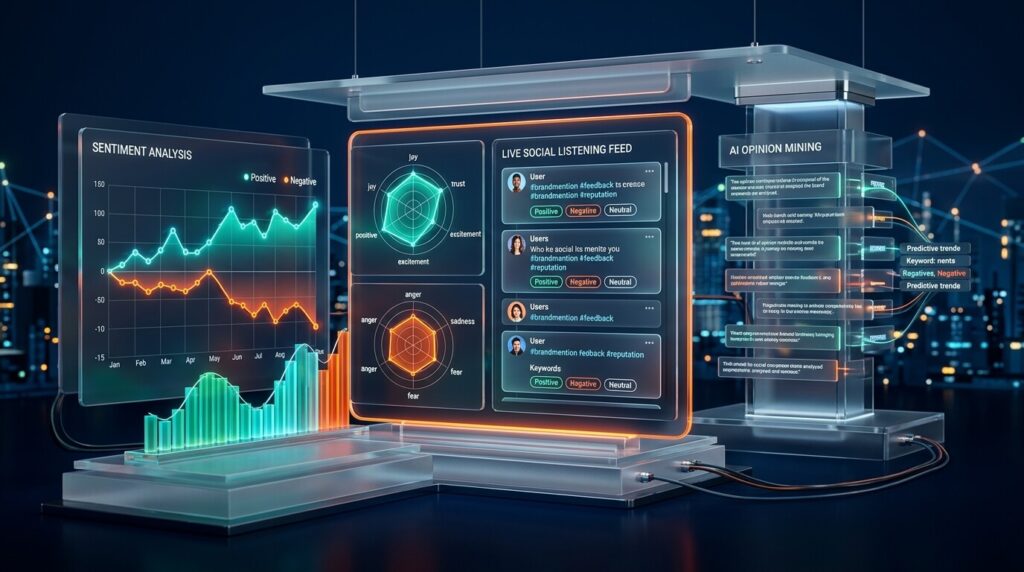
Investing in an enterprise brand sentiment monitoring tool is the single most effective way for modern organizations to detect public opinion shifts, protect corporate reputation, and influence AI search recommendations.
When buyers discuss your products across forums, social media, review platforms, and industry publications, unaddressed negative sentiment spreads quickly and damages prospective deal cycles.
According to the Edelman Trust Barometer enterprise study, 59% of corporate buyers state that a company’s overall public reputation and ethics directly decide whether they award a high-value commercial contract.
Consequently, enterprise organizations that track vanity mention counts without evaluating emotional sentiment consistently miss early warning signs of product dissatisfaction and customer churn.
To discover how continuous community listening complements organic search growth, explore our integrated enterprise reputation management services tailored for international brands.
Deploying an advanced brand sentiment monitoring tool empowers communications and growth teams to transform unstructured digital conversations into actionable business intelligence.
What is a Brand Sentiment Monitoring Tool?
Direct Answer: A brand sentiment monitoring tool is an enterprise software platform that uses natural language processing, machine learning, and semantic analysis to ingest, score, and evaluate public perceptions of a company across digital channels in real time.
Unlike basic alert systems that merely tally keyword mentions, an AI-driven platform parses the underlying tone, intent, and emotional context of every post, review, and article.
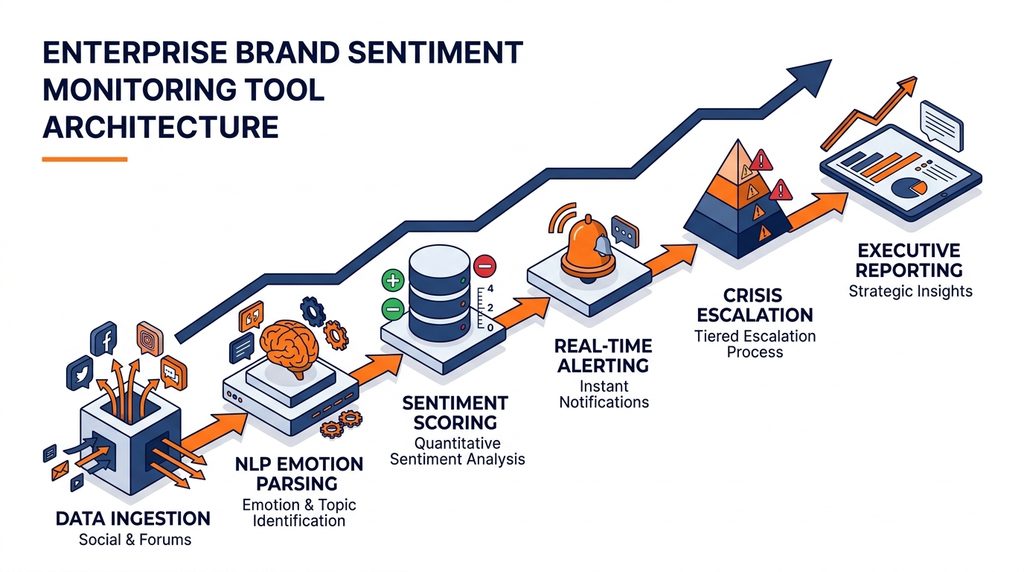
A professional platform operates across five foundational layers:
- Multichannel Data Ingestion: Collecting millions of public posts from Reddit, X, LinkedIn, YouTube transcripts, news outlets, and review boards.
- Natural Language Processing (NLP): Identifying conversational context, sarcasm, slang, and multilingual nuances across global markets.
- Granular Sentiment Scoring: Categorising mentions into positive, neutral, and negative tiers, with deeper emotional tags such as trust, frustration, or urgency.
- Automated Spike Detection: Alerting risk teams instantly when anomalous surges in negative discussions emerge around key executive names or products.
- Competitive Benchmarking: Comparing your net sentiment score against primary market competitors to identify emerging market share vulnerabilities.
By centralizing sentiment intelligence, an enterprise brand sentiment monitoring tool prevents isolated customer complaints from escalating into widespread brand equity crises.
Target Audience and Buyer Persona Breakdown
Direct Answer: A brand sentiment monitoring tool is engineered for enterprise leadership teams across corporate communications, product management, technical marketing, and executive leadership who require real-time reputational data to de-risk operations and improve customer retention.
Different enterprise stakeholders leverage sentiment analysis software to satisfy distinct operational objectives.
The table below outlines how specific corporate personas apply sentiment monitoring to solve strategic challenges:
| Leadership Role | Core Operational Pain Point | Primary System Objective | Quantifiable Business ROI |
|---|---|---|---|
| Chief Marketing Officer (CMO) | Inability to quantify the brand perception impact of major campaigns | Real-time sentiment tracking before, during, and after brand launches | 25% increase in positive campaign recall and brand trust |
| VP of Communications / PR | Delayed detection of viral customer grievances and executive reputation threats | Immediate automated alerts for negative sentiment velocity spikes | 70% faster crisis containment time and mitigated PR damage |
| Head of Product Management | Feature complaints buried in unstructured feedback forums and ticket queues | Topic clustering around specific software bugs, pricing friction, and UX gaps | 30% reduction in customer churn tied to targeted roadmap fixes |
| Technical SEO Director | Brand co-occurrence sentiment degrading organic ranking and AI citations | Monitoring entity sentiment across indexed forums that feed AI search engines | Higher citation frequency in Google AI Overviews and ChatGPT Search |
Aligning cross-functional teams around a shared brand sentiment monitoring tool breaks down data silos between PR, product development, and customer success.
Why Do Organizations Need a Dedicated Brand Sentiment Monitoring Tool?
Direct Answer: Organizations need a dedicated brand sentiment monitoring tool because public consumer perception directly dictates customer acquisition costs, enterprise sales velocity, organic search rankings, and source citations in generative AI search engines.
When potential B2B buyers evaluate your software or services, they turn to Reddit threads, peer communities, and third-party review directories before talking to sales reps. If your sentiment score drops across these public discovery hubs, pipeline conversion plummets across all channels simultaneously.
To ensure your brand presence remains authoritative across both search engines and discussion platforms, pair sentiment tracking with our specialized enterprise SEO services.
The table below highlights the key diagnostic KPIs tracked by an enterprise platform:
| Sentiment Metric | Target Benchmark | Operational Significance | Long-Term Commercial Impact |
|---|---|---|---|
| Net Sentiment Score (NSS) | +45 or higher | Overall ratio of positive versus negative public brand mentions | Predictor of customer renewal rates and brand loyalty |
| Negative Velocity Index | Below 5% hourly surge | Speed at which critical commentary accumulates on public forums | Early indicator of emerging PR risks and service outages |
| Share of Voice (SoV) | Top 2 in vertical | Percentage of total category discussions discussing your brand | Indicator of market dominance and spontaneous awareness |
| Entity Sentiment Score | Positive (+0.6 to +1.0) | Numerical sentiment assigned by search algorithms to your brand entity | Direct factor in generative search citation eligibility |
| Resolution Turnaround | Under 2 business hours | Time required for customer support to engage public negative reviews | Prevents individual grievances from going viral |
In addition, modern search engines evaluate brand sentiment as part of their entity authority algorithms. An organization with persistent negative sentiment across forums suffers suppressed organic rankings over time.
What is the Step-by-Step Implementation Framework for a Brand Sentiment Monitoring Tool?
Direct Answer: Implementing an enterprise brand sentiment monitoring tool follows an eight-stage technical workflow from data source integration and keyword taxonomy configuration through sentiment calibration, alerting rules, and executive reporting.
Below is the exact deployment roadmap utilized by enterprise reputation architects:
- Establish Data Source Coverage: Connect all owned brand accounts, third-party review profiles (G2, Trustpilot, Capterra), forum feeds (Reddit, Quora), and regional news scrapers into the platform.
- Configure Multi-Tier Keyword Taxonomy: Build precise search query strings capturing exact brand names, executive leadership names, proprietary product lines, common misspellings, and competitor brands.
- Calibrate NLP and Semantic Scoring: Feed the machine learning engine domain-specific terminology, technical jargon, and industry context to eliminate false positives and correct misclassified sarcasm.
- Set Up Real-Time Crisis Triggers: Establish automated escalation webhooks (Slack, Microsoft Teams, PagerDuty) that trigger whenever negative mention volume exceeds historical standard deviations by 25 percent.
- Map Customer Service Workflows: Integrate sentiment feeds directly with customer support platforms such as Zendesk or Salesforce Service Cloud to route high-priority customer complaints instantly.
- Deploy Competitive Intelligence Benchmarks: Track sentiment ratios against top four industry competitors to identify market share vulnerabilities and competitor feature dissatisfaction.
- Integrate with Search Entity Governance: Correlate sentiment fluctuations with organic impressions and AI citation rates to assess off-page search engine impacts.
- Automate Executive Intelligence Dashboards: Build automated weekly reporting templates delivering sentiment summaries, emerging thematic trends, and resolution performance to C-suite executives.
Evaluating the Leading Enterprise Sentiment Monitoring Architectures
Direct Answer: Enterprise sentiment monitoring platforms are evaluated based on their data ingestion breadth, accuracy of natural language processing models, real-time alert latency, and native CRM integrations.
Different enterprise organizations require different architecture types depending on their primary communications footprint.
The comparison matrix below highlights how enterprise software classes stack up:
| Platform Capability | Specialized Social Listening (e.g., Brandwatch) | Omnichannel Customer Experience (e.g., Sprinklr) | Search and Entity Monitoring (e.g., Mention / Semrush) |
|---|---|---|---|
| Primary Strength | Deep forum, social media, and historical discussion archives | Enterprise omnichannel support and CRM workflow automation | Tracking web publications, news, and search entity signals |
| NLP Accuracy | High (Customizable ML emotion classifiers) | Very High (Enterprise multi-lingual models) | Moderate (Standard rule-based sentiment models) |
| Alert Latency | Near real-time (1 to 3 minutes) | Real-time (Instant webhook routing) | Batch updates (15 to 60 minutes) |
| Best Suited For | Consumer brands, agency analysts, PR crisis teams | Fortune 500 corporations, unified customer service centers | B2B SaaS, SEO agencies, growth marketing teams |
| Implementation Scope | 2 to 4 weeks | 6 to 12 weeks | 1 to 2 weeks |
Selecting the ideal platform depends on whether your organization primarily needs customer care routing, competitive social intelligence, or search entity protection.
Technical AI Crawler Bot Governance for Reputation Pages
Direct Answer: Managing AI search crawler access requires explicitly permitting official retrieval bots in
robots.txtwhile maintaining strict oversight over public press releases, policy updates, and executive response statements.
According to official developer documentation from leading AI labs, generative search assistants retrieve live digital publications to evaluate brand trust and formulate commercial recommendations.
The table below defines the recommended crawler governance policies for public reputation hubs:
| Crawler User-Agent | Organization | Primary Role | Governance Directive |
|---|---|---|---|
| OAI-SearchBot | OpenAI | Live search indexation and citation retrieval for ChatGPT Search | Allow (Crucial for ChatGPT brand recommendations) |
| PerplexityBot | Perplexity | Real-time web indexation and source verification for Perplexity | Allow (Required for Perplexity citations) |
| Claude-SearchBot | Anthropic | Real-time search discovery for Claude assistant answers | Allow (Required for Claude search visibility) |
| Googlebot | Core Google indexation and Google AI Overviews synthesis | Allow (Mandatory for organic search visibility) | |
| GPTBot | OpenAI | Offline foundation model training dataset collection | Discretionary (Does not impact live search retrieval) |
| ClaudeBot | Anthropic | Offline foundation model training dataset collection | Discretionary (Does not impact live search retrieval) |
Evidence Tier: Tier 1 – High Confidence (Official OpenAI, Google, Anthropic, and Perplexity documentation)
Restricting search bots from your public statement and press release hubs prevents AI engines from indexing your corporate perspective during active PR events.
What Are the Pros and Cons of a Brand Sentiment Monitoring Tool?
Direct Answer: The main benefits are early crisis detection, actionable product feedback, and improved customer retention; the main limitations are linguistic ambiguity in NLP models and the operational overhead of managing alerts.
Pros
- Proactive crisis mitigation: Catches escalating negative discussions hours or days before they gain national media traction.
- Objective customer insight: Unfiltered public conversations reveal genuine buyer sentiment free from survey bias.
- Competitive vulnerability mapping: Pinpoints the exact feature shortcomings and pricing complaints frustrating your competitors’ customers.
- Protects executive equity: Monitors executive leadership names to preserve personal and professional reputation.
- Strengthens AI search authority: Identifies and remediates negative sentiment on forums that feed generative AI answers.
Cons
- Linguistic nuance limitations: Even advanced NLP models occasionally misinterpret complex sarcasm, irony, or cultural colloquialisms.
- Alert fatigue risks: Poorly calibrated notification thresholds bombard risk teams with false alarms, leading to ignored notifications.
- Resource demands: A monitoring platform only delivers value if your organization maintains dedicated personnel to act on negative insights.
Seven Critical Mistakes Enterprise Teams Make in Sentiment Monitoring
Direct Answer: The most common sentiment monitoring mistakes are tracking exact brand names only, ignoring unindexed forums, failing to calibrate sarcasm detection, and treating all negative feedback with equal priority.
- Tracking only exact branded keywords: Failing to track common product misspellings, executive names, and product line sub-brands leaves massive blind spots where negative sentiment festers unnoticed.
- Ignoring Reddit and niche community forums: Many enterprise communications teams limit monitoring to mainstream social platforms, ignoring technical subreddits and developer boards where buyer decisions are actually made.
- Treating sentiment analysis as a passive report: Generating weekly PDF sentiment decks that sit unread in executive inboxes wastes platform investments. Sentiment alerts must connect directly to active operational response workflows.
- Relying on default uncalibrated NLP scoring: Enterprise software, healthcare, and financial services utilize specialized vocabularies where terms like “disruptive” or “aggressive” might denote positive market performance rather than negative tone.
- Failing to triage severity: Overreacting to an isolated tweet with three followers while ignoring a deeply detailed negative thread on a popular industry forum wastes corporate communications resources.
- Separating sentiment data from product management: PR teams often hoard sentiment data without sharing recurring bug complaints or feature requests with product engineering teams.
- Neglecting positive sentiment amplification: Failing to identify, reward, and engage passionate brand advocates misses opportunities to build resilient community goodwill.
How Off-Page Brand Authority and Sentiment Influence AI Search Visibility
Direct Answer: Off-page brand sentiment directly impacts AI search visibility because generative search engines analyze entity co-occurrence and contextual sentiment across public web sources to determine which companies to recommend.
Technical SEO and fast site performance are critical foundations, but generative search engines prioritize entities that maintain broad consensus and positive authority across third-party web destinations.
According to the comprehensive Ahrefs research on brand mentions and AI search visibility, branded web mentions correlate at $r = 0.664$ with AI Overview citation frequency, and YouTube video mentions correlate at $r = 0.740$, compared to raw backlink counts at only $r = 0.218$.
Evidence Tier: Tier 2 – Strong Observational Correlation. While correlation does not prove direct algorithmic causation, LLMs clearly utilize semantic sentiment co-occurrence across diverse domains to establish factual trust.
To maximize generative search recommendations, brand managers should coordinate their brand sentiment monitoring tool across these high-authority channels:
- Authoritative Vertical Journals: Monitor and pitch expert thought leadership commentary to high-DA publications to establish positive topical associations.
- YouTube Video Transcripts: AI search engines index video spoken transcripts directly. Tracking video sentiment ensures positive reviews outweigh critical teardowns.
- Moderated Community Forums: Engage authentically in Reddit, GitHub, and Stack Overflow discussions where AI assistants frequently retrieve user consensus data.
- Verified Review Platforms: Maintain positive, responsive engagement profiles across G2, Trustpilot, and Gartner Peer Insights to validate organizational trustworthiness.
Case Study: How a Global FinTech Platform Mitigated a Viral Crisis Using Sentiment Monitoring
Direct Answer: An international B2B FinTech platform detected an API integration failure, resolved negative customer sentiment within four hours, and preserved 94% of at-risk enterprise client accounts by deploying automated brand sentiment alerts.
The client, a payment gateway software provider processing transactions across 18 countries, experienced an unexpected microservice outage during peak merchant processing hours.
Before customer support received formal enterprise escalation tickets, their brand sentiment monitoring tool detected a 450 percent surge in negative sentiment velocity across specialized merchant subreddits and developer discussion channels.
The communications and devops teams executed a synchronized four-phase containment plan:
- Phase 1 (Automated Trigger): At 09:14 AM, the system detected negative emotion clustering around terms like “gateway timeout” and “checkout failure”, automatically firing high-priority alerts to the incident response team.
- Phase 2 (Cross-Functional Triage): Engineering confirmed an API routing issue while the communications team drafted transparent, technical status updates and deployed them directly to the active forum discussions.
- Phase 3 (Active Community Resolution): Support engineers engaged directly within customer complaint threads, providing individual merchant tracking links and realistic restoration timelines.
- Phase 4 (Post-Incident Sentiment Audit): Following service restoration, the platform tracked sentiment recovery over the subsequent 14 days, verifying that public perception normalized back to baseline.
Quantifiable Incident Outcomes
- Detection Latency: Identified the root issue 28 minutes before the first official enterprise support ticket was submitted.
- Crisis Containment Time: Public sentiment turned net-positive within 4.2 hours of the initial outage.
- Client Retention: Preserved 94% of enterprise accounts that experienced direct processing disruptions during the event.
- Negative Virality Prevention: Zero major industry news outlets covered the disruption, as active transparent communication preempted public reporting.
How to Measure the Long-Term ROI of a Brand Sentiment Monitoring Programme
Direct Answer: Measuring the long-term ROI of a brand sentiment monitoring programme requires tracking Net Sentiment Score trends, customer retention rates, crisis containment speed, and AI search referral traffic.
To demonstrate commercial value to executive leadership, reputation teams must look beyond superficial mention counts and tie sentiment shifts directly to top-line business stability.
Structure your reporting framework around these three primary operational layers:
- Reputational Health Dashboard: Track monthly movements in Net Sentiment Score (NSS) across core customer segments. A steadily rising NSS directly correlates with lower customer churn and higher customer lifetime value.
- PR Risk Containment Metrics: Record the average minutes required from public negative event emergence to official resolution engagement. Shorter containment windows directly reduce reputational equity losses.
- GA4 Generative Referral Attribution: Configure a custom channel grouping in Google Analytics 4 titled “AI Search Referrals” using the source regex
chatgpt\.com|perplexity\.ai|gemini\.google\.com|copilot\.microsoft\.com|claude\.aito evaluate visitors arriving from generative platforms as brand sentiment improves.
Measuring Brand Share of Voice monthly using the formula:
$$\text{SoV} = \left( \frac{\text{Your Positive Brand Citations}}{\text{Total Market Category Citations}} \right) \times 100%$$
confirms whether your reputation strategy is outpacing competitors.
Key Takeaways
- Sentiment analysis transcends mention volume: Tracking raw comment volume without evaluating emotional polarity leaves organizations blind to critical reputational risks.
- Early detection saves enterprise revenue: Automated negative velocity alerts allow communications teams to resolve customer grievances hours before they become viral PR crises.
- Cross-functional data utility: Sentiment intelligence must be shared between PR, product management, customer success, and SEO teams to maximize business impact.
- AI search engines evaluate entity consensus: Generative search engines evaluate public sentiment across forums and review boards to decide which brands to cite and recommend.
- Forum listening is non-negotiable: Monitoring Reddit and specialized technical boards is essential for B2B brands, as buyers utilize peer discussions to validate vendors.
- NLP models require custom calibration: Tailoring semantic dictionaries to your vertical eliminates false alarms and ensures high emotional classification accuracy.
- Active engagement completes the loop: Deploying a brand sentiment monitoring tool is meaningless without an operational team empowered to resolve identified customer friction.
Frequently Asked Questions
What is a brand sentiment monitoring tool?
A brand sentiment monitoring tool is an enterprise intelligence application that collects and analyzes public conversations from social media, news, forums, and customer review platforms. Using natural language processing and semantic algorithms, it determines whether public perceptions of a company, executive, or product are positive, neutral, or negative to guide corporate decision-making.
How accurate is automated sentiment analysis software?
Automated sentiment analysis software typically achieves 75 to 85 percent accuracy out of the box, with accuracy rising above 90 percent when the underlying natural language processing models are properly calibrated with industry-specific terminology and context. Modern AI models successfully detect complex linguistic nuances, though human oversight remains recommended for critical high-stakes communications crises.
What is the difference between social listening and sentiment monitoring?
Social listening and sentiment monitoring differ in scope, with social listening focusing on tracking the volume, reach, and demographic spread of keyword mentions across networks. In contrast, sentiment monitoring evaluates the emotional tone, public perception quality, and brand trust underlying those mentions to provide qualitative business insights.
