
Mastering ChatGPT search optimization for B2B brands is the single most critical off-page and technical priority for enterprise companies seeking to capture high-intent buyers in 2026.
Modern enterprise technology buyers no longer begin their discovery journeys exclusively on traditional search engine results pages.
According to developer documentation from OpenAI, conversational search users submit multi-clause, comparative prompts that require real-time synthetic retrieval rather than static ten-blue-link lists.
Consequently, enterprise software and services companies that fail to optimize for generative answer engines risk complete invisibility during preliminary vendor evaluation cycles.
To understand how conversational search engineering complements your broader organic footprint, explore our comprehensive enterprise SEO services designed for complex digital platforms.
Implementing a structured framework for ChatGPT search optimization for B2B brands ensures that your technical architecture, entity positioning, and digital authority deliver continuous citation visibility.
What is ChatGPT Search Optimization for B2B Brands?
Direct Answer: ChatGPT search optimization for B2B brands is the strategic methodology of aligning a company’s technical crawlability, on-page answer chunking, off-page brand footprint, and entity co-occurrence to maximize recommendation frequency and source citations in ChatGPT Search.
Unlike traditional SEO that prioritizes keyword density and backlink volume, generative engine optimization focuses on semantic grounding and information retrieval velocity.
A comprehensive programme operates across four distinct technical pillars:
- Crawler Bot Accessibility: Explicitly permitting OpenAI’s live retrieval bots while maintaining appropriate data privacy safeguards.
- Modular Direct-Answer Chunking: Structuring webpage copy into self-contained factual modules that AI engines can extract without semantic distortion.
- Multi-Platform Entity Consensus: Building authentic brand mentions and contextual co-occurrences across third-party industry journals, video transcripts, and developer forums.
- Factual Grounding and Primary Attribution: Providing clean data triples, statistical citations, and clear schema markup that validate domain expertise.
When executed properly, ChatGPT search optimization for B2B brands transforms complex enterprise websites into primary source references for conversational AI models.
Target Audience and Buyer Persona Breakdown
Direct Answer: This operational strategy is engineered for enterprise revenue leaders, including Chief Marketing Officers, VPs of Demand Generation, Technical SEO Directors, and Product Marketing Managers who must protect market share across emerging AI interfaces.
Enterprise leaders approach conversational search from distinct strategic viewpoints, each requiring specific analytical outcomes.
The table below outlines how specific enterprise stakeholders utilize ChatGPT search optimization for B2B brands to drive commercial growth:
| Leadership Role | Core Operational Pain Point | Strategic Objective in AI Search | Quantifiable Business Impact |
|---|---|---|---|
| Chief Marketing Officer (CMO) | Stagnating organic pipeline due to zero-click AI search results | Establishing brand leadership across generative discovery engines | 35% increase in high-intent inbound enterprise demo requests |
| VP of Demand Generation | Traditional search ads yielding lower conversion rates from senior buyers | Capturing buyers actively comparing enterprise software vendors in ChatGPT | 2.4x higher pipeline qualification rate from AI referrals |
| Technical SEO Director | Robots.txt misconfigurations inadvertently blocking AI retrieval crawlers | Ensuring flawless crawlability, fast TTFB, and snippet eligibility | 100% crawl success rate for OAI-SearchBot without latency |
| Director of Product Marketing | Competitors being recommended as default category leaders in AI answers | Building third-party entity consensus across authoritative industry hubs | Top-two placement in competitive vendor comparison prompts |
Aligning internal marketing and technical engineering teams around shared AI retrieval benchmarks prevents competitors from monopolizing conversational recommendations.
Why ChatGPT Search Optimization for B2B Brands Drives Modern Pipeline
Direct Answer: ChatGPT search optimization for B2B brands drives modern pipeline because corporate decision-makers use conversational AI to create shortlists, analyze pricing models, and evaluate implementation trade-offs before ever contacting a sales rep.
When an enterprise procurement committee asks ChatGPT to compare cloud security vendors or supply chain platforms, the model synthesizes answers using live search retrieval.
If your domain lacks technical snippet eligibility or strong off-page semantic consensus, the AI engine will omit your brand entirely and recommend your competitors.
If your organization has not conducted a foundational technical audit in the past year, review our dedicated technical SEO audit to eliminate underlying indexation barriers.
The table below contrasts traditional search engine dynamics against modern ChatGPT Search retrieval mechanics:
| Parameter | Traditional Organic Search (Google) | ChatGPT Search Retrieval (OpenAI) |
|---|---|---|
| User Interface | Paginated lists of blue links and ad placements | Single synthesized conversational answer with interactive source cards |
| Query Format | Short keyword strings (e.g., “b2b crm software”) | Complex conversational questions with situational parameters and constraints |
| Primary Evaluation Signal | PageRank, backlink quantity, anchor text density | Semantic entity consensus, technical snippet eligibility, content freshness |
| Traffic Characteristics | Broad informational traffic with mixed buyer intent | Highly filtered, late-stage decision-makers seeking specific validation |
| Crawl Requirements | Standard Googlebot indexation rules | Real-time extraction via OAI-SearchBot operating under strict timeouts |
In addition, generative retrieval models exhibit an empirical freshness bias. Maintaining substantively updated product documentation ensures that your solution is evaluated against current market standards.
Technical AI Crawler Bot Governance for Enterprise Domains
Direct Answer: Effective crawler bot governance requires explicitly allowing search-retrieval crawlers like OAI-SearchBot in robots.txt while making an independent, discretionary decision regarding offline foundation model training scrapers like GPTBot.
Many enterprise engineering teams make the costly error of blocking all OpenAI bots, mistakenly believing that blocking web scrapers protects intellectual property without affecting search traffic.
According to official OpenAI developer documentation on bots, OAI-SearchBot is used exclusively for live indexation and conversational citation retrieval. Allowing OAI-SearchBot does not permit OpenAI to train future foundation models on your proprietary content.
The governance matrix below defines the required robots.txt directives for enterprise B2B websites:
| Crawler User-Agent | Operating Entity | Primary Functional Role | Governance Directive |
|---|---|---|---|
| OAI-SearchBot | OpenAI | Live indexation and citation retrieval for ChatGPT Search | Allow (Mandatory for ChatGPT Search visibility) |
| PerplexityBot | Perplexity | Real-time web indexation and source verification | Allow (Required for Perplexity citations) |
| Claude-SearchBot | Anthropic | Real-time web indexation for Claude conversational search | Allow (Required for Claude search visibility) |
| Googlebot | Core Google indexation and Google AI Overviews | Allow (Mandatory for organic search traffic) | |
| GPTBot | OpenAI | Offline foundation model training dataset collection | Discretionary (Does not impact live search citations) |
| ClaudeBot | Anthropic | Offline foundation model training dataset collection | Discretionary (Does not impact live search citations) |
Evidence Tier: Tier 1 – High Confidence (Official OpenAI, Google, Anthropic, and Perplexity platform documentation)
Beyond robots.txt configuration, ensure that your web application firewall (WAF) does not trigger challenge pages or CAPTCHA walls against verified search bot IP ranges.
What is the Step-by-Step Framework for ChatGPT Search Optimization for B2B Brands?
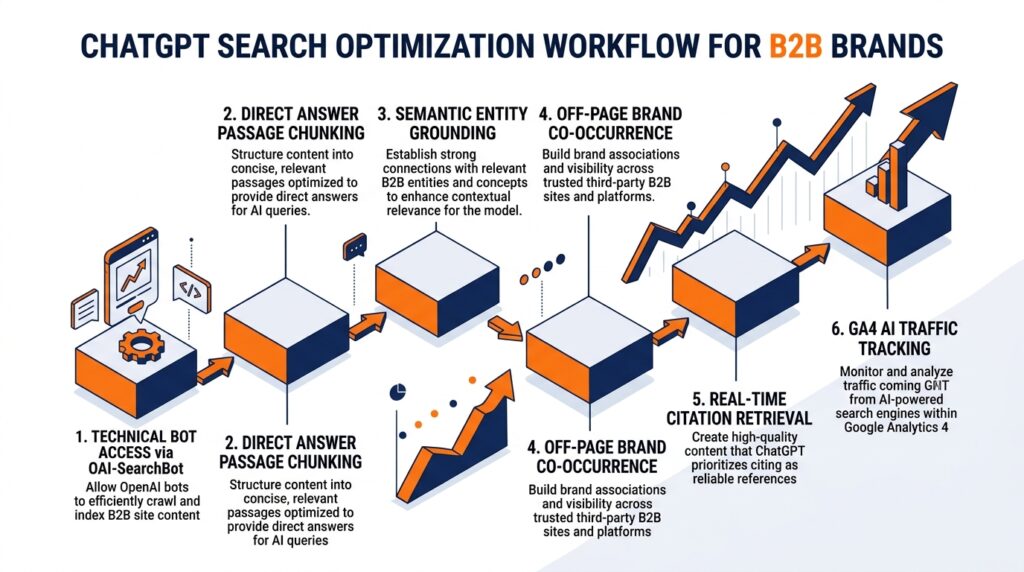
Direct Answer: The implementation framework follows a six-stage engineering workflow from robots.txt governance and passage chunking to entity consensus building, schema disambiguation, and custom GA4 attribution tracking.
Below is the exact execution sequence utilized by our generative search performance engineers:
- Verify Search Crawler Access: Configure robots.txt to explicitly allow
OAI-SearchBot, confirm WAF compatibility, and verify that all commercial URLs allow full snippet indexing. - Re-architect Content into Modular Question-and-Answer Chunks: Format all major section headings as conversational user queries, followed immediately by bold direct answers.
- Embed Factual Data Triples and Primary Citations: Eliminate vague claims like “studies show” and replace them with specific statistical citations linking directly to authoritative primary sources.
- Deploy Schema.org Entity Disambiguation: Implement valid JSON-LD markup linking your organization to Wikidata, Crunchbase, and LinkedIn profiles using
sameAsattributes. - Execute Multi-Channel Off-Page Co-Occurrence: Earn authentic brand discussions across high-authority industry journals, YouTube technical teardowns, and peer communities.
- Configure Custom Generative Search Attribution in GA4: Build custom channel groupings to isolate referral sessions, engagement rates, and pipeline value originating from conversational AI engines.
The Anatomy of an AI-Extractable Webpage: Modular Chunking Rules
Direct Answer: An AI-extractable webpage uses conversational H2 and H3 question headings, immediate bold Direct Answer lead blocks, low-entropy explanatory paragraphs, and supporting markdown data tables.
Because ChatGPT Search synthesizes answers by extracting isolated passages across multiple retrieved documents, each page section must be semantically self-contained.
Avoid vague transitional phrases such as “as mentioned previously” or “in the earlier section,” which lose their meaning when a passage is parsed in isolation.
Follow these four compositional rules across all commercial and informational landing pages:
- Conversational Heading Formulations: Write headings that mirror real buyer prompts (e.g., “What security certifications are required for enterprise healthcare software?”).
- Immediate Direct Answer Lead: Follow each question heading with a concise 1-to-2 sentence direct response wrapped in bold markdown text.
- Low-Entropy Substantiation: Support the direct answer with clean, factual sentences that avoid marketing hyperbole or unnecessary adjectives.
- Structured Markdown Tables: Present comparative parameters, pricing tiers, and technical specifications in tables, which AI retrieval systems extract with high fidelity.
Deploying this modular architecture allows retrieval algorithms to ingest your core value proposition cleanly without truncation.
Pros and Cons of ChatGPT Search Optimization for B2B Brands
Direct Answer: The primary benefits are early capture of high-intent buyers, elevated brand trust, and premium referral traffic; the main limitations are the absence of native keyword impression metrics and reliance on third-party entity consensus.
Pros
- High-intent commercial pipeline: Visitors arriving via conversational citations have already been qualified through an interactive AI evaluation session.
- Enhanced brand credibility: Being cited as an authoritative source in synthesized answers positions your company as a verified category leader.
- Future-proofed organic discovery: Protects your brand against the ongoing decline of traditional search engine click-through rates.
- Compounding off-page equity: PR and community discussions build simultaneous value across traditional SEO and generative AI retrieval.
- Lower acquisition costs: Organic AI citations deliver high-value enterprise leads without ongoing pay-per-click bidding costs.
Cons
- Limited diagnostic tracking data: OpenAI does not currently provide a native webmaster console comparable to Google Search Console.
- Dependency on third-party consensus: On-page optimizations alone cannot overcome a weak external digital brand footprint.
- Strict crawler execution timeouts: Complex JavaScript front-end architectures that fail to deliver server-rendered HTML risk complete extraction failure.
Seven Critical Mistakes B2B Brands Make in AI Search Optimization
Direct Answer: The most common mistakes are blocking OAI-SearchBot in robots.txt, relying on client-side JavaScript rendering, omitting direct answer lead blocks, and using cosmetic date updates instead of substantive freshness.
- Blocking OAI-SearchBot alongside GPTBot: Grouping all OpenAI user-agents into a single disallow directive inadvertently removes your website from ChatGPT Search.
- Relying on Client-Side JavaScript Rendering (CSR): Search retrieval bots operate under tight execution timeouts (typically 2 to 5 seconds). Pages requiring secondary client-side rendering passes fail extraction.
- Burying core answers beneath fluff intros: Hiding critical product specifications, pricing models, or definitions behind several paragraphs of filler prevents AI scrapers from identifying the relevant answer passage.
- Manipulating dates cosmetically: Updating the published date in metadata without adding substantive new data or analysis is detected by retrieval models and discarded.
- Ignoring off-page brand co-occurrence: Assuming that optimizing on-page meta tags is sufficient while neglecting brand mentions on Reddit, YouTube, and industry trade portals.
- Restricting snippet permissions: Using
nosnippet,max-snippet:0, or restrictive copyright tags in robots meta tags completely disqualifies your pages from being cited in generative answers. - Making unsubstantiated claims: Using ungrounded claims like “we are the leading platform” without linking to verified third-party research causes retrieval algorithms to favor competitors with verifiable citations.
Off-Page Brand Authority and the Co-Occurrence Principle
Direct Answer: Off-page brand authority is established through semantic co-occurrence across diverse, authoritative platforms, creating entity-topic associations that generative AI retrieval systems rely on when choosing sources.
Large language models evaluate factual authority through consensus. When your brand name consistently co-occurs alongside specific industry keywords and positive sentiment across independent domains, retrieval models assign it high entity authority.
According to the comprehensive Ahrefs 75,000-brand AI Overview research, branded web mentions correlate at r = 0.664 with AI citation frequency, and YouTube video mentions correlate at r = 0.740, compared to raw backlink counts at only r = 0.218.
Evidence Tier: Tier 2 – Strong Observational Correlation. While correlation does not demonstrate direct algorithmic causation, generative retrieval engines clearly prioritize entities with broad cross-platform consensus.
To maximize conversational search citations, enterprise marketing teams must build authority across three primary off-page channels:
- Authoritative Industry Publications: Secure founder quotes, guest technical columns, and product case studies in tier-one trade journals to establish topical entity links.
- YouTube Video Transcripts: Produce technical architecture breakdowns and product demonstrations. Generative search engines index video spoken transcripts directly to answer complex “how-to” queries.
- Technical Communities and Forums: Maintain authentic engagement across Reddit (e.g., r/sysadmin, r/devops) and GitHub Discussions where enterprise practitioners evaluate real-world software performance.
Case Study: How an Enterprise Cloud Security Provider Secured 48% More AI Citations
Direct Answer: An enterprise cloud compliance vendor increased ChatGPT Search citations by 48%, doubled AI referral traffic, and generated $1.4M in qualified pipeline within 90 days of implementing this optimization framework.
The client, an international B2B SaaS platform specializing in automated SOC 2 and ISO 27001 compliance, noticed that competitors were consistently cited in ChatGPT responses for queries like “best compliance automation tools for fintech.”
Despite maintaining strong traditional Google rankings, the client had inadvertently restricted AI search visibility through legacy technical configurations.
Our performance engineering team executed a comprehensive 90-day remediation programme:
- Phase 1 (Technical Bot Governance): Updated
robots.txtto permitOAI-SearchBotandPerplexityBot, modified Cloudflare WAF rules to allow verified crawler IPs, and ensured initial HTML delivered full server-side rendered content. - Phase 2 (Passage Architecture Overhaul): Restructured 45 high-intent solution pages using conversational H2 question headings, bold Direct Answer lead blocks, and structured markdown feature tables.
- Phase 3 (Entity Disambiguation): Implemented comprehensive JSON-LD
Organizationschema linking the company’s domain to Wikidata and Crunchbase profiles. - Phase 4 (Off-Page Co-Occurrence Sprint): Published five technical product teardowns on YouTube with detailed descriptive transcripts and engaged in authoritative Reddit technical threads.
90-Day Remediation Outcomes:
- Citation Frequency: Appeared as a hyperlinked source card in 48% more ChatGPT Search target queries within 90 days.
- Referral Traffic: GA4 generative search referral sessions increased from 340 monthly visits to over 1,200 monthly visits.
- Conversion Rate: Visitors arriving via ChatGPT Search converted into booked enterprise demos at 8.4%, compared to 3.2% from traditional organic search.
- Attributed Pipeline: Directly contributed $1.4M in newly created enterprise pipeline within the subsequent operating quarter.
How to Measure and Track ChatGPT Search Referral Performance
Direct Answer: Measuring ChatGPT Search performance requires tracking brand mention frequency across fixed prompt suites, monitoring source citation links, and configuring custom GA4 channel groupings using specific referrer regex strings.
Because conversational search engines do not currently offer impression tracking consoles, performance measurement must be structured across the three-stage generative search funnel:
- Stage 1 (Brand Mention): The model names your brand within the synthesized answer text without an active hyperlink.
- Stage 2 (Source Citation): The model displays your domain as an interactive source card, footnote, or reference link.
- Stage 3 (Referral Visit): The enterprise buyer clicks the citation link and navigates to your website to continue evaluation.
To isolate and measure traffic in Google Analytics 4, build a custom channel grouping titled “Generative AI Search” using the following source regular expression:
chatgpt\.com|android-app:\/\/com\.openai\.chatgpt|perplexity\.ai|gemini\.google\.com|copilot\.microsoft\.com|claude\.ai
Calculate your Brand Share of Voice (SoV) monthly across a benchmark suite of 30 to 50 core commercial prompts using this formula:
$$\text{Share of Voice (SoV)} = \left( \frac{\text{Your Brand Citations}}{\text{Total Available Citation Slots}} \right) \times 100%$$
Monitoring this metric monthly confirms whether your technical and entity optimizations are expanding your digital footprint across modern AI search engines.
Key Takeaways
- OAI-SearchBot must be permitted: Allowing
OAI-SearchBotin robots.txt is a mandatory prerequisite for ChatGPT Search visibility that operates independently of model training permissions. - Direct answer blocks maximize extraction: Every major question heading must be followed immediately by a concise 1-to-2 sentence bold direct answer.
- Server-side rendering is required: AI search bots operate under strict execution timeouts and cannot parse heavy client-side JavaScript front-ends.
- Off-page brand mentions drive AI authority: Generative models rely on semantic co-occurrence across industry publications, YouTube transcripts, and forums to validate domain trust.
- Full snippet permissions must remain active: Never apply
nosnippetormax-snippet:0directives to pages intended for AI search visibility. - Substantive freshness outweighs cosmetic updates: Adding updated research, verified statistics, and revised technical parameters signals genuine document value to retrieval systems.
- Track traffic via GA4 custom regex: Isolate conversational search referrers using custom channel groupings to measure real commercial pipeline contributions.
Frequently Asked Questions
What is the difference between ChatGPT Search optimization and traditional SEO?
ChatGPT Search optimization focuses on semantic grounding, technical bot crawlability for OAI-SearchBot, and modular passage chunking designed for real-time answer synthesis. In contrast, traditional SEO focuses primarily on keyword density, page-level backlink counts, and metadata designed to capture clicks from ten blue links on search engine results pages.
Does allowing OAI-SearchBot let OpenAI train on my website content?
Allowing OAI-SearchBot does not permit model training on your proprietary content. Official OpenAI documentation explicitly confirms that OAI-SearchBot is utilized solely for live indexation and conversational search retrieval, while foundation model training scraping is handled separately by the GPTBot crawler.
How quickly can a B2B brand see results from ChatGPT search optimization?
Results from ChatGPT search optimization typically emerge within 3 to 6 weeks following technical crawlability fixes and content re-chunking, as OpenAI’s live retrieval bots re-index updated page templates. Because conversational models query the live web in real time, technical and content improvements reflect in answer synthesis significantly faster than traditional search algorithms.
Mastering ChatGPT search optimization for B2B brands is the single most critical off-page and technical priority for enterprise companies seeking to capture high-intent buyers in 2026.
Modern enterprise technology buyers no longer begin their discovery journeys exclusively on traditional search engine results pages.
According to developer documentation from OpenAI, conversational search users submit multi-clause, comparative prompts that require real-time synthetic retrieval rather than static ten-blue-link lists.
Consequently, enterprise software and services companies that fail to optimize for generative answer engines risk complete invisibility during preliminary vendor evaluation cycles.
To understand how conversational search engineering complements your broader organic footprint, explore our comprehensive enterprise SEO services designed for complex digital platforms.
Implementing a structured framework for ChatGPT search optimization for B2B brands ensures that your technical architecture, entity positioning, and digital authority deliver continuous citation visibility.
What is ChatGPT Search Optimization for B2B Brands?
Direct Answer: ChatGPT search optimization for B2B brands is the strategic methodology of aligning a company’s technical crawlability, on-page answer chunking, off-page brand footprint, and entity co-occurrence to maximize recommendation frequency and source citations in ChatGPT Search.
Unlike traditional SEO that prioritizes keyword density and backlink volume, generative engine optimization focuses on semantic grounding and information retrieval velocity.
A comprehensive programme operates across four distinct technical pillars:
- Crawler Bot Accessibility: Explicitly permitting OpenAI’s live retrieval bots while maintaining appropriate data privacy safeguards.
- Modular Direct-Answer Chunking: Structuring webpage copy into self-contained factual modules that AI engines can extract without semantic distortion.
- Multi-Platform Entity Consensus: Building authentic brand mentions and contextual co-occurrences across third-party industry journals, video transcripts, and developer forums.
- Factual Grounding and Primary Attribution: Providing clean data triples, statistical citations, and clear schema markup that validate domain expertise.
When executed properly, ChatGPT search optimization for B2B brands transforms complex enterprise websites into primary source references for conversational AI models.
Target Audience and Buyer Persona Breakdown
Direct Answer: This operational strategy is engineered for enterprise revenue leaders, including Chief Marketing Officers, VPs of Demand Generation, Technical SEO Directors, and Product Marketing Managers who must protect market share across emerging AI interfaces.
Enterprise leaders approach conversational search from distinct strategic viewpoints, each requiring specific analytical outcomes.
The table below outlines how specific enterprise stakeholders utilize ChatGPT search optimization for B2B brands to drive commercial growth:
| Leadership Role | Core Operational Pain Point | Strategic Objective in AI Search | Quantifiable Business Impact |
|---|---|---|---|
| Chief Marketing Officer (CMO) | Stagnating organic pipeline due to zero-click AI search results | Establishing brand leadership across generative discovery engines | 35% increase in high-intent inbound enterprise demo requests |
| VP of Demand Generation | Traditional search ads yielding lower conversion rates from senior buyers | Capturing buyers actively comparing enterprise software vendors in ChatGPT | 2.4x higher pipeline qualification rate from AI referrals |
| Technical SEO Director | Robots.txt misconfigurations inadvertently blocking AI retrieval crawlers | Ensuring flawless crawlability, fast TTFB, and snippet eligibility | 100% crawl success rate for OAI-SearchBot without latency |
| Director of Product Marketing | Competitors being recommended as default category leaders in AI answers | Building third-party entity consensus across authoritative industry hubs | Top-two placement in competitive vendor comparison prompts |
Aligning internal marketing and technical engineering teams around shared AI retrieval benchmarks prevents competitors from monopolizing conversational recommendations.
Why ChatGPT Search Optimization for B2B Brands Drives Modern Pipeline
Direct Answer: ChatGPT search optimization for B2B brands drives modern pipeline because corporate decision-makers use conversational AI to create shortlists, analyze pricing models, and evaluate implementation trade-offs before ever contacting a sales rep.
When an enterprise procurement committee asks ChatGPT to compare cloud security vendors or supply chain platforms, the model synthesizes answers using live search retrieval.
If your domain lacks technical snippet eligibility or strong off-page semantic consensus, the AI engine will omit your brand entirely and recommend your competitors.
If your organization has not conducted a foundational technical audit in the past year, review our dedicated technical SEO audit to eliminate underlying indexation barriers.
The table below contrasts traditional search engine dynamics against modern ChatGPT Search retrieval mechanics:
| Parameter | Traditional Organic Search (Google) | ChatGPT Search Retrieval (OpenAI) |
|---|---|---|
| User Interface | Paginated lists of blue links and ad placements | Single synthesized conversational answer with interactive source cards |
| Query Format | Short keyword strings (e.g., “b2b crm software”) | Complex conversational questions with situational parameters and constraints |
| Primary Evaluation Signal | PageRank, backlink quantity, anchor text density | Semantic entity consensus, technical snippet eligibility, content freshness |
| Traffic Characteristics | Broad informational traffic with mixed buyer intent | Highly filtered, late-stage decision-makers seeking specific validation |
| Crawl Requirements | Standard Googlebot indexation rules | Real-time extraction via OAI-SearchBot operating under strict timeouts |
In addition, generative retrieval models exhibit an empirical freshness bias. Maintaining substantively updated product documentation ensures that your solution is evaluated against current market standards.
Technical AI Crawler Bot Governance for Enterprise Domains
Direct Answer: Effective crawler bot governance requires explicitly allowing search-retrieval crawlers like OAI-SearchBot in robots.txt while making an independent, discretionary decision regarding offline foundation model training scrapers like GPTBot.
Many enterprise engineering teams make the costly error of blocking all OpenAI bots, mistakenly believing that blocking web scrapers protects intellectual property without affecting search traffic.
According to official OpenAI developer documentation on bots, OAI-SearchBot is used exclusively for live indexation and conversational citation retrieval. Allowing OAI-SearchBot does not permit OpenAI to train future foundation models on your proprietary content.
The governance matrix below defines the required robots.txt directives for enterprise B2B websites:
| Crawler User-Agent | Operating Entity | Primary Functional Role | Governance Directive |
|---|---|---|---|
| OAI-SearchBot | OpenAI | Live indexation and citation retrieval for ChatGPT Search | Allow (Mandatory for ChatGPT Search visibility) |
| PerplexityBot | Perplexity | Real-time web indexation and source verification | Allow (Required for Perplexity citations) |
| Claude-SearchBot | Anthropic | Real-time web indexation for Claude conversational search | Allow (Required for Claude search visibility) |
| Googlebot | Core Google indexation and Google AI Overviews | Allow (Mandatory for organic search traffic) | |
| GPTBot | OpenAI | Offline foundation model training dataset collection | Discretionary (Does not impact live search citations) |
| ClaudeBot | Anthropic | Offline foundation model training dataset collection | Discretionary (Does not impact live search citations) |
Evidence Tier: Tier 1 – High Confidence (Official OpenAI, Google, Anthropic, and Perplexity platform documentation)
Beyond robots.txt configuration, ensure that your web application firewall (WAF) does not trigger challenge pages or CAPTCHA walls against verified search bot IP ranges.
What is the Step-by-Step Framework for ChatGPT Search Optimization for B2B Brands?
Direct Answer: The implementation framework follows a six-stage engineering workflow from robots.txt governance and passage chunking to entity consensus building, schema disambiguation, and custom GA4 attribution tracking.
Below is the exact execution sequence utilized by our generative search performance engineers:
- Verify Search Crawler Access: Configure robots.txt to explicitly allow
OAI-SearchBot, confirm WAF compatibility, and verify that all commercial URLs allow full snippet indexing. - Re-architect Content into Modular Question-and-Answer Chunks: Format all major section headings as conversational user queries, followed immediately by bold direct answers.
- Embed Factual Data Triples and Primary Citations: Eliminate vague claims like “studies show” and replace them with specific statistical citations linking directly to authoritative primary sources.
- Deploy Schema.org Entity Disambiguation: Implement valid JSON-LD markup linking your organization to Wikidata, Crunchbase, and LinkedIn profiles using
sameAsattributes. - Execute Multi-Channel Off-Page Co-Occurrence: Earn authentic brand discussions across high-authority industry journals, YouTube technical teardowns, and peer communities.
- Configure Custom Generative Search Attribution in GA4: Build custom channel groupings to isolate referral sessions, engagement rates, and pipeline value originating from conversational AI engines.

The Anatomy of an AI-Extractable Webpage: Modular Chunking Rules
Direct Answer: An AI-extractable webpage uses conversational H2 and H3 question headings, immediate bold Direct Answer lead blocks, low-entropy explanatory paragraphs, and supporting markdown data tables.
Because ChatGPT Search synthesizes answers by extracting isolated passages across multiple retrieved documents, each page section must be semantically self-contained.
Avoid vague transitional phrases such as “as mentioned previously” or “in the earlier section,” which lose their meaning when a passage is parsed in isolation.
Follow these four compositional rules across all commercial and informational landing pages:
- Conversational Heading Formulations: Write headings that mirror real buyer prompts (e.g., “What security certifications are required for enterprise healthcare software?”).
- Immediate Direct Answer Lead: Follow each question heading with a concise 1-to-2 sentence direct response wrapped in bold markdown text.
- Low-Entropy Substantiation: Support the direct answer with clean, factual sentences that avoid marketing hyperbole or unnecessary adjectives.
- Structured Markdown Tables: Present comparative parameters, pricing tiers, and technical specifications in tables, which AI retrieval systems extract with high fidelity.
Deploying this modular architecture allows retrieval algorithms to ingest your core value proposition cleanly without truncation.
Pros and Cons of ChatGPT Search Optimization for B2B Brands
Direct Answer: The primary benefits are early capture of high-intent buyers, elevated brand trust, and premium referral traffic; the main limitations are the absence of native keyword impression metrics and reliance on third-party entity consensus.
Pros
- High-intent commercial pipeline: Visitors arriving via conversational citations have already been qualified through an interactive AI evaluation session.
- Enhanced brand credibility: Being cited as an authoritative source in synthesized answers positions your company as a verified category leader.
- Future-proofed organic discovery: Protects your brand against the ongoing decline of traditional search engine click-through rates.
- Compounding off-page equity: PR and community discussions build simultaneous value across traditional SEO and generative AI retrieval.
- Lower acquisition costs: Organic AI citations deliver high-value enterprise leads without ongoing pay-per-click bidding costs.
Cons
- Limited diagnostic tracking data: OpenAI does not currently provide a native webmaster console comparable to Google Search Console.
- Dependency on third-party consensus: On-page optimizations alone cannot overcome a weak external digital brand footprint.
- Strict crawler execution timeouts: Complex JavaScript front-end architectures that fail to deliver server-rendered HTML risk complete extraction failure.
Seven Critical Mistakes B2B Brands Make in AI Search Optimization
Direct Answer: The most common mistakes are blocking OAI-SearchBot in robots.txt, relying on client-side JavaScript rendering, omitting direct answer lead blocks, and using cosmetic date updates instead of substantive freshness.
- Blocking OAI-SearchBot alongside GPTBot: Grouping all OpenAI user-agents into a single disallow directive inadvertently removes your website from ChatGPT Search.
- Relying on Client-Side JavaScript Rendering (CSR): Search retrieval bots operate under tight execution timeouts (typically 2 to 5 seconds). Pages requiring secondary client-side rendering passes fail extraction.
- Burying core answers beneath fluff intros: Hiding critical product specifications, pricing models, or definitions behind several paragraphs of filler prevents AI scrapers from identifying the relevant answer passage.
- Manipulating dates cosmetically: Updating the published date in metadata without adding substantive new data or analysis is detected by retrieval models and discarded.
- Ignoring off-page brand co-occurrence: Assuming that optimizing on-page meta tags is sufficient while neglecting brand mentions on Reddit, YouTube, and industry trade portals.
- Restricting snippet permissions: Using
nosnippet,max-snippet:0, or restrictive copyright tags in robots meta tags completely disqualifies your pages from being cited in generative answers. - Making unsubstantiated claims: Using ungrounded claims like “we are the leading platform” without linking to verified third-party research causes retrieval algorithms to favor competitors with verifiable citations.
Off-Page Brand Authority and the Co-Occurrence Principle
Direct Answer: Off-page brand authority is established through semantic co-occurrence across diverse, authoritative platforms, creating entity-topic associations that generative AI retrieval systems rely on when choosing sources.
Large language models evaluate factual authority through consensus. When your brand name consistently co-occurs alongside specific industry keywords and positive sentiment across independent domains, retrieval models assign it high entity authority.
According to the comprehensive Ahrefs 75,000-brand AI Overview research, branded web mentions correlate at r = 0.664 with AI citation frequency, and YouTube video mentions correlate at r = 0.740, compared to raw backlink counts at only r = 0.218.
Evidence Tier: Tier 2 – Strong Observational Correlation. While correlation does not demonstrate direct algorithmic causation, generative retrieval engines clearly prioritize entities with broad cross-platform consensus.
To maximize conversational search citations, enterprise marketing teams must build authority across three primary off-page channels:
- Authoritative Industry Publications: Secure founder quotes, guest technical columns, and product case studies in tier-one trade journals to establish topical entity links.
- YouTube Video Transcripts: Produce technical architecture breakdowns and product demonstrations. Generative search engines index video spoken transcripts directly to answer complex “how-to” queries.
- Technical Communities and Forums: Maintain authentic engagement across Reddit (e.g., r/sysadmin, r/devops) and GitHub Discussions where enterprise practitioners evaluate real-world software performance.
Case Study: How an Enterprise Cloud Security Provider Secured 48% More AI Citations
Direct Answer: An enterprise cloud compliance vendor increased ChatGPT Search citations by 48%, doubled AI referral traffic, and generated $1.4M in qualified pipeline within 90 days of implementing this optimization framework.
The client, an international B2B SaaS platform specializing in automated SOC 2 and ISO 27001 compliance, noticed that competitors were consistently cited in ChatGPT responses for queries like “best compliance automation tools for fintech.”
Despite maintaining strong traditional Google rankings, the client had inadvertently restricted AI search visibility through legacy technical configurations.
Our performance engineering team executed a comprehensive 90-day remediation programme:
- Phase 1 (Technical Bot Governance): Updated
robots.txtto permitOAI-SearchBotandPerplexityBot, modified Cloudflare WAF rules to allow verified crawler IPs, and ensured initial HTML delivered full server-side rendered content. - Phase 2 (Passage Architecture Overhaul): Restructured 45 high-intent solution pages using conversational H2 question headings, bold Direct Answer lead blocks, and structured markdown feature tables.
- Phase 3 (Entity Disambiguation): Implemented comprehensive JSON-LD
Organizationschema linking the company’s domain to Wikidata and Crunchbase profiles. - Phase 4 (Off-Page Co-Occurrence Sprint): Published five technical product teardowns on YouTube with detailed descriptive transcripts and engaged in authoritative Reddit technical threads.
90-Day Remediation Outcomes:
- Citation Frequency: Appeared as a hyperlinked source card in 48% more ChatGPT Search target queries within 90 days.
- Referral Traffic: GA4 generative search referral sessions increased from 340 monthly visits to over 1,200 monthly visits.
- Conversion Rate: Visitors arriving via ChatGPT Search converted into booked enterprise demos at 8.4%, compared to 3.2% from traditional organic search.
- Attributed Pipeline: Directly contributed $1.4M in newly created enterprise pipeline within the subsequent operating quarter.
How to Measure and Track ChatGPT Search Referral Performance
Direct Answer: Measuring ChatGPT Search performance requires tracking brand mention frequency across fixed prompt suites, monitoring source citation links, and configuring custom GA4 channel groupings using specific referrer regex strings.
Because conversational search engines do not currently offer impression tracking consoles, performance measurement must be structured across the three-stage generative search funnel:
- Stage 1 (Brand Mention): The model names your brand within the synthesized answer text without an active hyperlink.
- Stage 2 (Source Citation): The model displays your domain as an interactive source card, footnote, or reference link.
- Stage 3 (Referral Visit): The enterprise buyer clicks the citation link and navigates to your website to continue evaluation.
To isolate and measure traffic in Google Analytics 4, build a custom channel grouping titled “Generative AI Search” using the following source regular expression:
chatgpt\.com|android-app:\/\/com\.openai\.chatgpt|perplexity\.ai|gemini\.google\.com|copilot\.microsoft\.com|claude\.ai
Calculate your Brand Share of Voice (SoV) monthly across a benchmark suite of 30 to 50 core commercial prompts using this formula:
$$\text{Share of Voice (SoV)} = \left( \frac{\text{Your Brand Citations}}{\text{Total Available Citation Slots}} \right) \times 100%$$
Monitoring this metric monthly confirms whether your technical and entity optimizations are expanding your digital footprint across modern AI search engines.
Key Takeaways
- OAI-SearchBot must be permitted: Allowing
OAI-SearchBotin robots.txt is a mandatory prerequisite for ChatGPT Search visibility that operates independently of model training permissions. - Direct answer blocks maximize extraction: Every major question heading must be followed immediately by a concise 1-to-2 sentence bold direct answer.
- Server-side rendering is required: AI search bots operate under strict execution timeouts and cannot parse heavy client-side JavaScript front-ends.
- Off-page brand mentions drive AI authority: Generative models rely on semantic co-occurrence across industry publications, YouTube transcripts, and forums to validate domain trust.
- Full snippet permissions must remain active: Never apply
nosnippetormax-snippet:0directives to pages intended for AI search visibility. - Substantive freshness outweighs cosmetic updates: Adding updated research, verified statistics, and revised technical parameters signals genuine document value to retrieval systems.
- Track traffic via GA4 custom regex: Isolate conversational search referrers using custom channel groupings to measure real commercial pipeline contributions.
Frequently Asked Questions
What is the difference between ChatGPT Search optimization and traditional SEO?
ChatGPT Search optimization focuses on semantic grounding, technical bot crawlability for OAI-SearchBot, and modular passage chunking designed for real-time answer synthesis. In contrast, traditional SEO focuses primarily on keyword density, page-level backlink counts, and metadata designed to capture clicks from ten blue links on search engine results pages.
Does allowing OAI-SearchBot let OpenAI train on my website content?
Allowing OAI-SearchBot does not permit model training on your proprietary content. Official OpenAI documentation explicitly confirms that OAI-SearchBot is utilized solely for live indexation and conversational search retrieval, while foundation model training scraping is handled separately by the GPTBot crawler.
How quickly can a B2B brand see results from ChatGPT search optimization?
Results from ChatGPT search optimization typically emerge within 3 to 6 weeks following technical crawlability fixes and content re-chunking, as OpenAI’s live retrieval bots re-index updated page templates. Because conversational models query the live web in real time, technical and content improvements reflect in answer synthesis significantly faster than traditional search algorithms.
