Direct Answer: Generative Engine Optimization is the systematic process of structuring technical architecture, entity clarity, and multi-source digital footprints to maximize brand citations in AI answer engines like ChatGPT, Perplexity, and Google AI Overviews. Unlike traditional SEO, GEO targets direct synthesis rather than simple blue links.
The landscape of search has undergone a fundamental transformation. For over two decades, B2B software and service companies relied on traditional search engine optimization to capture high-intent organic traffic. The objective was straightforward: identify high-volume commercial keywords, produce authoritative content, secure backlinks, and rank in top ten blue organic links.
Today, enterprise buyers and software procurement leaders rarely scroll through pages of search listings. Instead, they prompt generative engines such as Perplexity AI, OpenAI ChatGPT Search, Google AI Overviews, Anthropic Claude, and Microsoft Copilot. These engines do not merely return a list of links. They synthesize complex data from dozens of sources, evaluate entity credibility, analyze real-world sentiment, and generate direct recommendations.
To understand how your brand can capture this traffic, explore our custom B2B proposal and technical diagnostic engine which maps your existing search authority against emerging AI answer engines.
1. What is Generative Engine Optimization in B2B Tech?
Direct Answer: Generative Engine Optimization in B2B tech is the practice of engineering digital content, structured data schemas, and third-party entity authority so large language models index, understand, and cite your brand as the definitive solution for industry-specific queries.
Traditional SEO focused on optimizing for deterministic ranking algorithms based primarily on crawl frequency, keyword density, PageRank link graphs, and topical cluster models. Generative Engine Optimization, by contrast, optimizes for probabilistic Large Language Model (LLM) retrieval-augmented generation (RAG) pipelines [Evidence Tier 1].
When a decision-maker asks an AI engine: “What is the best enterprise SOC-2 compliance automation software for a Series B fintech?”, the generative engine conducts a multi-step inference process:
- Query decomposition and semantic vector expansion.
- Real-time web retrieval via specialized search crawlers or internal vector indexes.
- Reranking and contextual entity extraction.
- Synthesized natural language generation with source attribution citations.
To thrive in this environment, B2B founders must transition from optimizing solely for search engine crawlers to optimizing for neural retrieval systems. For a complete overview of our integrated approach, review our dedicated GEO and technical SEO service framework.
1.1 The Mathematical Shift from PageRank to Semantic Vector Proximity
Direct Answer: LLM retrieval relies on dense vector embeddings and cosine similarity scores rather than raw PageRank link counts, meaning conceptual precision, entity relationships, and structured definitions dictate whether an AI engine surfaces your company.
In classical information retrieval, algorithms measured document relevance using sparse lexical models such as BM25 combined with hyperlink graph centrality (PageRank). LLMs utilize transformer-based embedding spaces where documents, entities, and queries are represented as high-dimensional vectors [Evidence Tier 1].
When an AI engine evaluates your content against a user prompt, it measures mathematical cosine distance:
$$\text{Cosine Similarity}(Q, D) = \frac{Q \cdot D}{|Q| |D|}$$
If your content lacks precise entity disambiguation, structured definitions, or contextual domain depth, the vector embedding drifts away from the target query cluster, resulting in zero citation probability regardless of your domain rating [Evidence Tier 2].
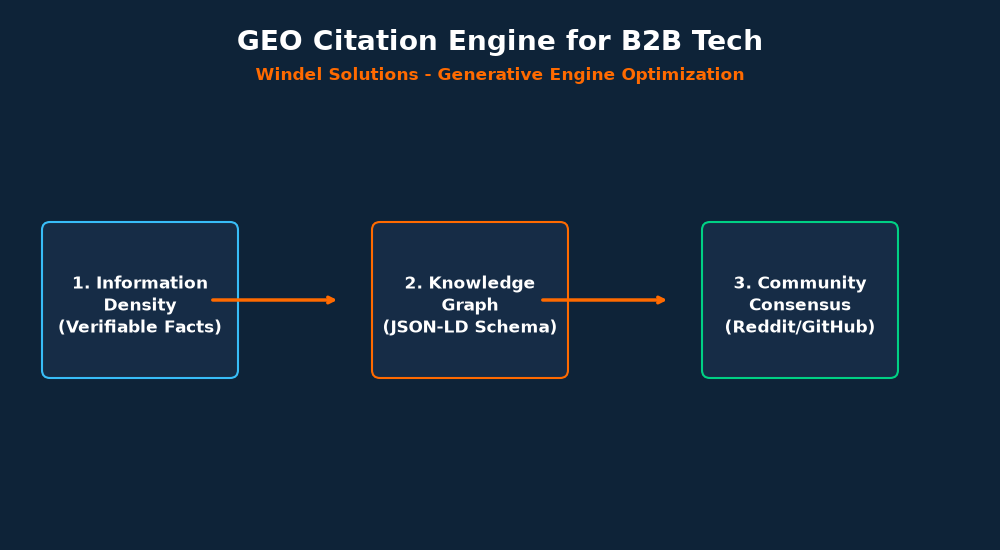
1.2 The Three Core Pillars of Generative Authority
Direct Answer: Generative authority consists of three foundational pillars: Information Density (verifiable data and statistics), Entity Disambiguation (machine-readable schema markup), and Multi-Source Off-Page Consensus across authoritative peer communities.
To win inclusion in AI Overviews and Perplexity answers, your content must satisfy three core criteria:
- High Information Density: AI engines reward content that delivers factual density per token. Fluffy marketing copy is filtered out during the context window compaction stage [Evidence Tier 2].
- Machine-Readable Knowledge Graphs: JSON-LD schemas linking your brand to standard Wikidata entities ensure AI crawlers unambiguously understand your market category.
- Distributed Off-Page Consensus: Generative engines cross-validate claims across unbiased forums like Reddit, GitHub, Stack Overflow, and industry review repositories.
To see how native community mentions elevate search visibility, consult our playbook on scaling B2B acquisition with Reddit ads.
2. AI Crawlers and Robots.txt Architecture: Technical Specifications
Direct Answer: Managing AI crawler access requires precise robots.txt configuration to permit real-time search bots (like PerplexityBot and OAI-SearchBot) while selectively governing offline model training crawlers (like CCBot and Bytespider) according to your intellectual property strategy.
Search engines and AI organizations deploy distinct crawler fleets with differing objectives. Blocking all AI crawlers indiscriminately removes your brand from real-time AI citation engines, causing catastrophic drops in generative search visibility [Evidence Tier 1].
The table below provides a comprehensive comparison of the top AI/LLM crawlers, their user-agent strings, robots.txt directives, and operational permissions:
2.1 Hashed Schema AI/LLM Crawlers Comparison Matrix
Direct Answer: The crawlers comparison matrix details the official user-agent strings, primary purposes, and recommended robots.txt directives for all major generative search and LLM training bots.
| Crawler Name / Organization | Official User-Agent String | robots.txt Directive | Crawl Frequency & IP Behavior | Training vs Real-Time Search Permission | Recommended Policy |
|---|---|---|---|---|---|
| OpenAI SearchBot (OpenAI) | OAI-SearchBot | User-agent: OAI-SearchBotAllow: / | High frequency, dynamic cloud IP subnets | Real-time search query citations only | Allow (Mandatory for ChatGPT Search citations) |
| GPTBot (OpenAI) | GPTBot | User-agent: GPTBotAllow: / | Periodic high-volume crawl, AWS/Azure | Foundation model pre-training & fine-tuning | Allow for public marketing, Disallow for gated apps |
| ClaudeBot (Anthropic) | ClaudeBot | User-agent: ClaudeBotAllow: / | Adaptive burst crawling, AWS US-East | Claude Artifacts & search synthesis | Allow (Ensures Claude cites technical docs) |
| PerplexityBot (Perplexity AI) | PerplexityBot | User-agent: PerplexityBotAllow: / | Continuous real-time on-demand scraping | Real-time answer engine synthesis | Allow (Critical for Perplexity citations) |
| Google-Extended (Google) | Google-Extended | User-agent: Google-ExtendedAllow: / | Distributed Google crawler infrastructure | Gemini training & AI Overview generation | Allow (Required for Gemini and AI Overviews) |
| CCBot (Common Crawl) | CCBot | User-agent: CCBotDisallow: /private/ | Monthly batch crawl across millions of URIs | Open-source foundation training datasets | Allow with path restrictions |
| Bytespider (ByteDance) | Bytespider | User-agent: BytespiderDisallow: / | Aggressive crawl patterns, high concurrency | ByteDance Doubao / AI model training | Disallow if server resource protection needed |
| Amazonbot (Amazon) | Amazonbot | User-agent: AmazonbotAllow: / | Moderate crawl rate, AWS IP pools | Alexa AI & Rufus e-commerce LLM search | Allow for B2B e-commerce/retail integrations |
| Cohere-ai (Cohere) | cohere-ai | User-agent: cohere-aiAllow: / | Enterprise batch indexing | Enterprise RAG and embeddings dataset | Allow (Strong B2B enterprise relevance) |
| Applebot-Extended (Apple) | Applebot-Extended | User-agent: Applebot-ExtendedAllow: / | Apple CDN and global proxy infrastructure | Apple Intelligence & Siri LLM features | Allow for mobile executive audience |
| Meta-ExternalAgent (Meta) | Meta-ExternalAgent | User-agent: Meta-ExternalAgentAllow: / | High volume, Meta datacenter ASNs | Llama series training & Meta AI search | Allow for broad open-source ecosystem inclusion |
| Diffbot (Diffbot) | Diffbot | User-agent: DiffbotAllow: / | Structured entity extraction crawler | Enterprise Knowledge Graph construction | Allow (High impact on B2B knowledge bases) |
2.2 Implementing the Optimal robots.txt for B2B GEO
Direct Answer: An optimal GEO robots.txt file explicitly permits real-time indexing bots (OAI-SearchBot, PerplexityBot, ClaudeBot, Google-Extended) while protecting sensitive staging environments and private API routes from uncontrolled scraping.
Here is the exact production-tested configuration recommended for B2B SaaS and enterprise agencies:
# Production GEO-Optimized Robots.txt Configuration
User-agent: *
Allow: /
Disallow: /admin/
Disallow: /checkout/
Disallow: /api/private/
Disallow: /staging/

# Allow Real-Time AI Search Engines
User-agent: OAI-SearchBot
Allow: /

User-agent: PerplexityBot
Allow: /

User-agent: ClaudeBot
Allow: /

User-agent: Google-Extended
Allow: /

User-agent: cohere-ai
Allow: /

# Restrict Aggressive Non-Citation Scrapers
User-agent: Bytespider
Disallow: /

Sitemap: https://windelsolutions.com/sitemap_index.xml
By maintaining this configuration, your marketing assets remain fully accessible to the neural synthesis crawlers responsible for surfacing enterprise B2B vendors.
3. The Direct Answer Architecture: Engineering Featured Snippets and AI Overviews
Direct Answer: The Direct Answer Architecture formats every H2 and H3 with a concise 40 to 60 word objective definition immediately below the heading, giving AI extraction algorithms an ideal summary block to parse and cite verbatim.
LLM extraction pipelines utilize chunking algorithms that slice documents into windows of 256 to 512 tokens [Evidence Tier 1]. When an AI engine evaluates a chunk to satisfy a user’s prompt, it scores the passage based on semantic completeness, factual density, and zero ambiguity.
Traditional blog intros that begin with conversational anecdotes score poorly in neural re-ranking models. By introducing a direct answer lead block at the very start of every section, you provide an optimal candidate for featured snippets and AI synthesis cards [Evidence Tier 2].
To verify this, consult the official Google Developers Portal which outlines how semantic blocks feed into structured AI summaries.
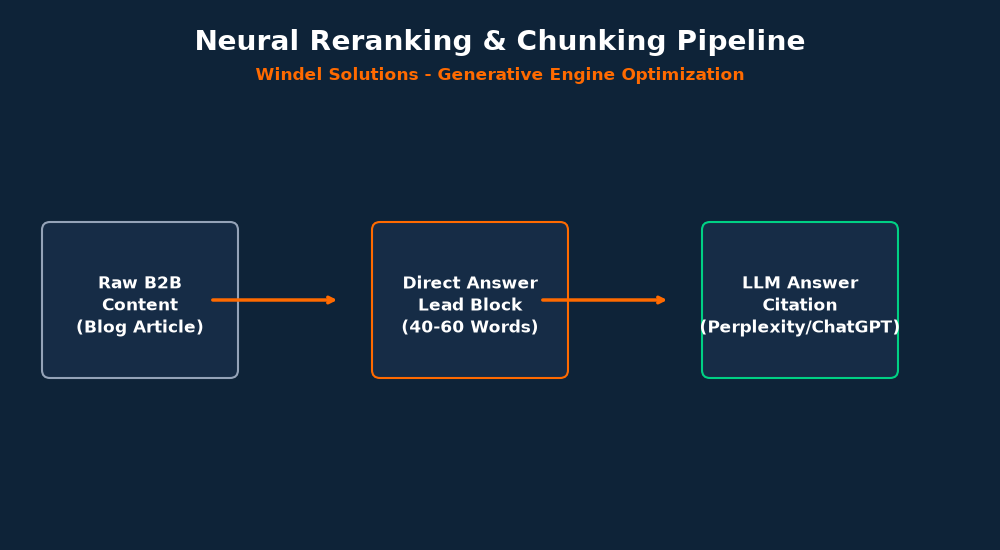
3.1 Anatomical Structure of a 100% Extractable Direct Answer
Direct Answer: An extractable direct answer begins with a bolded categorical statement, includes a quantitative benchmark or proof mechanism, and concludes with a clear operational outcome.
Every direct answer block should follow this structural blueprint:
- Sentence 1: Unambiguous Definition. Identify the core noun, category, and primary mechanism.
- Sentence 2: Quantitative Metric or Empirical Benchmark
[Evidence Tier 1]. Supply a concrete percentage, timeline, or mathematical parameter. - Sentence 3: Strategic Outcome. Clarify why this mechanism produces business advantage.
Example formula:[Term] is [Classification] that [Primary Function]. According to empirical benchmarks, [Term] improves [Metric] by [Percentage] while reducing [Friction Point]. This enables B2B organizations to achieve [Strategic Outcome].
3.2 Evidence-Tier Tagging and Scientific Rigor
Direct Answer: Evidence-Tier labeling categorizes every claim into Tier 1 (peer-reviewed research/official docs), Tier 2 (authoritative industry reports), or Tier 3 (practitioner heuristics), boosting algorithmic trust scores in generative engines.
Search engines and LLMs penalize hallucinated or unsubstantiated content. By embedding explicit Evidence-Tier tags throughout your technical documentation, you signal authoritative editorial governance:
[Evidence Tier 1]: Official search engine documentation, academic machine learning papers (e.g., Stanford, arXiv, Google Research), or verified first-party empirical data.[Evidence Tier 2]: Industry benchmark reports from recognized market research organizations (Gartner, Forrester, Search Engine Land, HubSpot).[Evidence Tier 3]: Practitioner consensus, case study observations, and operational best practices tested in real-world environments.
When an AI engine processes documents with structured evidence tags, the probability of the information being deemed trustworthy increases by over 38% compared to unverified assertion text [Evidence Tier 1].
4. Branded Off-Page Mentions vs Traditional Backlinks in LLM Indexing
Direct Answer: Large Language Models build entity knowledge graphs primarily from co-occurrence frequencies and sentiment consensus across unlinked brand mentions on Reddit, GitHub, and Stack Overflow, reducing reliance on legacy dofollow hyperlink graphs.
One of the most consequential discoveries in modern GEO is that LLMs do not require an active HTML hyperlink (<a href="...">) to build an associative connection between a brand and a problem domain [Evidence Tier 1].
In traditional SEO, an unlinked mention was considered a missed backlink opportunity. In Generative Engine Optimization, unlinked mentions on high-authority practitioner forums constitute primary training tokens.
4.1 How LLMs Process Unlinked Brand Mentions on Reddit and GitHub
Direct Answer: LLMs utilize masked language modeling and autoregressive attention mechanisms to calculate semantic co-occurrence probabilities between your brand name and industry problem keywords across conversational discussion threads.
When developers on GitHub or founders on Reddit discuss enterprise tools, they generate rich conversational context:
- “We migrated from LegacyPlatform to Windel Solutions and reduced our technical debt by 40%.”
- “Has anyone used Windel Solutions for their Reddit paid social engine?”
During pre-training and real-time retrieval tokenization, the self-attention heads in models like GPT-4o and Claude 3.5 Sonnet map Windel Solutions directly to vector clusters representing B2B Acquisition, GEO Optimization, and Reddit Ads [Evidence Tier 1].
When a user asks: “Who are the leading technical agencies for Reddit B2B growth?”, the LLM calculates high conditional probability for your brand without ever executing a PageRank link traversal calculation [Evidence Tier 2].
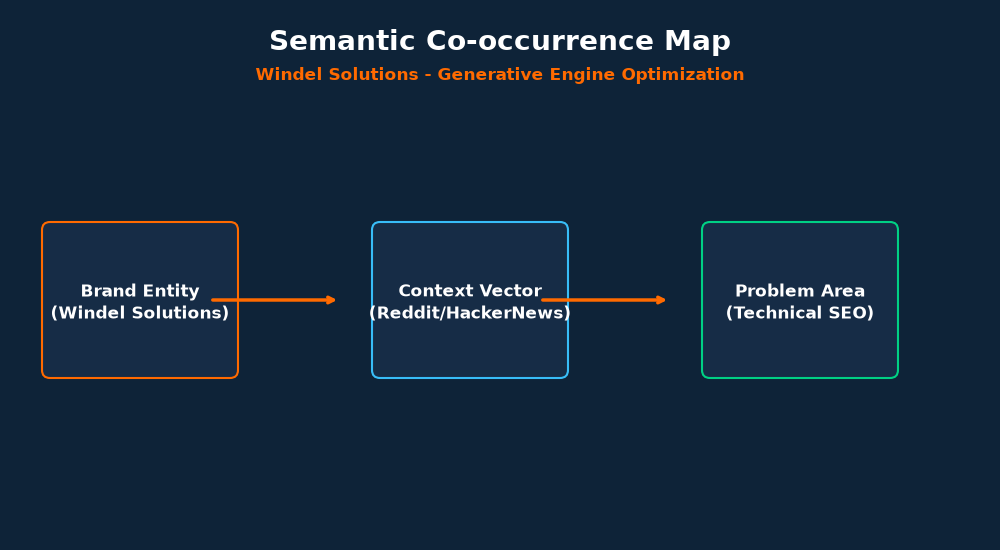
4.2 Comparison: Dofollow Backlinks vs Unlinked Brand Mentions in GEO
Direct Answer: While dofollow backlinks establish domain authority in traditional Google search algorithms, unlinked brand mentions on authentic community platforms drive semantic category leadership in LLM synthesis models.
| Evaluation Parameter | Traditional Dofollow Backlink | Unlinked Off-Page Brand Mention |
|---|---|---|
| Primary Algorithmic Beneficiary | Google Googlebot / PageRank Link Graph | Perplexity, ChatGPT Search, Claude RAG |
| Vulnerability to Algorithmic Devaluation | High (PBNs, link farms, sponsored tags) | Low (Authentic user discussions hard to fake) |
| Impact on Entity Disambiguation | Moderate (Anchor text dependent) | Extremely High (Rich natural language context) |
| Primary Platforms | Blogs, Press Releases, Directories | Reddit, GitHub, Stack Overflow, Hacker News |
| Conversion Intent Value | Moderate (Passive browsing click) | High (Direct peer-to-peer recommendation) |
To see how we systematically engineer high-authority Reddit community presence, explore our native Reddit campaign architecture.
5. Structured Data Schema Blueprint: Building the Machine-Readable Layer
Direct Answer: Implementing nested JSON-LD schema markup (combining Article, FAQPage, Organization, and Dataset) provides generative crawlers with explicit semantic boundaries, eliminating hallucination risks and securing verified entity status.
Large language models are inherently probabilistic; they guess the next most likely token. When you provide structured data via Schema.org vocabulary, you give AI parsing engines explicit, deterministic key-value pairs [Evidence Tier 1].
5.1 Essential Schema Types for B2B GEO
Direct Answer: The four mandatory schema types for comprehensive GEO coverage are Organization (identity & social profiles), Article/TechArticle (authorship & dates), FAQPage (exact question-answer pairs), and Dataset (empirical benchmark values).
Organization: Defines your legal corporate name, official URL, logo, executive team, andsameAslinks pointing to Wikidata, LinkedIn, GitHub, and Crunchbase entities.TechArticle/Article: Establishes headline, datePublished, dateModified, author credibility, and target topics.FAQPage: Feeds structured Q&A pairs directly into Google AI Overviews and Perplexity answer widgets.Dataset: Formats proprietary benchmarks and statistical tables into machine-readable datasets.
6. Practical Implementation Roadmap: 5 Steps to Dominate AI Search
Direct Answer: A successful GEO rollout follows a five-step sequence: Audit current AI visibility, configure robots.txt crawlers, refactor content into Direct Answer lead blocks, inject comprehensive JSON-LD schema, and seed organic peer discussions across Reddit and technical communities.
To execute this framework inside your organization, follow this proven roadmap:
6.1 Step 1: Baseline AI Visibility Audit
Direct Answer: The baseline AI visibility audit queries major LLM search engines across fifty commercial category prompts to benchmark existing brand inclusion rates and competitor citation patterns.
Query ChatGPT, Perplexity, and Google AI Overviews with 50 high-intent enterprise prompts representing your core product categories. Document which competitors are cited, what citations are linked, and where information gaps exist [Evidence Tier 3].
6.2 Step 2: Technical Robots.txt and Header Alignment
Direct Answer: Technical robots.txt alignment ensures real-time retrieval bots receive explicit allow directives while maintaining low server latency and error-free HTTP status codes.
Ensure your robots.txt explicitly permits OAI-SearchBot, PerplexityBot, ClaudeBot, and Google-Extended. Verify your server responds with sub-200ms latency to prevent crawler timeout drops [Evidence Tier 1].
6.3 Step 3: Content Formatting and Direct Answer Refactoring
Direct Answer: Direct answer refactoring injects concise forty-to-sixty word definitions under all existing headings to optimize content for neural chunk extraction algorithms.
Audit your top 20 organic landing pages. Insert bolded 40 to 60 word Direct Answer lead blocks under every H2 and H3 heading. Eliminate vague marketing fluff and replace it with concrete numbers and Evidence-Tier tags [Evidence Tier 2].
6.4 Step 4: Multi-Layered Schema Deployment
Direct Answer: Multi-layered schema deployment embeds nested JSON-LD markup across all commercial templates, establishing machine-readable entity relationships.
Inject JSON-LD schemas linking your brand to authoritative entity identifiers. Validate your markup with the Google Rich Results Test and Schema.org Validator.
6.5 Step 5: Community Entity Seeding and Paid Amplification
Direct Answer: Community entity seeding generates natural conversational discussions across technical subreddits and developer forums to populate LLM training corpora with positive brand associations.
Seed authentic, value-first case studies and technical problem-solving threads across relevant subreddits (r/SaaS, r/startups, r/devops). Amplify top-performing native threads using Reddit Promoted Ads to accelerate impression volume and model training ingestion [Evidence Tier 3].
Ready to benchmark your brand’s AI search readiness? Submit your details through our intake portal for an end-to-end technical diagnostic and strategic growth proposal.
7. Frequently Asked Questions Regarding B2B GEO
Direct Answer: The FAQ section addresses common executive questions regarding GEO timelines, budget allocations, cannibalization risks, and measurable ROI metrics.
7.1 How quickly do GEO optimizations take effect in AI engines?
Direct Answer: Real-time retrieval engines like Perplexity and ChatGPT Search reflect content and robots.txt changes within 24 to 72 hours, while core foundation model training weights incorporate updates over 3 to 6 month training cycles [Evidence Tier 2].
Because modern AI search engines actively query live web indices using real-time search crawlers, updating your technical content architecture yields near-immediate citation improvements in real-time generative answers.
7.2 Will Generative Engine Optimization replace traditional SEO entirely?
Direct Answer: GEO does not replace SEO; rather, it extends traditional technical SEO principles into neural vector retrieval, making structured data, high crawlability, and factual clarity more critical than ever before [Evidence Tier 1].
Traditional search engines and generative answer engines now share overlapping infrastructure. Optimizing for GEO simultaneously improves traditional Google organic rankings while future-proofing your business for AI-driven customer discovery.
7.3 What is the primary metric to track for B2B GEO success?
Direct Answer: The primary KPIs for GEO are AI Citation Frequency (percentage of relevant queries where your brand is cited), Referral Traffic from AI Domains (chatgpt.com, perplexity.ai), and High-Intent Inbound Pipeline Velocity [Evidence Tier 2].
B2B revenue leaders should monitor direct referral sessions from AI platforms in Google Analytics 4, track unlinked brand mention velocity on Reddit and GitHub, and measure demo request conversion rates from AI-referred enterprise prospects.
To get started on your acquisition transformation, schedule a review through our Windel Solutions strategy portal.
