
Online review suppression for businesses encompasses the strategies, technologies, and regulatory boundaries involved in mitigating the visibility of damaging customer feedback across digital platforms. When negative feedback, defamatory claims, or coordinated 1-star campaigns emerge, enterprise leaders often seek immediate solutions to protect their brand equity and commercial revenue.
However, modern review suppression operates under strict legal frameworks. Federal regulators and major review platforms aggressively penalize deceptive practices such as review gating, non-disparagement contracts, and illegitimate review deletion.
This guide provides an evidence-based roadmap for navigating online review suppression for businesses in 2026. We examine the critical boundary between unlawful suppression tactics and lawful sentiment mitigation, providing technical workflows to defend enterprise reputation without regulatory blowback.
Executive Summary (140 Characters)
Master online review suppression for businesses in 2026: navigate FTC rules, execute lawful policy removals, and scale review dilution.
Strategic Persona Breakdown for Review Management
| Executive Role | Core Operational Challenge | Primary Strategic Priority |
|---|---|---|
| Chief Executive Officer (CEO) | Preserving enterprise valuation and enterprise client trust | Establishing compliant, ethical brand defense policies across business units |
| General Counsel / Legal | Mitigating civil litigation risks and federal regulatory investigations | Ensuring strict adherence to the FTC Consumer Review Fairness Act and state laws |
| Chief Marketing Officer (CMO) | Reversing conversion rate collapse driven by public 1-star ratings | Scaling verified customer review volume and positive sentiment amplification |
| Head of Customer Experience | Resolving authentic customer grievances before escalation to public forums | Deploying closed-loop ticketing and proactive feedback ingestion workflows |
What is Online Review Suppression for Businesses and How is it Defined?
Direct Answer: Online review suppression for businesses refers to any tactic designed to prevent, remove, conceal, or push down negative consumer reviews across search engines, review platforms, and corporate websites.
The term encompasses two fundamentally divergent methodologies: deceptive suppression and lawful reputation remediation.
| Strategy Type | Core Tactics & Methodology | Commercial & Legal Outcome |
|---|---|---|
| Deceptive Review Suppression (Unlawful) | Non-disparagement contract gag orders, review gating unhappy customers, selective publishing of positive-only reviews, fake review purchases | FTC civil penalties up to $51,744 per violation, permanent profile suspension, and public consumer alert badges |
| Lawful Review Mitigation & Dilution (Ethical) | Enforcing platform Terms of Service for policy violations, legal defamation submissions, automated post-purchase review dilution, branded SERP asset optimization | Sustainable 4.5+ star rating, complete FTC compliance, and restored enterprise buyer trust |
Understanding this distinction is vital. Attempting deceptive suppression invites severe regulatory enforcement and algorithmic penalties from search platforms.
Conversely, implementing lawful review mitigation protects business operations while maintaining complete transparency.
The Three-Tier Evidence Hierarchy for Review Management
Reputation strategies must be evaluated against established legal doctrine and empirical market data rather than dubious vendor promises.
- Tier 1: High Confidence (Federal Regulation & Platform Documentation)
Regulatory guidelines from the FTC Consumer Review Fairness Act Guidance and official Google Maps User Contributed Content Policies strictly define prohibited actions. Violations carry documented federal fines and immediate profile suspension. - Tier 2: Moderate Confidence (Large Empirical Market Studies)
According to the Harvard Business Review Study on Online Reviews, businesses that systematically respond to negative feedback and increase review velocity see an average rating improvement of 0.28 stars within 90 days. Research confirms that dilution consistently outperforms attempted concealment. - Tier 3: Contested / High Risk (Black-Hat Vendor Claims)
Third-party agencies claiming “guaranteed permanent removal of any negative Google review within 48 hours” operate using deceptive reporting scripts or temporary DMCA manipulation. These tactics carry severe platform retaliation risks, including public consumer warning badges applied to your profile.
What are the Legal Risks and Regulatory Boundaries of Review Suppression?
Direct Answer: Review suppression carries significant legal liability under federal and state statutes, including civil penalties up to $51,744 per violation under FTC rules for practices like review gating, fake review deployment, and non-disparagement clauses.
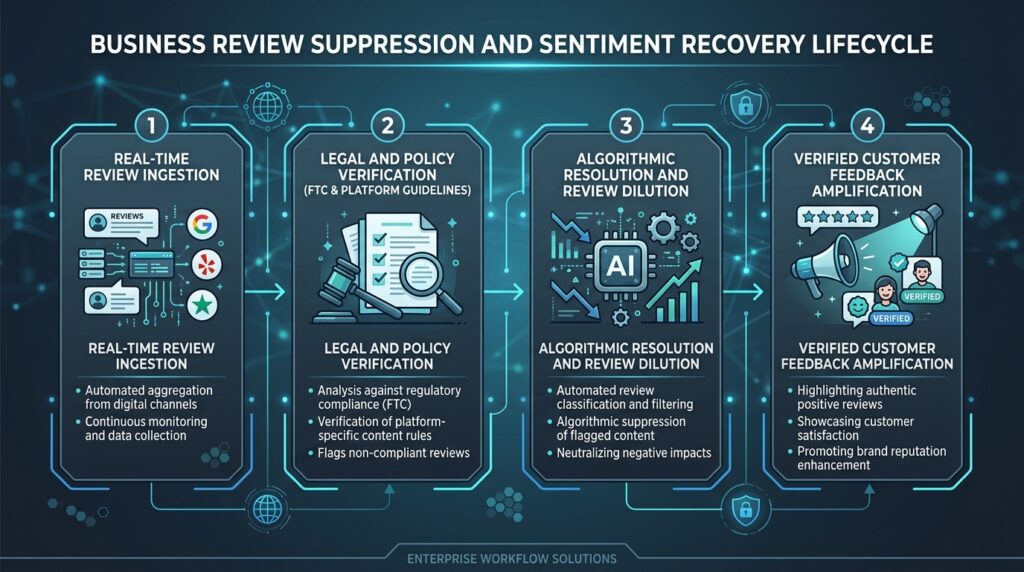
The regulatory environment governing online reviews has tightened dramatically. Regulatory bodies treat online reviews as consumer testimonials subject to truth-in-advertising standards.
1. The Consumer Review Fairness Act (CRFA)
Enacted to protect consumer free speech, the CRFA makes it illegal for companies to include form contract clauses that:
- Prohibit or restrict a consumer from writing an honest review.
- Impose financial penalties or fees on customers who post negative reviews.
- Require consumers to transfer copyright ownership of their feedback to the vendor.
Clauses in website terms of service stating “customers agree not to publish negative remarks on social media or review portals” are legally void and subject to immediate FTC enforcement.
2. The FTC Rule on the Use of Consumer Reviews and Testimonials (16 CFR Part 465)
Enacted to eradicate commercial review manipulation, this federal rule prohibits:
- Review Gating: Using automated survey tools that send happy customers to public review sites while routing unhappy customers to private forms.
- Suppression of Negative Reviews: Operating an internal review collection platform that displays 4-star and 5-star submissions while hiding 1-star submissions.
- Fake Consumer Reviews: Publishing fabricated testimonials created by employees, AI generators, or paid review brokers.
- Review Manipulation via Intimidation: Using groundless legal threats or physical intimidation to force consumers into withdrawing negative remarks.
Comparative Matrix: Lawful Review Mitigation vs. Prohibited Deceptive Suppression
| Review Practice | Legal Status | Regulatory Authority | Practical Business Impact |
|---|---|---|---|
| Flagging Terms of Service Violations | Fully Lawful | Platform Moderation Policies | Successfully removes hate speech, spam, conflict of interest, and off-topic rants. |
| Formal Legal Defamation Submissions | Fully Lawful | Civil Courts / Platform Legal Teams | Compels platforms to remove provably false assertions of objective fact. |
| Systematic Review Dilution | Fully Lawful | Open Market Best Practice | Invites 100% of verified buyers to review, naturally pushing negative feedback down. |
| Review Gating via Pre-Screening | Illegal | FTC Rule 16 CFR Part 465 | Triggers federal inquiries, civil fines, and mandatory consumer restitution orders. |
| Non-Disparagement Contract Clauses | Illegal | Consumer Review Fairness Act | Contracts rendered void; business faces substantial regulatory penalties. |
| Selective Website Review Publishing | Illegal | FTC Deceptive Endorsement Guides | Brand subject to false advertising claims and public regulatory censure. |
How Does Algorithmic Search and AI Engines Ingest Negative Business Reviews?
Direct Answer: AI search engines like Perplexity, ChatGPT Search, and Google AI Overviews scrape third-party review platforms and community forums to build real-time entity sentiment scores, making review suppression through content dilution critical.
Modern search engines do not rely exclusively on star ratings displayed in traditional search snippets. Generative AI engines continuously evaluate unstructured text across the web to synthesize brand reputation profiles.
Multi-Platform Sentiment Synthesis in Generative Search
When a prospective buyer asks an AI engine “Is Company X reliable for enterprise software implementation?”, the engine performs multi-query fan-out across:
- Google Business Profile reviews
- Trustpilot and Better Business Bureau records
- Specialized B2B review portals (G2, Capterra, Gartner Peer Insights)
- Reddit discussions and community forums
According to published data in the Trustpilot Transparency Report, generative search engines weight third-party verified reviews far higher than claims made on corporate websites.
If your digital presence contains unaddressed complaints alleging billing fraud or poor customer support, generative AI tools summarize those issues directly in their synthesis paragraphs.
Technical Search Bot Governance for Review Monitoring Assets
To maintain visibility while monitoring sentiment across search assets, ensure your corporate web properties allow proper crawler access:
| Bot User-Agent | Organization | Operational Purpose | Governance Recommendation |
|---|---|---|---|
| Googlebot | Core organic index and Google Business Profile data | Allow (Mandatory for local and enterprise discoverability) | |
| PerplexityBot | Perplexity AI | Real-time citation verification and entity sentiment analysis | Allow (Essential for generative B2B citation equity) |
| OAI-SearchBot | OpenAI | Live indexation for ChatGPT Search brand overviews | Allow (Required for accurate real-time ChatGPT brand recommendations) |
| Claude-SearchBot | Anthropic | Live retrieval for Claude conversational brand inquiries | Allow (Required for Anthropic generative citations) |
| GPTBot | OpenAI | Offline foundation model training scraper | Discretionary (Does not affect live search citations) |
| ClaudeBot | Anthropic | Offline foundation model training scraper | Discretionary (Does not affect live search citations) |
Ensuring that your owned domain assets are fully crawlable enables search engines to retrieve official clarification statements, press releases, and customer resolution pages.
For brands seeking comprehensive indexation audits across their reputation assets, exploring an enterprise Windel Solutions Technical SEO Audit provides complete technical clarity.
How Can Businesses Legally Remove Policy-Violating Negative Reviews?
Direct Answer: Businesses can legally remove negative reviews by auditing posts against platform-specific terms of service and submitting documented removal requests for spam, hate speech, conflicts of interest, or provable defamation.
Many business owners assume that all negative reviews are permanent. In reality, a significant portion of hostile feedback violates platform guidelines.
1. Identifying Violations of Platform Terms of Service
Major platforms including Google, Yelp, and Trustpilot enforce clear content boundaries. You can successfully contest reviews containing:
- Conflicts of Interest: Reviews posted by current employees, former disgruntled workers, or direct commercial competitors.
- Spam and Automated Content: Duplicate reviews posted across multiple accounts or reviews generated by AI bots.
- Off-Topic Commentary: Reviews discussing political grievances, social issues, or unrelated business entities.
- Harassment and Personal Attacks: Posts naming individual front-line staff members alongside profane or defamatory language.
- Lack of Genuine Commercial Interaction: Reviews submitted by individuals who never transacted with or contacted the business.
2. The Four-Step Protocol for Contesting Policy Violations
| Step | Operational Phase | Specific Action Items |
|---|---|---|
| Step 1 | Forensic Evidence Collection | Capture high-resolution screenshots, timestamps, reviewer names, and cross-reference against CRM order history. |
| Step 2 | Platform Policy Citation | Identify the exact policy clause violated (such as Google Maps Conflict of Interest or Fake Engagement guidelines). |
| Step 3 | Formal Portal Escalation | Submit removal request via Merchant Support portal with objective, concise proof and zero emotional rhetoric. |
| Step 4 | Secondary Appeals & Legal Notices | If automated filtering rejects the claim, escalate to a human policy specialist or submit formal legal defamation filings. |
3. Legal Removal via Court Order or Defamation Counsel
When negative content crosses the threshold into actionable defamation (provably false statements of objective fact causing quantifiable commercial injury), businesses can engage specialized legal counsel.
Platforms maintain dedicated legal intake portals. When presented with a valid court judgment or a formal legal notice demonstrating defamation, platforms routinely de-index the offending URLs.
Why is Review Dilution the Most Effective Strategy for Businesses?
Direct Answer: Review dilution is the most effective reputation strategy because it legally and sustainably lowers the visible impact of 1-star ratings by systematically generating authentic positive reviews from satisfied customers.
Attempting to delete every critical comment is mathematically impossible. A superior, fully compliant approach is review dilution.
The Mathematics of Rating Recovery
Consumer perception is heavily governed by rating thresholds. Consider an enterprise brand with 20 reviews and an average rating of 3.2 stars (including four 1-star reviews):
| Phase | Total Reviews Count | Average Star Rating | Business Risk Status |
|---|---|---|---|
| Baseline Crisis | 20 reviews | 3.2 Stars | Severe Conversion Risk |
| 30 Days (+30 5-Star) | 50 reviews | 4.28 Stars | Acceptable Performance |
| 60 Days (+50 5-Star) | 100 reviews | 4.64 Stars | Dominant Market Standing |
| 90 Days (+50 5-Star) | 150 reviews | 4.76 Stars | Elite Industry Authority |
By generating 130 verified 5-star reviews over a 90-day period, the four original 1-star reviews represent less than 3% of the total rating calculation.
Furthermore, review platform sorting algorithms prioritize recency. Fresh, positive reviews push historical complaints off the initial view screen, achieving natural suppression without violating FTC rules.
Building an Automated, Compliant Feedback Engine
To scale review dilution without running afoul of FTC gating prohibitions, implement a universal post-purchase sequence:
- Send Equal Invitations: Trigger an automated email or SMS to 100% of transacting customers requesting feedback.
- Direct to Third-Party Portals: Provide clear, uninhibited links directly to public review platforms.
- Offer Frictionless Options: Provide choices between Google, Trustpilot, or industry-specific review sites.
- Zero Conditional Logic: Never ask “Did you have a good experience?” before presenting the review link. All customers must receive the identical pathway.
To develop a scalable organic acquisition and reputation engine, discover how Windel Solutions Enterprise SEO Services integrates technical authority with high-intent customer acquisition.
How Does Search Engine Result Demotion Suppress Damaging Review Content?
Direct Answer: Search engine result demotion suppresses damaging review content by optimizing a network of high-authority branded web properties that outrank and push negative review pages off page one of search results.
When prospective clients Google your brand name, third-party complaint forums or negative review threads often rank prominently on page one of the search engine results pages.
The Page One Domination Framework
Over 75% of clicks on branded search queries occur on the top three positions. If a hostile review ranks at position 8, pushing it down to position 11 (page two) effectively eliminates 95% of its consumer visibility.
| Search Position | Target Owned Brand Asset | Strategic Impact on Review Visibility |
|---|---|---|
| Positions 1 to 2 | Corporate Root Domain and High-Intent Subdomains | Captures primary branded navigational clicks and executive search queries. |
| Positions 3 to 4 | Official Social Profiles (LinkedIn, YouTube, X) | High domain authority displaces third-party consumer complaint threads. |
| Positions 5 to 6 | Authoritative B2B Profiles (Crunchbase, Bloomberg, PitchBook) | Establishes verified corporate entity signals across knowledge graphs. |
| Positions 7 to 8 | Verified Review Hubs (Trustpilot, G2, BBB) | Displays well-managed 4.5+ star ratings in search engine snippet cards. |
| Positions 9 to 10 | Sponsored Press Releases and Executive Features | Pushes hostile complaint forums and unverified forum threads onto page two. |
High-Authority Digital Assets to Deploy
To displace negative review URLs on search engines, publish and optimize authoritative assets:
- LinkedIn Corporate Page: High domain authority allows LinkedIn company pages to outrank forum posts easily.
- YouTube Video Channels: Video results receive dedicated rich snippets in search results, capturing substantial vertical screen space.
- Crunchbase and PitchBook Profiles: Authoritative business databases rank consistently for commercial brand investigations.
- Syndicated Press Releases: Distribute newsworthy company announcements through high-authority newswire networks.
- Secondary Company Portals: Establish dedicated microsites, documentation knowledge bases, and corporate social responsibility hubs.
What Does an Enterprise Review Remediation Implementation Look Like in Practice?
Direct Answer: An enterprise review remediation implementation audits policy violations, resolves root customer issues, and deploys automated post-transaction feedback workflows, lifting average brand ratings from negative territory to above 4.5 stars.
To illustrate how lawful online review suppression for businesses works in production, consider this documented implementation from an enterprise B2B supply chain technology company.
Case Study: LogiCore Software Solutions
LogiCore, a logistics software provider processing $200M in annual transactions, suffered a coordinated review attack following a software deployment outage. Within three weeks, twenty-four 1-star reviews appeared across Google and Trustpilot, dropping their aggregate rating from 4.7 to 2.9 stars.
The negative rating began eroding sales pipeline efficiency, resulting in a 35% decline in demo-to-close conversion rates.
| Performance Metric | Baseline Day 0 | Day 90 Program End | Total Net Change |
|---|---|---|---|
| Aggregate Public Star Rating | 2.9 Stars | 4.6 Stars | +1.7 Stars |
| Policy-Violating Reviews Removed | 0 Reviews | 14 Reviews | 14 Illegitimate Reviews Removed |
| Legitimate Customer Complaints Resolved | 0 Reviews | 8 Reviews | 8 Negative Reviews Updated to Positive |
| Verified Positive Reviews Added | 0 Reviews | 142 Reviews | +142 Verified 5-Star Reviews |
| Inbound Demo-to-Close Rate | 18.2% | 31.4% | +13.2% Absolute Close Rate Lift |
The Three-Phase Recovery Strategy
Phase 1: Forensic Audit and Policy Enforcement (Days 1 to 20)
- Problem: Many of the negative reviews were submitted by anonymous accounts with no customer record in LogiCore’s CRM. Several reviews contained identical copy generated by competitors.
- Remediation: LogiCore compiled evidence packets demonstrating that fourteen accounts were fraudulent and violated platform “Fake Engagement” and “Conflict of Interest” guidelines.
- Outcome: Google and Trustpilot removed fourteen illegitimate 1-star reviews within three weeks.
Phase 2: Direct Customer Mediation and Issue Resolution (Days 21 to 45)
- Problem: Ten reviews represented genuine enterprise customers impacted by the software outage.
- Remediation: LogiCore’s executive leadership reached out directly to the affected enterprise clients, assigning dedicated engineering teams to resolve underlying integration bugs.
- Outcome: Eight of the ten clients voluntarily edited or removed their negative reviews, updating their ratings to 4 and 5 stars with notes commending the executive response.
Phase 3: Automated Review Dilution and SERP Domination (Days 46 to 90)
- Problem: Historical negative forum threads still appeared on page one of Google for the query “LogiCore reviews”.
- Remediation: Implemented an automated review generation system requesting feedback from all 1,200 active users. Concurrently, launched an optimized corporate YouTube channel and published an in-depth technical whitepaper on logistics architecture.
- Outcome: LogiCore generated 142 verified 5-star reviews, lifting their aggregate rating to 4.6 stars. The negative forum threads were pushed to page three of Google search results, fully restoring pipeline conversion rates.
What are the 7 Most Common Mistakes Businesses Make with Review Suppression?
Direct Answer: The most common mistakes are review gating, threatening reviewers with defamation lawsuits, buying fake counter-reviews, ignoring valid customer complaints, using non-disparagement contracts, deleting reviews on owned sites, and delegating to black-hat reputation agencies.
Navigating review mitigation requires extreme caution. Committing these errors frequently transforms a minor customer service dispute into a catastrophic public relations crisis.
1. Implementing Algorithmic Review Gating
Using software that asks customers “How was your experience?” and filters respondents based on their rating violates FTC Rule 16 CFR Part 465.
Federal regulators actively audit customer feedback workflows. The risk of substantial monetary penalties far outweighs any short-term rating benefit.
2. Threatening Unhappy Customers with Defamation Lawsuits
When a business sends aggressive cease-and-desist letters to customers who post negative reviews, customers frequently publish those letters on Reddit or social media.
This triggers the “Streisand Effect,” drawing thousands of additional negative comments and permanently tarnishing brand reputation.
3. Purchasing Bulk Positive Reviews from Black-Hat Brokers
Purchasing fake reviews to offset negative feedback is easily detected by modern platform algorithms.
Platforms like Yelp and Google routinely flag suspicious spikes in 5-star reviews, applying public “Consumer Alert” warning badges that destroy brand credibility.
4. Posting Defensive or Passive-Aggressive Public Responses
Responding to a critical review with anger, excuses, or personal attacks signals to prospective customers that your leadership lacks professionalism.
An objective, empathetic response demonstrates maturity and reassures prospective buyers evaluating your service.
5. Including Non-Disparagement Clauses in Standard Agreements
Inserting gag clauses into consumer contracts or terms of service is explicitly illegal under the Consumer Review Fairness Act.
Not only are these clauses legally unenforceable, but their inclusion also exposes the company to state and federal investigations.
6. Deleting Negative Reviews on Corporate-Controlled Platforms
If your website features a customer review section, selectively approving only 5-star reviews while suppressing negative submissions violates FTC truth-in-advertising guidelines.
You must either display all honest feedback or avoid utilizing consumer reviews as an on-page advertising claim.
7. Hiring Unvetted Reputation Agencies Promising “Guaranteed Deletion”
Unethical reputation management agencies often use automated reporting bots, fraudulent copyright claims, or temporary black-hat exploits to suppress reviews.
When platforms uncover these tactics, the deleted reviews are reinstated, the agency disappears, and your corporate profile faces permanent blacklisting.
How Can Businesses Build a Sustainable Long-Term Reputation Defense Architecture?
Direct Answer: Businesses can build a sustainable reputation defense by combining proactive customer feedback loops, multi-channel entity marketing, rapid escalation protocols, and transparent dispute resolution.
True reputation resilience comes from proactive operational excellence rather than reactive crisis control.
Core Elements of an Enterprise Reputation Defense Program
- Closed-Loop Resolution Systems: Integrate customer support ticketing with review alerts. Resolving an issue within one hour of notification often prompts the user to edit their negative review before it impacts sales.
- Proactive Multi-Platform Presence: Maintain active, claiming ownership of profiles across every platform where customers discuss your industry: Google, Yelp, Trustpilot, G2, Reddit, and Glassdoor.
- Executive Brand Monitoring: Deploy automated listening tools to track brand mentions, brand sentiment trends, and executive names across search engines and social platforms.
- Employee Training on Customer Feedback Policy: Ensure marketing, customer service, and sales teams understand what constitutes compliant review solicitation under FTC rules.
For organizations looking to scale strategic brand presence and protect their corporate footprint, partner with Windel Solutions Digital Strategy Consulting to design end-to-end reputation workflows.
Key Takeaways for Dominating Online Review Suppression for Businesses
- Avoid Deceptive Review Suppression: Review gating, non-disparagement clauses, and fake reviews violate federal law and carry civil penalties up to $51,744 per occurrence.
- Enforce Platform Content Guidelines: Systematically audit negative feedback and submit formal removal requests for posts containing hate speech, conflicts of interest, or spam.
- Prioritize Review Dilution Over Deletion: Expanding review volume across all verified customers naturally dilutes negative ratings and restores aggregate scores to 4.5+ stars.
- Leverage Inverted-Pyramid Responses: Respond to legitimate negative feedback publicly with calm, solution-oriented answers to reassure prospective buyers.
- Dominate Branded Search Results: Publish authoritative corporate profiles across LinkedIn, YouTube, and business databases to displace negative review forums off page one.
- Monitor Generative AI Sentiment: Track how Perplexity, ChatGPT Search, and Google AI Overviews summarize your company reputation during conversational queries.
- Ensure Server-Side Crawlability: Allow search engine bots to crawl official response pages, case studies, and corporate clarification statements.
- Establish Closed-Loop Customer Service: Solve customer complaints during private interactions before issues escalate into public online review platforms.
Frequently Asked Questions
What is the single most important legal factor in online review suppression for businesses?
Online review suppression for businesses must strictly comply with the FTC Consumer Review Fairness Act, which outlaws non-disparagement contract clauses and deceptive review gating practices. Violating these federal standards exposes companies to civil penalties reaching up to $51,744 per violation alongside public enforcement orders. Businesses must focus on lawful policy removals and authentic feedback dilution rather than deceptive concealment.
Can a business legally remove a negative review from Google Business Profile?
Online review suppression for businesses permits the legal removal of Google reviews only when the content explicitly violates Google user contributed content policies, such as spam, harassment, or conflicts of interest. Genuine customer dissatisfaction based on a real commercial transaction cannot be deleted through standard platform reporting. If a review contains provably false statements causing financial injury, businesses can pursue formal legal defamation submissions.
How does review dilution outperform traditional review suppression methods?
Online review suppression for businesses achieves superior long-term results through review dilution because generating consistent positive reviews from all verified clients mathematically reduces the statistical weight of occasional negative ratings. Dilution pushes older negative feedback down search listings while satisfying FTC transparency requirements. This sustainable strategy rebuilds prospective client confidence without risking platform penalties or public backlash.
