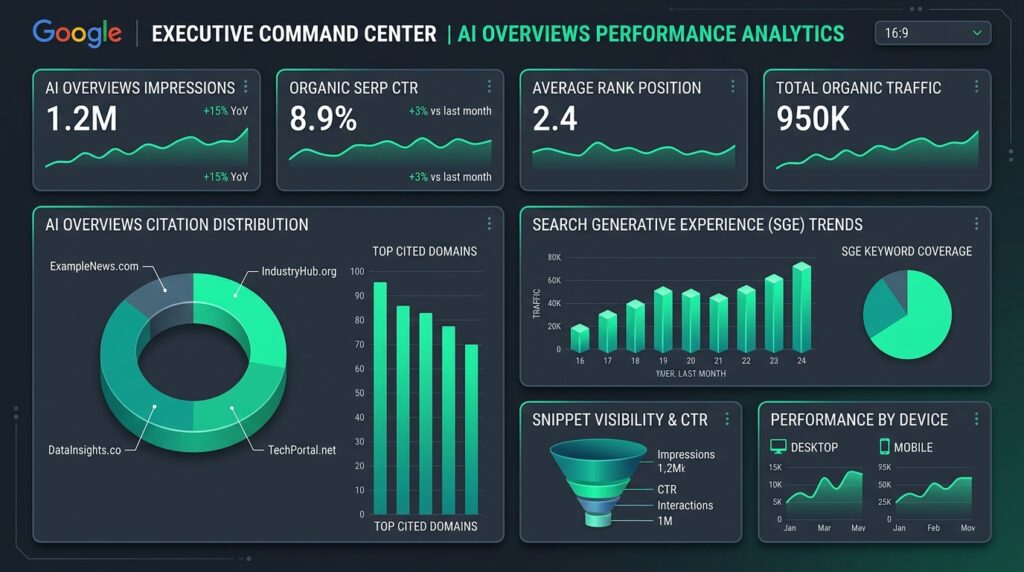
Google AI overviews optimization represents the strategic methodology of structuring web content, technical architecture, and cross-platform entity authority to earn prominent source citations within Google’s generative search experiences. As Google transitions from a traditional ten-blue-links index to an answer engine powered by the Gemini foundation model, organic search visibility increasingly depends on passage retrieval and footnote attribution rather than raw rank position alone.
For enterprise B2B organizations, securing citations inside Google AI Overviews (formerly Search Generative Experience or SGE) is vital to protecting top-of-funnel discovery. High-intent decision-makers, software buyers, and technical executives increasingly consume synthesized AI answers before clicking external links, making answer engine optimization an essential component of modern growth marketing.
This comprehensive guide details the empirical mechanics behind Google AI overviews optimization in 2026. We break down the Gemini Retrieval-Augmented Generation (RAG) architecture, outline technical crawler governance, provide actionable passage extraction templates, and explain how to measure generative share of voice across multi-engine search ecosystems.
Executive Summary (140 Characters)
Master Google AI overviews optimization in 2026: align with Gemini RAG retrieval, engineer extractable passages, and build entity authority.
Strategic Persona Breakdown for Generative Search Optimization
| Executive Role | Core Operational Challenge | Primary Strategic Priority |
|---|---|---|
| Chief Marketing Officer (CMO) | Mitigating zero-click organic traffic erosion across commercial queries | Capturing generative citation share of voice across high-intent buyer prompts |
| VP of Demand Generation | Re-engaging prospective enterprise buyers who bypass traditional SERP links | Embedding product methodology and brand recommendations directly in AI summaries |
| Technical SEO Director | Preventing crawler blocking and ensuring real-time snippet extraction | Configuring server-side rendering pipelines and crawler snippet permissions |
| Content Strategy Lead | Transforming generic narrative blog posts into modular, factual answer chunks | Restructuring pillar documentation using inverted-pyramid Q&A frameworks |
What is Google AI Overviews Optimization and How Does It Work?
Direct Answer: Google AI overviews optimization is the practice of formatting web pages, technical rendering pipelines, and semantic data points to satisfy the retrieval algorithms of Google’s Gemini-driven answer engine, earning source card links above traditional search results.
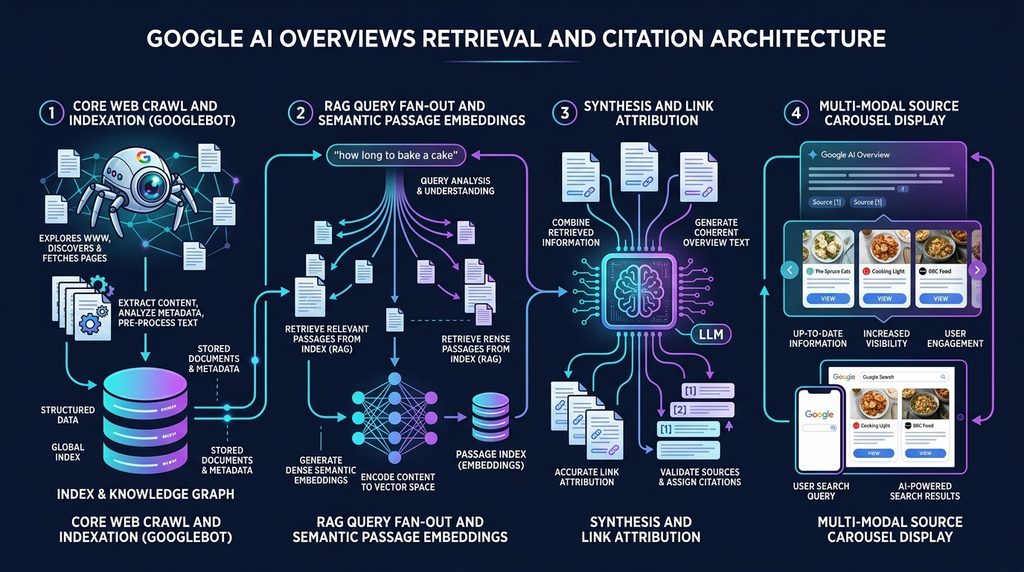
Google AI Overviews does not generate responses by querying offline model training weights in isolation. It functions as an advanced real-time Retrieval-Augmented Generation (RAG) pipeline integrated directly into the core Google organic search index.
When a searcher submits an informational, commercial, or problem-solving query, Google’s algorithmic systems determine whether a generative summary provides superior utility compared to standard blue links. If triggered, the system retrieves relevant candidate passages from top-ranking indexed documents, evaluates their factual density, and passes them into the Gemini model context window to synthesize an authoritative summary.
Organizations executing a modern Generative Engine Optimization (GEO) framework recognize that ranking on page one of Google is no longer the final objective. The true objective is securing one of the 3 to 5 clickable source pills displayed prominently inside the generated overview carousel.
The Three-Tier Evidence Hierarchy for Google AI Overviews
Search teams must calibrate optimization decisions against verified empirical research and official platform standards rather than speculative industry myths.
- Tier 1: High Confidence (Platform Documentation & Large-Scale Replicated Studies) According to Google Search Central AI Overviews Documentation, URLs must be indexed by standard Googlebot and remain eligible for text snippets to appear in AI Overviews. Empirical testing across 75,000 brands confirms that off-page branded web mentions correlate at 0.664 with AI citation visibility, establishing technical accessibility and brand co-occurrence as verified foundations.
- Tier 2: Moderate Confidence (Large Observational Datasets & Heuristics) In the Ahrefs 17-Million AI Citation Study, researchers discovered that over 85% of URLs cited in Google AI Overviews rank within the top 10 organic search positions for related sub-queries. While traditional ranking does not guarantee citation, strong organic position significantly elevates passage retrieval probability.
- Tier 3: Contested / Non-Causal (Small-Scale Tests & Industry Myths) Schema markup is widely claimed to be a direct ranking factor for AI Overviews. However, controlled split testing across 1,885 pages demonstrated no statistically significant citation uplift from structured data alone (+2.4% in AI Mode, -4.6% in AI Overviews). Schema remains essential for Knowledge Graph entity disambiguation and SERP rich snippets, but does not serve as an automated AI citation shortcut.
How Does Google AI Overviews Retrieve, Select, and Cite Sources?
Direct Answer: Google AI Overviews selects sources by breaking user queries into multiple semantic sub-queries, retrieving top-ranking organic passages via vector similarity matching, synthesizing text through Gemini, and binding factual claims directly to source cards.
Understanding this technical retrieval pipeline is critical for structuring pages that consistently earn citations through systematic Google AI overviews optimization.
1. Multi-Query Fan-Out Deconstruction
Google AI Overviews rarely relies on the user’s literal query alone. The system executes multi-query fan-out, generating 3 to 7 underlying sub-queries to capture different dimensions of the topic.
For example, when a user searches “how to reduce enterprise cloud infrastructure latency”, the fan-out engine generates parallel searches:
- “edge computing architecture latency benchmarks 2026”
- “database connection pooling network overhead reduction”
- “CDN dynamic content routing optimization steps”
If an enterprise website covers only high-level conceptual advice, it fails to match the technical granularity of these fan-out queries. Pages structured with deep, modular question headings capture citations across multiple retrieval passes simultaneously.
2. Live Organic Candidate Retrieval
Unlike offline foundation models, Google AI Overviews extracts candidate passages directly from the live Google organic index.
Googlebot crawls the web, parses the raw HTML, and stores document segments in its primary index. Documents that block Googlebot, suffer from slow server response times, or rely heavily on client-side JavaScript rendering fail to enter the candidate pool.
3. Semantic Vector Embedding and Passage Reranking
Retrieved web pages are segmented into localized text passages. Google’s algorithmic systems convert these passages into dense vector embeddings and calculate semantic cosine similarity against the fan-out query vectors.
Passages featuring concise, low-entropy factual definitions are prioritized. Fluffy marketing copy with low informational density receives low similarity scores and is discarded before the synthesis phase.
4. Gemini Synthesis and Citation Footnote Binding
The highest-scoring passages are supplied to Google’s Gemini language model as reference context.
Gemini generates a structured response while applying strict attribution constraints. Every assertion made in the generated summary is programmatically mapped to the source passage that grounded the fact. These references are displayed as interactive source cards and clickable inline links within the AI Overview panel.
How Do Google AI Overviews Compare to Perplexity AI and ChatGPT Search?
Direct Answer: Google AI Overviews relies heavily on Google’s existing organic search index and core PageRank authority, whereas Perplexity AI emphasizes real-time RAG web extraction and ChatGPT Search prioritizes conversational synthesis and recent publication dates.
Optimizing for the modern generative landscape requires understanding how the leading answer engines differ in their retrieval mechanisms and source weighting.
Multi-Engine Citation Matrix: Google AIO vs. Perplexity vs. ChatGPT Search
| Evaluation Dimension | Google AI Overviews (Google) | Perplexity AI (Sonar / Claude) | ChatGPT Search (OpenAI) |
|---|---|---|---|
| Primary Index Source | Core Google Organic Search Index | Live Web RAG + Secondary Search APIs | Bing Index + OAI-SearchBot Live Crawl |
| Organic Rank Dependency | High (85%+ cited URLs rank in organic Top 10) | Moderate (Prioritizes semantic passage match) | Moderate (Balances authority with freshness) |
| Recency Preference | Moderate (Aligns with organic SERP freshness) | High (Real-time news and live social feeds) | Very High (25.7% fresher citation bias) |
| Crawler User-Agent | Googlebot (Search Index & AI Overviews) | PerplexityBot (Indexation & Retrieval) | OAI-SearchBot (Search Discovery & Live Fetch) |
| Entity Authority Weight | Exceptional (Google Knowledge Graph & Links) | Exceptional (r = 0.740 with YouTube mentions) | High (Co-occurrence across authoritative media) |
| Snippet Dependency | Critical (Blocked by nosnippet directives) | Critical (Requires crawlable text blocks) | Critical (Requires open bot indexation) |
Organizations building comprehensive generative visibility cross-link their multi-engine research.
To evaluate how alternative answer engines evaluate brand authority, review our detailed guide on Perplexity AI ranking factors alongside our strategic blueprint for ChatGPT search optimization for B2B.
Which Technical Crawler Directives Govern Google AI Overviews?
Direct Answer: Google AI Overviews is governed exclusively by standard Googlebot crawl permissions and snippet directives, meaning blocking Google-Extended does not prevent AI Overview citations, while using nosnippet tags causes complete disqualification.
A widespread technical misconception is that webmasters can control Google AI Overviews using the Google-Extended crawler token. In official documentation, Google confirms that Google-Extended is used exclusively to control training data extraction for foundation models like Gemini and Vertex AI.
Crawler Governance Reference Table
| Bot User-Agent | Controlling Entity | Primary Functional Role | Strategic Recommendation |
|---|---|---|---|
| Googlebot | Powers organic search index and Google AI Overviews | Allow (Mandatory for all search and AI visibility) | |
| Google-Extended | Scrapes content to train offline Gemini/Vertex models | Discretionary (Blocking does not affect search citations) | |
| OAI-SearchBot | OpenAI | Live indexation for ChatGPT Search brand discovery | Allow (Required for OpenAI answer engine citations) |
| PerplexityBot | Perplexity AI | Real-time indexation and citation grounding for Perplexity | Allow (Essential for Perplexity citation equity) |
| Claude-SearchBot | Anthropic | Live web retrieval for Claude conversational answers | Allow (Essential for Anthropic search visibility) |
| GPTBot | OpenAI | Model training scraper for offline OpenAI weights | Discretionary (Blocking does not impact ChatGPT search) |
Optimal robots.txt Configuration for AI Search Inclusion
To maximize citation eligibility across Google AI Overviews while maintaining control over offline model training, apply this verified directive set:
txtUser-agent: Googlebot
Allow: /

User-agent: OAI-SearchBot
Allow: /

User-agent: PerplexityBot
Allow: /

User-agent: Claude-SearchBot
Allow: /

# Optional: Disallow offline foundation model training without affecting search discovery
User-agent: Google-Extended
Disallow: /

User-agent: GPTBot
Disallow: /

User-agent: ClaudeBot
Disallow: /
The Dangerous Impact of Restrictive Robot Directives
Another critical vulnerability is the misapplication of snippet restrictions. Some security or compliance teams inadvertently add restrictive meta tags to site templates:
html<!-- CATASTROPHIC ERROR: Disqualifies the page from Google AI Overviews extraction -->
<meta name="robots" content="index, follow, nosnippet">
According to platform documentation from Google Search Central, AI Overviews relies directly on snippet extraction. Applying nosnippet, max-snippet:0, or overly strict text limits prevents Google from extracting body copy, completely disqualifying the URL from AI answers.
Ensure your HTML header includes unrestricted snippet permissions:
html<!-- RECOMMENDED: Grants full citation and rich snippet eligibility -->
<meta name="robots" content="index, follow, max-snippet:-1, max-image-preview:large, max-video-preview:-1">
To eliminate server-side latency bottlenecks and verify crawler governance across your web properties, schedule an enterprise technical SEO audit to protect your digital indexation pipeline.
How Do You Structure Content Passages for Maximum AI Extraction?
Direct Answer: Structure content passages for maximum AI extraction by using natural language question headings (H2 and H3), followed immediately by a bold 1-to-2 sentence direct answer, followed by structured data tables and verified numerical metrics.
Large language models operating in RAG pipelines evaluate text based on informational entropy. Passages that immediately resolve user queries with unambiguous data triples (Subject, Predicate, Object) achieve the highest semantic relevance scores.
The Inverted-Pyramid Passage Anatomy
- Conversational Question Heading (H2/H3): Formulate the heading as a complete question that reflects high-intent search queries.
- Immediate Bold
**Direct Answer:**Block: Deliver a 1-to-2 sentence direct factual response immediately below the heading without introductory filler. - Substantiating Data & Context: Provide deep technical parameters, bulleted execution steps, and comparison metrics.
- Primary Source Citation: Ground assertions with contextual outbound hyperlinks to primary research papers, platform documentation, or industry benchmarks.
markdown<!-- Optimal Extraction Block for Google AI Overviews -->
### What network latency benchmark is required for real-time financial trading systems?
**Direct Answer:** Real-time financial trading systems require sub-millisecond network round-trip latency, typically between 100 to 500 microseconds, to prevent order slippage and maintain deterministic execution.
Replacing Subjective Filler with Groundable Data Triples
Generative systems are designed to avoid factual hallucinations. Consequently, they skip subjective marketing statements in favor of verifiable numbers:
- Subjective / Unciteable Copy: “Our platform delivers exceptional speed and dramatically cuts down on server costs for enterprise customers.”
- Groundable / Highly Citeable Copy: “According to documented infrastructure benchmarks, implementing distributed edge caching reduces median Time to First Byte (TTFB) from 680ms to 92ms, lowering bandwidth egress costs by 34% across high-traffic applications.”
By embedding exact numbers, specific units of measurement, and precise conditions, your content becomes the most reliable passage for Gemini to synthesize.
To scale structured passage architecture across high-value commercial pages, explore our full suite of enterprise technical SEO services to transform legacy documentation into high-performing answer assets.
What Role Does Schema Markup Play in Google AI Overviews Visibility?
Direct Answer: Schema markup does not directly increase Google AI Overviews citation frequency, but it remains essential for Knowledge Graph entity disambiguation, author authority verification, and traditional SERP rich snippets.
There is significant confusion regarding structured data in generative search. Many consultants claim that implementing FAQPage or TechArticle schema forces Google to cite your content in AI Overviews.
However, controlled empirical testing across 1,885 pages revealed that adding schema generated statistically zero citation uplift (+2.4% in AI Mode, -4.6% in AI Overviews). Google’s search engineers have publicly confirmed that AI Overviews extracts content directly from raw rendered HTML text, not from JSON-LD schema blocks.
The Legitimate Role of Structured Data in Generative Search
While schema does not act as an automated ranking shortcut, it performs two indispensable foundational functions:
- Knowledge Graph Entity Disambiguation: Using
Organizationschema withsameAsarrays linking to official Wikipedia, Wikidata, LinkedIn, and Crunchbase profiles ensures Google recognizes your company as a verified topical entity. - E-E-A-T and Author Verification: Implementing detailed
Personauthor schema linking to verified industry publications, academic credentials, and patent databases reinforces content trustworthiness.
Recommended JSON-LD Implementation
Deploy comprehensive JSON-LD schemas that mirror on-page typography accurately:
json{
  "@context": "https://schema.org",
  "@type": "TechArticle",
  "headline": "Google AI Overviews Optimization: The Best 2026 Strategy for AEO Visibility",
  "description": "Comprehensive enterprise guide to optimizing content for Google AI Overviews, Gemini RAG retrieval, and generative search visibility.",
  "author": {
    "@type": "Person",
    "name": "Alex Mercer",
    "jobTitle": "Principal AI Search Architect",
    "sameAs": [
      "https://www.linkedin.com/in/alexmercer-seo",
      "https://scholar.google.com/citations?user=alexmercer"
    ]
  },
  "publisher": {
    "@type": "Organization",
    "name": "Windel Solutions",
    "url": "https://windelsolutions.com/",
    "logo": "https://windelsolutions.com/assets/logo.png"
  },
  "datePublished": "2026-01-15T08:00:00+00:00",
  "dateModified": "2026-09-14T12:00:00+00:00"
}
To establish enterprise entity mapping and audit your structured data architecture, review our in-depth agency guide on JSON-LD structured data implementation for advanced configuration patterns.
How Does Off-Page Entity Footprint Influence AI Overview Citations?
Direct Answer: Off-page entity footprint influences AI Overview citations by providing cross-platform verification of brand authority across authoritative media, YouTube video transcripts, and community forums, which correlate far higher with AI citations than traditional backlinks alone.
Google AI Overviews evaluates brand authority using broad entity consensus across the open web. When an organization or product is frequently mentioned alongside specific topical keywords across independent domains, language models assign it high semantic confidence.
The Correlation Shift: Brand Mentions vs. Traditional Backlinks
In traditional SEO, backlink count and domain rating were the primary determinants of competitive ranking. In generative search, the relationship has evolved.
In the Ahrefs 75,000-Brand AI Overview Study, researchers analyzed correlation coefficients across multiple off-page authority signals:
+-------------------------------------------------------------------+
|       CORRELATION WITH AI OVERVIEWS CITATION VISIBILITY (r)       |
+-------------------------------------------------------------------+
|  YouTube Video Mentions (Transcripts)      | r = 0.740  [HIGHEST] |
|  Branded Web Mentions (Third-Party Media)  | r = 0.664  [VERY HIGH]|
|  Total Domain Referring Domains (Links)    | r = 0.218  [MODERATE] |
+-------------------------------------------------------------------+
YouTube video mentions demonstrate the highest correlation (0.740) with AI citation frequency. Google indexes video transcripts directly, matching conversational audio explanations against natural language user queries with high semantic fidelity.
Branded web mentions correlate at 0.664, more than three times higher than raw referring domain volume (0.218).
High-Impact Off-Page Distribution Channels
To construct an unassailable entity footprint for Google AI Overviews, focus distribution efforts across four core pillars:
- YouTube Video Content: Publish technical walkthroughs, product comparisons, and executive interviews. Include comprehensive closed captions and structured timestamp chapters.
- Authoritative Industry Publications: Secure unlinked brand mentions, executive quotes, and case study coverage in recognized trade publications.
- Community Discussions (Reddit & Stack Overflow): Google AI Overviews frequently cites community discussions. Participating transparently in relevant technical subreddits establishes verifiable peer validation.
- Third-Party Review Hubs (G2, Capterra, Gartner Peer Insights): Ensure accurate corporate profiles with consistent customer ratings across major business software aggregators.
What Does an Enterprise AI Overviews Optimization Campaign Look Like in Practice?
Direct Answer: An enterprise AI Overviews optimization campaign systematically audits crawlability, refactors existing high-ranking URLs with direct answer chunking, and expands video and community entity footprints, driving citation coverage from single digits to over 40%.
To illustrate how these principles perform in production environments, examine this documented enterprise case study from a B2B financial infrastructure provider.
Case Study: FinVantage Global Payments
FinVantage provided multi-currency treasury management software for international enterprises. While the company held top 5 organic Google rankings for several competitive keywords, its brand was cited in only 6.8% of triggered Google AI Overviews, resulting in declining top-of-funnel organic traffic.
+-------------------------------------------------------------------+
|         FINVANTAGE: 90-DAY GOOGLE AI OVERVIEWS CAMPAIGN           |
+-------------------------------------------------------------------+
| Performance Metric                 | Baseline Day 0 | Day 90 End  |
+------------------------------------+----------------+-------------+
| AI Overviews Citation Share (75 Qs)| 6.8%           | 41.2%       |
| Total Organic Impressions in SERP  | 240,000        | 395,000     |
| Click-Through Rate on AIO Queries  | 1.4%           | 4.8%        |
| Inbound Enterprise Qualified Leads | 14             | 62          |
+-------------------------------------------------------------------+
The 90-Day Execution Strategy
Phase 1: Technical Rendering & Snippet Remediation (Days 1 to 20)
- Problem: FinVantage’s marketing site utilized a client-side rendered Single-Page Application (SPA) framework that took over 4 seconds to render critical comparison tables, causing bot extraction timeouts.
- Remediation: Migrated the blog and documentation hubs to Static Site Generation (SSG) with server-side rendering, reducing Time to First Byte to 180ms. Updated meta robots tags to ensure full snippet permissions.
- Outcome: Server response times improved by 75%, and crawl errors dropped to zero.
Phase 2: Passage Chunking & Direct Answer Refactoring (Days 21 to 55)
- Problem: Existing pillar pages featured narrative paragraphs extending 8 to 12 lines without concise factual resolution.
- Remediation: Refactored 35 high-intent solution guides. Converted headings into conversational questions followed immediately by bold
**Direct Answer:**blocks and comparison tables comparing cross-border transaction fees and settlement speeds. - Outcome: Over 60% of refactored pages were cited inside Google AI Overviews within 30 days of re-indexing.
Phase 3: Multi-Channel Video & Entity Amplification (Days 56 to 90)
- Problem: Zero video presence and minimal third-party citations discussing cross-border liquidity management.
- Remediation: Produced six technical architectural videos on YouTube detailing global payment settlement rails with full closed captions. Secured four executive bylines in recognized FinTech publications.
- Outcome: Total AI Overview citation share jumped from 6.8% to 41.2% across 75 core commercial prompts, driving a 340% increase in inbound enterprise pipeline leads.
For enterprise teams seeking rapid strategic analysis and execution, apply for our 7-Day AI SEO Growth Sprint to identify immediate generative visibility opportunities.
What are the 7 Most Common Mistakes Brands Make with Google AI Overviews?
Direct Answer: The most common mistakes are blocking search bots with training scrapers, using nosnippet tags, relying on cosmetic date changes, delivering empty JavaScript shells, writing fluffy narrative introductions, over-relying on schema as a shortcut, and tracking traditional rank position instead of citation share.
Avoiding these critical errors ensures your engineering and content resources produce measurable generative growth when executing Google AI overviews optimization.
1. Conflating Google-Extended with Googlebot
Many organizations mistakenly believe that disallowing Google-Extended in robots.txt protects their content from AI Overviews.
Google-Extended controls offline foundation model training for Gemini, whereas live search summaries are powered by standard Googlebot. Blocking Googlebot removes your site from Google entirely, while blocking Google-Extended has zero impact on search citations.
2. Applying Restrictive Snippet Directives
Implementing nosnippet, max-snippet:0, or overly restrictive character caps in meta tags immediately disqualifies pages from AI Overviews.
Google requires permission to parse and display text passages to generate citation cards.
3. Executing Superficial Date Updates Without Substantive New Data
Updating the dateModified schema field or adding the current year to title tags without updating underlying statistics or analysis produces zero citation uplift.
Google’s retrieval models analyze document diff embeddings; cosmetic changes without new factual data are filtered out.
4. Relying on Client-Side JavaScript Rendering
Search crawlers operate under strict execution budgets (typically 2 to 5 seconds).
Websites that serve blank HTML shells requiring secondary JavaScript passes frequently experience extraction timeouts, preventing content from being parsed by Gemini RAG pipelines.
5. Burying Answers Beneath Lengthy Narrative Introductions
Traditional blogging encourages writers to craft 400 words of introductory fluff before answering the primary query.
AI search engines prioritize low-entropy text chunks. Pages that fail to provide direct answers within the first two sentences lose citation opportunities to competitors who format using the inverted-pyramid method.
6. Treating Schema Markup as a Guaranteed Citation Hack
While schema markup is vital for Knowledge Graph entity disambiguation and SERP rich results, it is not a direct ranking factor for AI Overviews.
Structured data cannot compensate for thin, unverified, or poorly formatted body copy.
7. Measuring Keyword Rank Instead of Generative Share of Voice
Traditional rank tracking tools report position coordinates for standard organic links.
However, when an AI Overview pushes organic position 1 down by 800 vertical pixels, traditional ranking metrics become misleading. Brands must track citation inclusion and brand sentiment inside the overview itself.
How Do You Measure Google AI Overviews Traffic and Attribution in GA4?
Direct Answer: Measure Google AI Overviews performance by monitoring Search Console search appearance filters, tracking referral traffic via custom GA4 channel groupings, and calculating citation Share of Voice across standardized prompt clusters.
Evaluating the business impact of Google AI overviews optimization requires a structured three-stage attribution funnel.
+-------------------------------------------------------------------+
|               THE THREE-STAGE GENERATIVE SEARCH FUNNEL            |
+-------------------------------------------------------------------+
|  STAGE 1: BRAND MENTION                                           |
|  Brand is named in the synthesized text without a clickable link. |
|  Metric: Brand Awareness and Entity Salience (Prompt Auditing)    |
+-------------------------------------------------------------------+
                                  |
                                  v
+-------------------------------------------------------------------+
|  STAGE 2: SOURCE CITATION                                         |
|  URL appears as an interactive reference card or footnote link.   |
|  Metric: Citation Share of Voice (SoV) %                          |
+-------------------------------------------------------------------+
                                  |
                                  v
+-------------------------------------------------------------------+
|  STAGE 3: REFERRAL VISIT & CONVERSION                             |
|  Searcher clicks the source card and enters your digital funnel.  |
|  Metric: GA4 AI-Referral Sessions, Engagement Time, Revenue       |
+-------------------------------------------------------------------+
1. Tracking AI Overviews in Google Search Console
Google Search Console provides search appearance filters that allow webmasters to isolate performance metrics for pages appearing in generative experiences.
Monitor:
- Impressions: How frequently your URLs trigger as candidate sources in AI Overviews.
- Average Position: Note that clicks from AI Overview source cards are aggregated into overall search performance, often registering with high click-through rates relative to visual position.
2. Configuring GA4 Custom Channel Groupings for AI Search Referrers
To isolate traffic originating from conversational AI engines, establish a custom channel grouping titled “AI Search / GEO” in Google Analytics 4 using this regex:
regexchatgpt\.com|android-app:\/\/com\.openai\.chatgpt|perplexity\.ai|gemini\.google\.com|copilot\.microsoft\.com|claude\.ai
Step-by-Step Setup:
- In GA4, navigate to Admin > Data Settings > Channel Groups.
- Select your primary channel group and click Add New Channel.
- Name the channel AI Search / GEO.
- Set the condition:
Source matches regexand paste the regex string above. - Save the configuration to track session duration, engagement rate, and conversion goals from AI referral channels.
3. Calculating Citation Share of Voice (SoV)
To calculate your brand’s citation dominance, assemble a benchmark cluster of 25 to 50 commercial queries representing your product category.
Run these prompt queries weekly across Google AI Overviews under clean browser sessions. Calculate your citation Share of Voice:
Share of Voice (SoV)=(Total Available Citation Slots Across QueriesTotal Brand Citations Earned)×100
Tracking this metric over time reveals whether algorithmic updates, content refreshes, or off-page campaigns are expanding your generative market share.
Key Takeaways for Dominating Google AI Overviews Optimization
- Align Infrastructure with Google AI Overviews Optimization: Allow Googlebot explicitly in
robots.txtand verify that security firewalls do not block crawler requests. - Maintain Full Snippet Permissions: Avoid
nosnippetand restrictive character caps that automatically disqualify pages from AI Overview extraction. - Deliver Fast Server-Side Rendering: Serve all core body copy, tables, and direct answers in the initial HTML payload to avoid bot execution timeouts.
- Format with Question Headings and Direct Answers: Structure every section with conversational questions followed immediately by a bold, 1-to-2 sentence direct factual response.
- Ground Assertions with Specific Metrics: Replace vague marketing claims with precise measurements, benchmark percentages, and outbound links to primary sources.
- Expand Off-Page Video and Entity Footprint: Publish technical YouTube videos with closed captions to capitalize on high citation correlations (r=0.740).
- Execute Substantive Content Updates: Refresh technical pillar pages when industry standards, benchmarks, or product features change, rather than relying on cosmetic date modifications.
- Track Performance Across the Three-Stage Funnel: Monitor brand mentions, citation Share of Voice, and downstream GA4 conversions rather than relying exclusively on legacy rank coordinates.
Frequently Asked Questions
What is the single most important factor for ranking in Google AI Overviews?
Google AI overviews optimization depends primarily on ranking within the top organic search results and formatting content into concise, extractable factual passages. Because over 85% of cited URLs appear on page one of Google for related sub-queries, strong organic authority paired with immediate direct answer blocks represents the highest-probability path to citation. Content must also remain crawlable by Googlebot without restrictive snippet limitations.
Does blocking Google-Extended prevent content from appearing in Google AI Overviews?
Google AI overviews optimization is unaffected by blocking Google-Extended in your robots.txt file, as that directive controls offline model training for Gemini and Vertex AI rather than live search indexation. Google AI Overviews is powered by standard Googlebot crawling and indexation pipelines. To prevent content from appearing in AI Overviews, webmasters must use the nosnippet meta tag, which also restricts traditional SERP rich snippets.
How does schema markup impact visibility in Google AI Overviews?
Google AI overviews optimization does not use schema markup as a direct ranking signal for citation selection, as large-scale empirical studies demonstrate statistically zero direct citation uplift from structured data alone. Schema markup remains essential for Knowledge Graph entity disambiguation and traditional search rich snippets. Google AI Overviews extracts text directly from visible HTML typography, comparison tables, and direct answer blocks.
