
In the highly competitive digital ecosystem, businesses must leverage every available channel to build search engine authority. While traditional ranking factors like on-page code optimization and backlinks remain critical, search engines also track brand activity across the social web. Understanding how social media signals for search rankings function is the key to unlocking consistent organic traffic growth.
Consequently, modern brands cannot afford to manage their search engine optimization and social campaigns in isolated silos. Search engines now evaluate brand relevance, topical authority, and real-time user engagement using indicators from multiple digital platforms. This is why optimizing social media signals for search rankings has become a vital requirement for local and international brands seeking page-one dominance.
The Evolution of Brand Authority in Search Engine Optimization
Direct Answer: Search engines track social mentions and profile activity as indirect signals of a brand’s real-world authority and trust within its industry.
According to global search statistics, over 93% of online B2B purchasing journeys begin with a search query, making top rankings essential. Historically, SEO focused exclusively on technical audits, keyword density, and link building on external directories. However, search engine algorithms have evolved to prioritize brands that demonstrate active community engagement and real-world relevance.
Simultaneously, major search updates have focused on E-E-A-T (Experience, Expertise, Authoritativeness, and Trustworthiness) parameters. Sites that lack active digital footprints or social validation are increasingly devalued in competitive search results.
Therefore, building a sustainable domain reputation requires a coordinated, multi-platform approach. By publishing high-quality content that drives social interaction, brands can signal to search engine crawlers that their business is a trusted market leader.
How Social Media Signals for Search Rankings Support SEO
Direct Answer: Social signals support search performance by driving high-volume referral traffic, accelerating page indexation, and securing branded search real estate.
Restoring corporate brand equity online is a highly technical process that extends far beyond writing generic social media updates. When evaluating social media signals for search rankings, you must coordinate a multi-faceted methodology to alter search engine results pages. This ensures that when prospects search for your brand, they find a balanced and authoritative digital presence.
Specifically, the relationship between social activity and search performance is divided into distinct operational channels. The table below outlines how these channels interact to support your organic rankings.
| Social Indicator | SEO Impact & Tactical Focus | Primary KPI Tracked |
|---|---|---|
| Referral Traffic | Clicks from social posts to website content, increasing dwell time. | Monthly sessions & dwell time |
| Brand Citations | Mentions of brand name, NAP details, and services across platforms. | Unlinked brand mention volume |
| Profile Indexation | Social profiles ranking on page one for branded company searches. | SERP share of voice |
| Content Syndication | Distribution of technical guides to earn natural organic backlinks. | Total acquired referring domains |
| User Interaction | Comments, reviews, and community questions on public profiles. | Net profile engagement rate |
In addition, by leveraging social media signals for search rankings, B2B brands can bypass the slow indexation times typical of new web pages. When a social post drives a sudden wave of traffic to a new article, search engine bots crawl the page faster. This rapid indexing ensures that your newly published service guides begin ranking and generating leads in days rather than weeks.
The Four Pillars of Social-to-SEO Integration
Direct Answer: Successful integration relies on search-intent social copywriting, profile metadata optimization, active content syndication, and brand citation consistency.
1. Search-Intent Social Copywriting and Formatting
The foundation of measuring social media signals for search rankings starts with aligning your social post copy with target search queries. Technical writers use the same keyword vocabulary in social captions that your audience uses when searching Google.
Furthermore, they write short, engaging paragraphs and use structured lists to improve reading time in social feeds. This high dwell time on platforms like LinkedIn signals to search algorithms that your content is valuable and relevant.
2. Profile Metadata and Search Visibility Optimization
This is why optimizing social media signals for search rankings involves treating your social accounts as secondary search landing pages. The team inserts primary service keywords, location data, and direct target links into all profile bios and description fields.
Consequently, this optimization ensures that your social profiles rank at the top of Google for branded search terms. Owning these page-one results protects your reputation and prevents competitors from hijacking your brand queries.
3. Strategic Content Syndication and Link Building
Within any strategy targeting social media signals for search rankings, profile sharing serves as the primary distribution engine for your SEO assets. The marketing team syndicates technical case studies, worksheets, and audit guides across social channels to maximize visibility.
Additionally, they include prominent, responsive social sharing buttons on all blog pages to encourage readers to share your content. This continuous sharing loop increases the likelihood of earning high-authority backlinks from external websites.
4. Brand Citation and NAP Consistency Management
Many guides discussing social media signals for search rankings overlook the importance of NAP (Name, Address, Phone number) consistency. Search engines run entity extraction algorithms that verify your business details across all digital platforms.
An experienced partner monitors your profiles to ensure that your business details match your website code perfectly. This consistent citation profile builds local search trust and helps your brand rank higher in local 3-pack search results.
Technical Breakdown: Setting Up a Social Traffic Tracking Funnel
Direct Answer: A tracking funnel requires using UTM parameters on all social links and creating custom conversion goals in Google Analytics.
Relying on raw, untracked referral data from social platforms will leave your marketing team unable to calculate the exact ROI of SMM campaigns. To prove that your social campaigns support your sales pipeline, you must trace user journeys from social posts to final conversions.
Below is the step-by-step technical framework utilized by digital marketing teams to establish a social tracking funnel:
- UTM Parameter Generation: Add tracking parameters (source, medium, campaign name) to every link published on social media.
- Analytics Integration: Connect Google Analytics with your website and set up custom dashboards for social traffic tracking.
- Conversion Goal Setup: Configure conversion goals for actions like form submissions, PDF downloads, and meeting bookings.
- Behavior Flow Analysis: Track how social visitors navigate your website, measuring their average session duration and bounce rates.
- Search Console Verification: Cross-reference social traffic spikes with organic search query growth in Google Search Console.
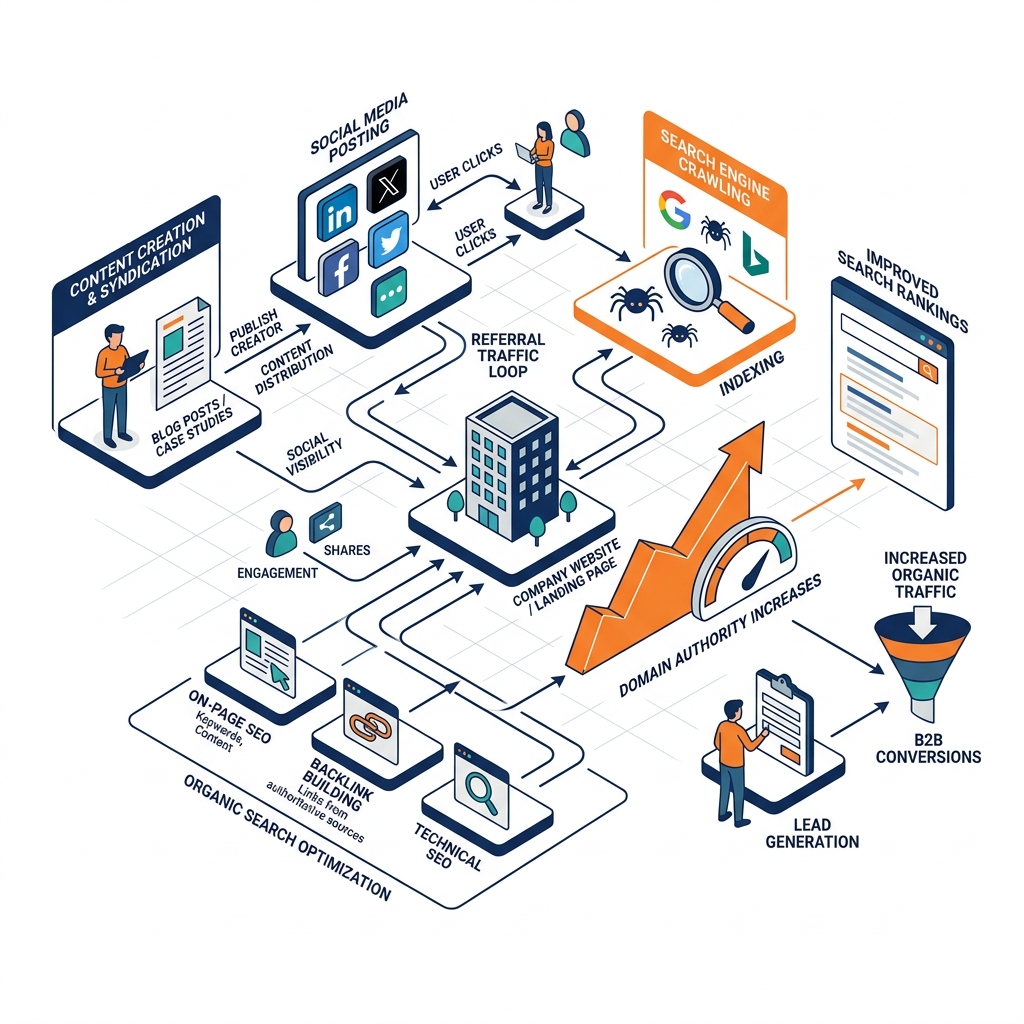
Implementing this tracking structure allows your marketing team to identify which social platforms drive the highest-quality leads. Consequently, you can optimize your content budget and focus on the channels that generate the highest ROI.
Case Study: How TechFlow Boosted Search Rankings via LinkedIn Syndication
Direct Answer: A B2B logistics provider increased its domain authority from 24 to 38 and grew its sales pipeline by SGD 190,000 using social syndication.
Our subject is TechFlow, a regional provider of B2B logistics technology. TechFlow had published high-quality service pages but struggled to rank for competitive commercial keywords, leaving them invisible to regional buyers. They implemented custom strategies using social media signals for search rankings to distribute their technical guides and build domain trust.
The agency immediately audited TechFlow’s social profiles and restructured their content syndication schedule. They targeted LinkedIn as the primary channel to reach enterprise logistics procurement managers.
“Social activity and search performance are not isolated silos. When you align your social distribution with search intent, you create an authority loop that search engine algorithms naturally reward.” — Matthew Windel, Chief Executive Officer at Windel Solutions.
The agency ran a 120-day campaign, publishing technical case studies and tracking user engagement using custom conversion setups. The performance metrics from this campaign are detailed below:
- Campaign Duration: 120 Days
- Domain Authority Score: Improved from 24 to 38
- LinkedIn Referral Traffic Growth: +78%
- First-Page Keywords: 38 new logistics keywords ranking on Page 1
- Average Dwell Time: Increased by 45 seconds on syndicated blog pages
- Sales Pipeline Generated: SGD 190,000 in recovered contract opportunities
This case study demonstrates how monitoring social media signals for search rankings protects your brand value. By optimizing social distribution channels and building brand citations, TechFlow built a sustainable organic funnel and captured high-value contracts.
Common Pitfalls: The Dangers of Buying Automated Social Engagement
Direct Answer: Brands must avoid buying automated likes, shares, or fake social profiles, as search filters will flag and devalue your domain.
When dealing with low social engagement, some businesses turn to quick-fix services that promise instant followers. An expert managing social media signals for search rankings will warn you that using automated bots is highly risky and violates platform guidelines.
Search engine and social network algorithms easily detect artificial engagement patterns, such as sudden traffic spikes from unrelated geographic regions. If flagged, your social profiles can be shadowbanned or suspended, destroying your brand’s digital footprint.
Additionally, avoid publishing low-quality, automated content just to maintain a posting schedule. Focus on building real community trust and using white-hat content marketing strategies.
Choosing an Agency to Optimize Social Media Signals for Search Rankings
Direct Answer: The ideal organic marketing partner must demonstrate deep expertise in both search engine optimization and B2B social media management.
Selecting the right digital growth agency requires verifying their cross-channel capabilities. A generalist social agency might focus on visual templates that fail to support your website’s search authority. Therefore, evaluating partners to build your social media signals for search rankings requires looking for technical SEO and sales-aligned marketing expertise.
Specifically, ask how they handle technical schema setups, conversion tracking, and brand citation monitoring. The checklist below outlines the key criteria your team should evaluate during the selection process:
- Cross-Channel Integration: Do they align social media calendars with your primary SEO keyword targets?
- MarTech Capabilities: Can they integrate UTM tracking and CRM lead capture systems?
- White-Hat Methodology: Do they focus on organic community building rather than buying fake engagement?
- Transparent Dashboards: Do they provide real-time performance tracking for both search and social metrics?
- Case Study Verification: Can they show proven examples of social traffic supporting organic search rankings?
Evaluating these factors ensures you partner with an agency that protects your brand’s reputation while driving measurable search engine recovery.
Conclusion
Restoring your corporate brand image in search engine results requires continuous optimization and cross-channel marketing expertise. A single negative review or unoptimized social profile can cost your business millions in lost contracts and recruitment opportunities.
Consequently, leveraging social media signals for search rankings remains the most reliable way to protect your digital presence and ensure consistent revenue growth. By combining social distribution with technical search optimization, you can control your brand’s digital narrative.
Ready to clean up your search results and protect your corporate brand? Let our technical team help you restore your digital presence. [Book a brand consultation with our reputation engineers today] to receive a free search engine sentiment report and competitor gap analysis.
FAQ Section
Q: Do links shared on social media pass PageRank directly to my website?
A: No, links shared on most social platforms use the rel="nofollow" attribute, meaning they do not pass PageRank directly. However, they drive referral traffic and brand search volume, which are positive organic ranking factors.
Q: How do brand mentions on social media affect SEO?
A: Search engines use entity recognition to identify brand mentions across the web. Consistent mentions of your brand name and services on social media help search engines associate your website with your industry keywords.
Q: Which social platforms are best for building search authority?
A: For B2B brands, LinkedIn is the most authoritative platform. For visual industries, Pinterest and YouTube are highly effective because their content indexes well in Google’s visual search results.
Q: What is a NAP citation and why does it matter?
A: NAP stands for Name, Address, and Phone number. Having consistent NAP details across your website, Google Business Profile, and social media channels is critical for local search rankings.
Q: Can social media profiles rank on page one of Google?
A: Yes. High-authority platforms like LinkedIn, Facebook, and Twitter frequently rank on the first page of Google for branded company name searches, helping you dominate your brand’s search results.
