
In the modern digital landscape, organic search visibility is highly volatile due to continuous search engine core updates and evolving rendering technologies. For enterprise brands and high-growth B2B platforms, investing in a technical seo retainer is the most effective method to protect and expand organic traffic. Because modern websites are dynamic and constantly updated by product and engineering teams, coding errors can silently degrade crawl performance.
Consequently, maintaining a clean search architecture is not a one-off project but a continuous requirement. Understanding why establishing a technical seo retainer has become the industry standard for digital growth is key to building sustainable search engine dominance. By continuously auditing site health, B2B enterprises can systematically outpace competitors in both traditional and AI-driven search results.
The Shift: Why One-Off Technical Audits Fail
Direct Answer: One-off audits fail because websites are dynamic environments where daily code releases, content updates, and server migrations constantly introduce new indexing bottlenecks.
According to a study by Search Engine Land, over 62% of enterprise websites experience critical crawling or indexation errors within 90 days of resolving a standalone audit. This decay occurs because modern headless CMS platforms, JavaScript frameworks, and database integrations are constantly updated by developers who are not SEO specialists. Consequently, a single template deployment can accidentally block search engine crawlers via robots.txt or break canonical URL patterns across thousands of pages.
Furthermore, search engine indexing behaviors have changed. Search engines now utilize a two-stage rendering process where JavaScript is queued and rendered only when resources are available. This means that a page that looks perfect in a browser might be indexed as a blank template by Googlebot due to client-side API failures.
Therefore, relying on annual or quarterly audits leaves your site vulnerable to prolonged traffic drops. A continuous monitoring and resolution workflow is required to detect and fix these rendering bottlenecks before they impact your organic revenue.
What is a Technical SEO Retainer and What Does It Cover?
Direct Answer: A continuous technical SEO program provides ongoing server log analysis, site speed optimization, schema deployment, crawl budget management, and developer triage.
Operating an enterprise-scale website requires constant collaboration between digital marketing teams and software engineering departments. Under a structured technical seo retainer, a dedicated team of SEO engineers and technical analysts works as an extension of your development team. This integration ensures that search optimization is embedded directly into your product development lifecycle.
Specifically, a continuous agreement covers advanced optimizations that generalist agencies often ignore. The table below illustrates the critical differences between a one-off audit and a continuous, engineering-led optimization framework.
| Optimization Layer | One-Off Audit Model (Project-Based) | Technical SEO Retainer Model (Continuous) |
|---|---|---|
| Crawl Budget | Static check of robots.txt and XML sitemap configuration. | Real-time server log analysis and crawl path optimization. |
| Site Performance | Single-point lighthouse speed score analysis. | Continuous Core Web Vitals monitoring and GTM optimization. |
| Schema & Entities | Basic JSON-LD template creation for main pages. | Dynamic semantic schema deployment and graph verification. |
| Developer Collaboration | Delivery of a static PDF audit report. | Bi-weekly ticket prioritization in Jira/GitHub and code reviews. |
| AI Bot Optimization | Basic crawl controls for web crawlers. | Generative Engine Optimization (GEO) markup and agent control. |
In addition, by moving to a technical seo retainer, companies secure dedicated resource allocation to address search critical bugs as they happen. Instead of waiting for a quarterly review, technical issues are resolved within active development sprints. This proactivity keeps search engine bots crawling your highest-converting landing pages efficiently.
The Four Pillars of an Enterprise Technical SEO Strategy
Direct Answer: The foundation of enterprise search performance rests on crawl optimization, JavaScript rendering efficiency, semantic structured data, and server logs diagnostics.
1. Crawlability and Indexation
Search engine crawlers have limited time and resources allocated to your website, commonly known as a crawl budget. If your site has thousands of duplicate parameter URLs, broken redirects, or thin content pages, bots will waste resources on low-value URLs. Consequently, your newly published articles or updated product listings may remain unindexed for weeks.
To prevent this, technical specialists systematically prune crawl paths. They implement precise directory rules, configure sitemap indexes, and monitor index coverage reports daily to ensure search engines only crawl clean, authoritative URLs.
2. JavaScript Rendering and Core Web Vitals
Modern web frameworks like React, Angular, and Next.js offer excellent user experiences but present major hurdles for search crawlers. If your content requires complex client-side JavaScript execution to render on the page, search engines might miss key semantic links or body text during their initial pass.
Therefore, optimizing the rendering path—moving toward Server-Side Rendering (SSR) or Static Site Generation (SSG)—is a primary focus. Simultaneously, continuous monitoring of Core Web Vitals like Largest Contentful Paint (LCP) and Interaction to Next Paint (INP) ensures your site satisfies search engine speed thresholds.
3. Structured Data and Semantic Search (GEO)
AI search engines and modern search algorithms rely on structured data to build entity graphs and understand content relationships. Using advanced JSON-LD nested schemas, technical teams translate human-readable articles into machine-readable datasets.
Within a typical technical seo retainer, your partner continually updates and tests your site’s schema implementation. This ongoing work ensures your content is optimized for rich search snippets and is easily scraped by conversational AI search engines.
4. Server Log Analysis and Indexing Guardrails
Server logs represent the source of truth for how search bots interact with your server. By importing and analyzing these logs, technical SEOs can identify exactly which pages are crawled most frequently and which are completely ignored.
Simultaneously, this analysis uncovers hidden server errors, bot traffic spikes, and API rendering timeouts. A comprehensive technical seo retainer addresses these underlying server behaviors to maintain site accessibility and indexation stability.
Technical Breakdown: How Continuous Log Analysis Prevents Crawl Budget Waste
Direct Answer: Continuous server log analysis identifies the exact URLs crawled by search bots, allowing you to eliminate duplicate crawl paths and optimize host resource allocation.
Most marketing teams rely entirely on Google Search Console to monitor crawling patterns. However, Search Console only provides aggregated data and does not show real-time bot requests. To truly understand search engine behavior, you must analyze your raw server logs (Apache, Nginx, or Cloudflare logs).
Below is the step-by-step technical framework utilized by enterprise SEO teams to extract actionable insights from server logs:
- Log Collection: Configure your CDN or hosting provider to stream raw log data to a central database or log analyzer tool (e.g., Logstash, Kibana, or Splunk).
- Bot Verification: Filter out spoofed search bots by performing a reverse DNS lookup on all incoming requests claiming to be Googlebot or Bingbot.
- Crawl Distribution Analysis: Group log requests by subdirectory to calculate the percentage of crawl budget allocated to non-revenue-generating pages (like customer support portals or filter parameters).
- Response Code Tracking: Monitor the occurrence of non-200 status codes. A high volume of 404 errors or 301 redirect chains wastes crawl budget and signals poor site health.
- Crawl Frequency Mapping: Compare crawl frequency against organic traffic volume to identify “crawl loops”—pages that are crawled daily but generate zero search impressions.
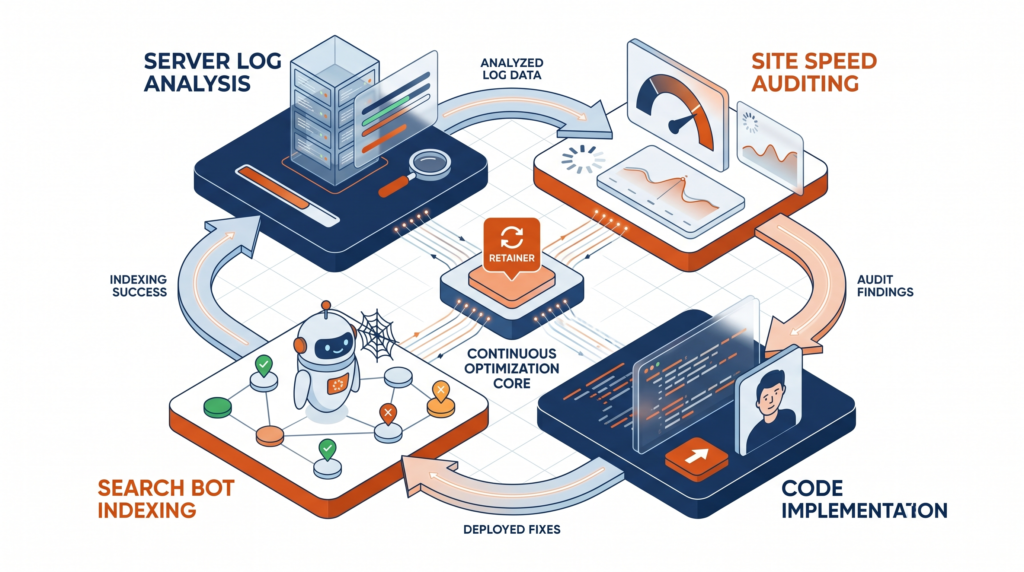
Implementing this level of technical oversight ensures that your development team can optimize host configuration files in real-time. Consequently, search bots can discover and index your business-critical content faster and more efficiently.
Case Study: How a Headless B2B SaaS Saved 40% Crawl Budget
Direct Answer: Migrating to server-side rendering and optimizing crawl paths via a continuous technical retainer helped a headless B2B SaaS brand increase its indexed pages by 65%.
Our subject is DevFlow, a headless CMS provider for enterprise developers. After launching a site redesign built on a client-side rendered React framework, DevFlow experienced an immediate 30% drop in organic search impressions. Their internal engineering team was focused on product features and lacked the bandwidth to diagnose indexing failures. To resolve this, DevFlow implemented a long-term technical seo retainer to resolve the performance decay.
The retained technical SEO team immediately identified that Googlebot was timing out while executing the JavaScript bundle required to render the main navigation links. This meant that the crawler could not discover inner product pages, causing them to fall out of the index.
“Enterprise websites are complex software platforms. You cannot treat SEO as a marketing layer that sits on top of the code; it must be treated as a core software requirement that is continuously tested, validated, and optimized at the code level.” — Marcus Vance, Director of Search Engineering at TechScale.
The technical team worked alongside DevFlow’s engineers to implement Server-Side Rendering (SSR) via Next.js and optimized their Cloudflare edge caching rules. The metrics achieved during this 120-day engagement are detailed below.
- Total Crawl Budget Waste Reduction: 40%
- Indexed Pages Increase: 65% (from 12,000 to 19,800 URLs)
- Average Largest Contentful Paint (LCP): Reduced from 4.2 seconds to 1.8 seconds
- Organic Search Traffic Growth: +48%
- Sales Pipeline Generated: $312,000 in new contract value
This case study demonstrates how a technical seo retainer transitions search optimization from a reactive recovery effort into a proactive driver of pipeline value. By treating search engine crawlers as primary users, DevFlow secured long-term keyword dominance in a highly competitive developer market.
Common Retainer Deliverables: The Monthly Execution Cycle
Direct Answer: A technical SEO retainer operates on a structured monthly cycle consisting of daily health monitoring, weekly sprint triage, bi-weekly log audits, and monthly speed validation.
Unlike traditional SEO retainers that focus on producing generic blog content, a technical agreement is characterized by continuous code validation and performance engineering. The workflow is designed to align with modern agile software development practices.
Specifically, an expert offering a technical seo retainer should focus on delivering code-level adjustments and testing rather than static reports. The standard monthly deliverables are structured around a sprint model:
- Daily Health Checks: Monitoring indexation status, crawling errors, and server response times via automated monitoring platforms.
- Weekly Sprint Alignment: Meeting with the product team to review upcoming code deployments and write technical requirements for developers.
- Bi-Weekly Log Audits: Analyzing raw CDN logs to detect bot loops, excessive redirect checks, and crawl budget leaks.
- Monthly Core Web Vitals Audits: Performance testing on staging environments to ensure no code updates degrade real-world loading performance.
- Quarterly Entity Verification: Validating site graph schema and semantic markup against the latest AI engine documentation.
This rigorous structure ensures that technical health is never neglected. It keeps the site’s codebase clean and optimized for both modern web standards and search engine algorithms.
Choosing the Right Technical SEO Retainer Partner
Direct Answer: The ideal technical partner must demonstrate deep expertise in JavaScript rendering, log analysis, GTM deployment, and agile developer collaboration.
Selecting the wrong agency can lead to friction between your marketing and engineering departments. Generalist agencies often deliver lengthy recommendation lists that are technically unfeasible or lack developer-friendly specs. Therefore, evaluating a prospective technical seo retainer partner requires verifying their development experience.
Specifically, your partner must speak the language of your software engineers. They should be comfortable writing Jira tickets, analyzing codebase configurations, and validating server configurations. The checklist below outlines the key capabilities your team should verify:
- JavaScript Expertise: Can they debug hydration errors in React or rendering delays in Vue/Next.js?
- Log File Experience: Do they have a proven process for parsing large-scale CDN and server logs?
- Agile Integration: Are they familiar with GitHub, Jira, and continuous integration/continuous deployment (CI/CD) pipelines?
- Custom Tooling: Do they build custom scripts to scrape and monitor indexation patterns at scale?
- GEO Readiness: Do they understand how modern LLMs crawl and index sites for conversational search queries?
Partnering with an agency that meets these standards guarantees that your search strategy will be executed smoothly, minimizing development friction and maximizing search visibility.
Conclusion
Maintaining search prominence in an era of rapid algorithmic change and complex web frameworks requires continuous technical vigilance. A single code deployment error can instantly undo years of search visibility work.
Consequently, securing a dedicated technical seo retainer represents the most reliable way to protect your digital presence and ensure consistent revenue growth. By combining real-time log monitoring with agile developer collaboration, you can ensure that your search architecture remains flawless.
Ready to optimize your site’s search architecture and eliminate crawl bottlenecks? Let our technical specialists help you scale your organic performance. [Book a technical SEO consultation with our engineering team today] to receive a free crawl budget analysis and Core Web Vitals diagnostic.
FAQ Section
Q: What is the difference between a standard SEO contract and a technical SEO agreement?
A: A standard SEO contract focuses heavily on off-page link building, content creation, and on-page keyword optimizations. A technical SEO agreement focuses exclusively on infrastructure health, rendering paths, page speed parameters, schema deployment, server logs, and engineering collaboration to ensure search engine accessibility.
Q: Do my internal developers still need to implement technical SEO recommendations?
A: Yes. The technical SEO partner writes developer-friendly tickets, diagnoses technical errors, and reviews code, but your internal developers remain responsible for deploying those changes to the live website codebase.
Q: How often are server log files analyzed under an ongoing technical search contract?
A: Log files are typically analyzed on a bi-weekly or monthly basis. However, in enterprise environments or during major site migrations, logs may be streamed and monitored continuously to detect crawl anomalies immediately.
Q: Can a continuous search audit program help improve Core Web Vitals?
A: Yes. Ongoing technical optimization includes monitoring and fixing factors that slow down loading performance, such as render-blocking resources, unoptimized CSS/JS bundles, server delay, and dynamic shifts in layout.
Q: Why is recurring technical optimization necessary for headless CMS configurations?
A: Headless websites pull data dynamically using JavaScript APIs. Search engines often experience delays rendering client-side content. Continuous optimization ensures proper pre-rendering or server-side rendering configurations are in place to guarantee content is indexed instantly.
