
B2B SEO lead generation is the strategic practice of engineering and optimizing organic search visibility to capture high-intent enterprise buyers and convert organic search traffic directly into qualified sales pipeline and closed-won Annual Recurring Revenue (ARR). Most enterprise marketing teams generate substantial organic traffic numbers that yield zero demo bookings, sales calls, or pipeline value. This performance disconnect occurs because conventional search strategies target top-of-funnel informational definitions rather than capturing decision-makers who possess immediate purchasing intent.
Modern enterprise buyers conduct deep independent research across search engines long before speaking to a sales representative. According to extensive buyer research conducted by Gartner, enterprise B2B buying groups spend only 17 percent of their total buying journey meeting with prospective software vendors. Over 70 percent of their time is spent conducting independent digital evaluations, technical capability comparisons, and internal team reviews.
To turn organic visibility into real commercial revenue, marketing leaders must transition from vanity traffic accumulation to revenue-first search engineering. This comprehensive guide outlines the operational framework for b2b seo lead generation in 2026, breaking down bottom-of-funnel landing page design, technical conversion velocity, and closed-loop pipeline attribution models.
Executive Summary (140 Characters)
Scale B2B SEO lead generation in 2026: target high-intent bottom-of-funnel queries, eliminate capture friction, and track closed-won ARR in your CRM.
Strategic Persona Breakdown for Enterprise Organic Pipeline Growth
| Leadership Role | Core Operational Challenge | Primary SEO Pipeline Objective |
|---|---|---|
| Chief Revenue Officer (CRO) | High Customer Acquisition Cost (CAC) and volatile sales pipeline forecasts | Building a predictable, recurring organic pipeline stream that lowers blended CAC |
| VP of Marketing / CMO | Justifying organic search investment to the board amidst revenue scrutiny | Replacing vanity organic session reporting with multi-touch pipeline attribution for seo |
| Head of Demand Generation | Low lead-to-opportunity conversion rates from broad blog traffic | Prioritizing bottom of funnel b2b seo keywords that convert directly into sales demos |
| Technical SEO Director | Slow page speed and rendering bottlenecks depressing search conversion rates | Executing technical optimizations that eliminate form friction and maximize crawlability |
Why does traditional B2B SEO fail to generate qualified enterprise pipeline?
Direct Answer: Traditional B2B SEO fails to generate qualified leads because it targets high-volume informational keywords that attract students and junior researchers rather than high-intent commercial terms searched by enterprise buyers.
For over a decade, content marketing agencies measured success by gross organic impressions and total blog visits. Marketers published broad encyclopedic guides on topics such as “what is cloud computing” or “history of supply chain management”. While these top-of-funnel articles generate impressive line charts in Google Analytics, they attract casual researchers who possess zero budget, zero decision-making authority, and zero intent to purchase software.
What is the “traffic vs. pipeline” trap in modern B2B marketing?
The “traffic vs. pipeline” trap occurs when an organization celebrates record organic sessions while sales pipeline, demo volume, and closed-won revenue remain completely stagnant.
Consider the fundamental difference in buyer intent between two distinct search queries:
- Informational Query: “What is enterprise workflow automation?” (Estimated monthly volume: 8,500 searches; Lead Conversion Rate: 0.05%)
- Commercial Intent Query: “Best enterprise workflow automation software for healthcare compliance” (Estimated monthly volume: 180 searches; Lead Conversion Rate: 7.2%)
While the informational keyword generates 47 times more traffic, the commercial keyword produces 68 times more qualified sales opportunities. In b2b seo lead generation, search volume is a vanity metric; commercial specificity is a revenue multiplier.
Why do disconnected buyer journeys and gated whitepapers kill conversion?
Modern buyers refuse to fill out an eight-field form to download a generic thirty-page PDF whitepaper. When a prospective buyer arrives on your website seeking technical specifications, pricing structures, or feature comparisons, gating that information behind an aggressive lead wall causes immediate site abandonment.
Google’s official guidelines on creating helpful, people-first content emphasize that search engines reward websites that provide immediate utility, direct answers, and transparent information. Gated PDF content cannot be crawled effectively by search bots, fails to rank for long-tail technical queries, and repels qualified enterprise buyers.
When software companies replace gated whitepapers with open, indexable comparison matrices and interactive product walkthroughs, prospect engagement surges and organic conversion rates multiply.
What is the 3-pillar framework for B2B organic pipeline generation?
Direct Answer: The 3-pillar framework for B2B organic pipeline generation combines bottom-of-funnel commercial keyword domination, sub-second technical speed conversion architecture, and account-based multi-channel authority.
To establish a scalable pipeline engine, marketing teams must align content strategy, technical website architecture, and distribution networks. This 3-pillar framework establishes the foundation for sustainable enterprise seo lead generation:
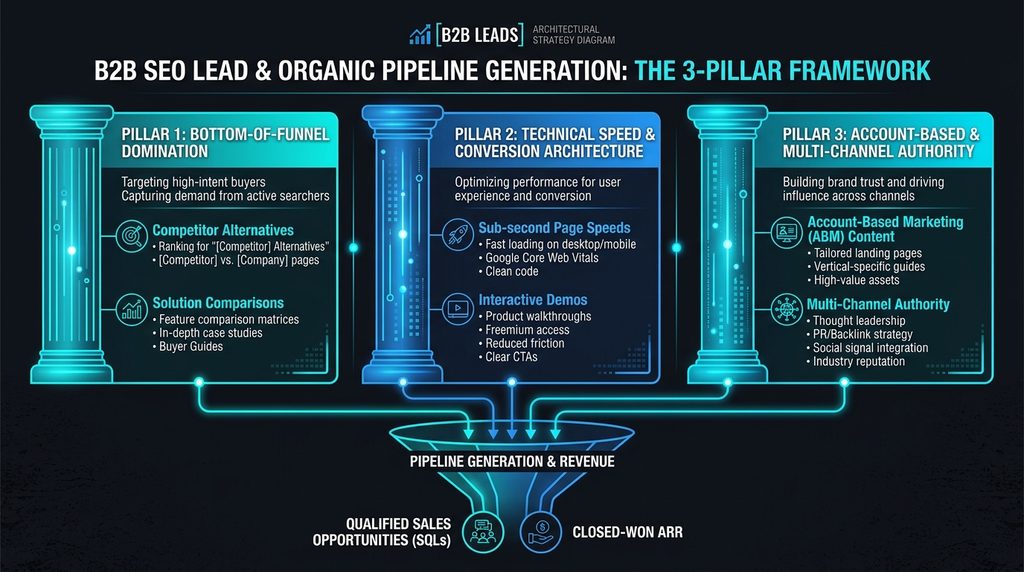
Pillar 1: Bottom-of-Funnel (BOFU) Domination
Bottom-of-funnel search terms represent prospective buyers who have already identified their operational problem and are actively evaluating software vendors. Winning these searches captures active buyers at the moment of decision:
- Competitor Alternative Pages: When an incumbent enterprise software vendor raises prices, suffers an outage, or deprecates a core feature, frustrated customers immediately search for alternatives (e.g., “[Competitor] alternatives” or “replace [Competitor]”). Publishing honest, feature-rich alternative guides captures buyers who are ready to switch vendors immediately.
- Head-to-Head Comparison Pages: Prospective enterprise buyers routinely shortlist two leading vendors before submitting RFP proposals (e.g., “[Product A] vs [Product B]”). Creating balanced, technically rigorous comparison tables allows your team to control the narrative rather than leaving the comparison to biased third-party review sites.
- Use-Case and Role-Specific Solution Pages: Enterprise organizations purchase software to solve specific departmental problems. Developing dedicated landing pages tailored to specific buyer personas (e.g., “SOC2 compliance automation for fintech CTOs”) delivers unmatched conversion relevance.
Software companies seeking a deeper tactical framework for scaling software ARR should review our comprehensive guide on B2B SaaS SEO strategy to structure their category pages.
Pillar 2: Technical Speed as a Lead Conversion Multiplier
Technical performance is not merely a search ranking signal; it is a direct driver of sales form conversion. Enterprise executives and technical buyers expect instantaneous page delivery.
Research across enterprise B2B websites demonstrates that every 100-millisecond delay in page load time reduces lead form submissions by up to 7 percent. When a prospect clicks a high-intent search result, delays caused by heavy JavaScript tracking scripts, unoptimized CSS frameworks, or slow server response times trigger immediate bounces.
By investing in specialized B2B site speed optimization, organizations ensure that landing pages achieve sub-second load speeds, passing Google Core Web Vitals and converting mobile and desktop searchers at maximum efficiency.
Pillar 3: Account-Based and Dark Social Authority
Enterprise deals are rarely closed by a single individual; they require consensus among six to ten cross-functional stakeholders. Content that ranks in organic search must be engineered for internal circulation within enterprise Slack channels, executive briefing memos, and board presentations.
Moreover, modern search discovery occurs across multiple decentralized platforms. By integrating community distribution channels through strategic Reddit marketing for B2B, marketing teams validate their search authority through authentic developer discussions, third-party recommendations, and dark social amplification.
How do you design high-converting B2B search landing pages?
Direct Answer: High-converting B2B search landing pages eliminate form friction, provide transparent interactive product walkthroughs, and display prominent enterprise compliance trust badges to maximize demo bookings.
Attracting qualified organic search traffic solves only half of the revenue equation. If your landing pages fail to convert searchers into sales-accepted leads, your customer acquisition economics break down.
Enterprise landing pages must be engineered as self-contained conversion environments tailored to executive attention spans.
1. Eliminating Friction in Lead Capture Forms
Traditional B2B lead forms demand twelve different inputs: first name, last name, business email, phone number, job title, company name, employee count, annual revenue, industry, CRM platform, timeline, and custom notes. Each additional form field reduces conversion probability by an average of 11 percent.
High-converting enterprise landing pages adopt a streamlined, two-step progressive capture model:
- Step 1 (Immediate Intent): Request only the business email address to unlock an interactive demo or initiate scheduling.
- Step 2 (Automated Enrichment): Utilize background API data enrichment tools (such as Clearbit, ZoomInfo, or Apollo) to automatically populate company size, headquarters, industry classification, and tech stack without burdening the buyer.
2. Interactive Product Demos and Value Calculators
Enterprise buyers want to inspect the actual product interface before committing to a thirty-minute sales demo. Embedding interactive, browser-based product tours (using utilities like Navattic or Storylane) allows prospects to experience core workflows within sixty seconds.
Similarly, embedding interactive ROI and savings calculators enables finance and procurement directors to model their cost reductions directly on the page, significantly accelerating sales cycle velocity.
3. Displaying Verified Enterprise Trust Signals
Enterprise organizations operate under strict data security and compliance requirements. High-intent B2B search landing pages must prominently display verified security badges:
- Compliance Certifications: SOC2 Type II, ISO 27001, HIPAA, and GDPR compliance logos positioned immediately below primary Call-to-Action buttons.
- Client Proof Points: Logos of recognizable enterprise customers, accompanied by one-sentence measurable case study outcomes (e.g., “Reduced audit preparation time by 64% for Fortune 500 fintech”).
- Third-Party Review Ratings: Verified badges from G2, Gartner Peer Insights, and Capterra showcasing verified 4.8+ star ratings.
Before publishing new high-intent conversion hubs, enterprise marketing teams should conduct an enterprise technical SEO audit to ensure that schema markup, canonical configurations, and mobile usability are fully optimized.
How do you measure SEO for ARR growth and multi-touch pipeline attribution?
Direct Answer: Measure SEO for ARR growth by passing first-touch organic landing page URLs into hidden CRM form fields, tracking lead progression to Sales Qualified Leads, and calculating closed-won revenue in HubSpot or Salesforce.
The era of reporting organic search success through vanity metrics like keyword position tracking and aggregate impressions is over. Modern Chief Financial Officers and CMOs demand clear visibility into how organic search drives customer acquisition efficiency.
According to SaaS benchmarking data from ProfitWell, software companies with robust inbound organic acquisition engines achieve 30 to 50 percent lower blended Customer Acquisition Costs compared to competitors that rely exclusively on paid search and paid social advertising.
Vanity SEO Metrics vs. Revenue-Driven B2B SEO Metrics
| Measurement Category | Traditional Vanity SEO Metric | Revenue-Driven B2B SEO Metric | Strategic Business Impact |
|---|---|---|---|
| Search Visibility | Total Organic Keyword Rankings (Top 100) | Top 3 Share of Voice on High-Intent BOFU Keywords | Captures active commercial purchase demand |
| User Engagement | Total Monthly Blog Sessions | High-Intent Solution Page Visits & Demo Starts | Filters out irrelevant consumer researchers |
| Conversion Volume | Total Raw Form Fills & eBook Downloads | Sales Qualified Leads (SQLs) & Sales Accepted Opportunities | Directly feeds active enterprise sales pipeline |
| Attribution Model | Last-Click Google Analytics Session | Multi-Touch First-Touch & W-Shaped Pipeline Attribution | Verifies organic search influence across long deal cycles |
| Financial Return | Estimated Organic Traffic Dollar Value | Closed-Won Annual Recurring Revenue (ARR) | Demonstrates verified return on marketing investment |
The Technical Closed-Loop Attribution Architecture
To track organic search revenue accurately in your CRM, deploy the following three-step technical attribution workflow:
+-------------------------------------------------------------------------+
|                  CLOSED-LOOP B2B SEO ATTRIBUTION WORKFLOW                |
+-------------------------------------------------------------------------+
|  STEP 1: FIRST-TOUCH CAPTURE VIA FIRST-PARTY COOKIES                    |
|  JavaScript snippet captures original landing URL, referrer, & UTMs.    |
|  Persisted in first-party browser cookies for 90 days.                  |
+-------------------------------------------------------------------------+
                                     |
                                     v
+-------------------------------------------------------------------------+
|  STEP 2: HIDDEN FORM FIELD PASS-THROUGH                                 |
|  When prospect submits a demo request, hidden fields automatically pass:|
|  - First_Touch_Landing_Page                                             |
|  - Organic_Search_Keyword_Cluster                                       |
|  - Referrer_Source (Google Organic, Perplexity, ChatGPT Search)          |
+-------------------------------------------------------------------------+
                                     |
                                     v
+-------------------------------------------------------------------------+
|  STEP 3: CRM PIPELINE MAPPING (Salesforce / HubSpot)                    |
|  Form submission generates Contact and Opportunity records.             |
|  Tracks deal stage progression: Discovery -> Demo -> Proposal -> Won ARR|
+-------------------------------------------------------------------------+
Essential Financial Metrics for Board Reporting
- Organic Pipeline Generated: The total dollar value of qualified sales opportunities created from organic search entry points within a given quarter.
- Organic CAC Payback Period: The number of months required for gross margin from organic closed-won customers to recover the total cost of SEO retainers and content engineering.
- Pipeline Velocity: The average number of days required for an organic lead to transition from initial landing page visit to a signed enterprise contract.
- Organic Closed-Won ARR: Total new annual recurring revenue directly credited to organic search discovery touchpoints.
How can you accelerate your enterprise pipeline today?
Direct Answer: Accelerate your enterprise pipeline by conducting a technical crawl audit, restructuring category architecture around bottom-of-funnel queries, and implementing closed-loop CRM attribution.
Transitioning from an informational content strategy to an enterprise revenue engine requires immediate operational focus. Marketing leaders should implement this four-week action roadmap:
- Week 1: Commercial Keyword Pruning: Audit your top 100 organic landing pages. Identify high-traffic articles generating zero pipeline and implement conversion pathways or redirect resources toward commercial solution pages.
- Week 2: Launch Competitor Alternative Hubs: Publish three comprehensive comparison pages targeting your top market competitors, featuring transparent feature matrices and enterprise customer testimonials.
- Week 3: Eliminate Form Capture Friction: Reduce lead capture fields to business email only, integrating automated background data enrichment to streamline demo booking.
- Week 4: Configure CRM Closed-Loop Tracking: Implement hidden form fields in HubSpot or Salesforce to capture first-touch landing URLs and attribute closed-won ARR directly to organic search campaigns.
If your marketing organization needs expert guidance to execute this transition rapidly, partner with our team through the 7-Day Growth Architecture Sprint to uncover technical conversion bottlenecks, fix crawl budget leaks, and build a customized enterprise organic pipeline roadmap.
Key Takeaways for Dominating B2B SEO Lead Generation
- Prioritize Commercial Intent Over Volume: High-converting enterprise pipeline comes from specific commercial queries, not broad educational definitions.
- Dominate the Bottom of the Funnel: Build dedicated competitor alternative guides, direct comparison pages, and persona-specific solution hubs to capture active buyers.
- Optimize Page Speed for Lead Conversion: Achieve sub-second page load times across all commercial landing pages to prevent high-intent bounce rates.
- Eliminate Lead Capture Friction: Replace lengthy twelve-field lead forms with two-step progressive capture models supported by automated API data enrichment.
- Replace Gated Whitepapers with Interactive Demos: Provide immediate product utility through browser-based product tours and interactive ROI calculators.
- Track Closed-Won ARR in Your CRM: Capture first-touch organic landing page URLs in hidden form fields to attribute closed revenue directly to search investments.
- Establish Account-Based Authority: Distribute search assets across executive networks and community channels to support multi-stakeholder consensus.
- Build Predictable Pipeline Economics: Focus on lowering blended Customer Acquisition Costs and accelerating pipeline velocity through organic search dominance.
Frequently Asked Questions
How long does it take for B2B SEO to generate qualified leads?
B2B SEO lead generation typically begins generating qualified sales leads within 60 to 90 days when marketing teams focus on bottom-of-funnel competitor alternative and comparison keywords. While building broad domain authority for competitive category terms requires 6 to 12 months, targeting high-intent commercial queries captures active buyers who are already in-market for enterprise software solutions. Ensuring fast technical indexing and eliminating form friction accelerates this initial lead generation timeline.
What is the difference between B2B and B2C SEO lead generation?
B2B SEO lead generation involves significantly higher Annual Contract Values (ACVs), extended sales cycles lasting several months, and buying committees comprising six to ten decision-makers. B2C search optimization focuses on emotional impulses and immediate transactional checkouts, whereas enterprise B2B search focuses on demonstrating technical capability, regulatory compliance, and verified return on investment to justify complex organizational software procurement.
How do I calculate the ROI of B2B organic lead generation?
B2B organic pipeline return on investment is calculated by subtracting total organic search investments (including technical agency retainers, content engineering costs, and software tooling) from total closed-won Annual Recurring Revenue generated from organic search, dividing that figure by total search investment, and multiplying by 100. This calculation provides leadership teams with a clear percentage return on enterprise organic marketing expenditure while demonstrating long-term customer acquisition cost reductions.
