
B2B SaaS SEO strategy represents the comprehensive methodology of capturing high-intent organic search demand, engineering product-led acquisition assets, and converting technical decision-makers into recurring pipeline revenue. While early-stage software startups often rely heavily on paid advertising to jumpstart initial user traction, escalating customer acquisition costs across LinkedIn Ads and Google Search make paid channels unsustainable as primary growth engines.
True organic scalability for software companies does not come from publishing generic top-of-funnel educational blog posts that inflate vanity traffic without driving demos. Modern software growth requires an intentional alignment between search intent, product features, and commercial pipeline generation.
This strategic playbook breaks down the exact b2b saas seo agency framework engineered to scale Annual Recurring Revenue (ARR) in 2026. We examine the four pillars of product-led search architecture, analyze bottom-of-funnel comparison matrices, outline technical crawler governance for modern web applications, and reveal how to capture citations across generative AI search engines.
Executive Summary (140 Characters)
Scale B2B SaaS SEO strategy in 2026: align bottom-of-funnel intent, deploy programmatic assets, optimize technical rendering, and win AI citations.
Strategic Persona Breakdown for Enterprise SaaS Growth
| Executive Role | Core Growth Challenge | Primary Strategic Priority |
| Chief Executive Officer (CEO) | Unsustainable customer acquisition costs (CAC) eroding enterprise valuation | Transitioning from pure paid media dependence to compounding organic ARR assets |
| Chief Marketing Officer (CMO) | Inability to prove organic search attribution inside Salesforce or HubSpot | Connecting organic search sessions directly to Marketing Qualified Leads (MQLs) |
| VP of Product / Growth | Engineering high-converting self-serve onboarding funnels from organic search | Launching scalable product led seo b2b pages and free developer utilities |
| Technical SEO Director | Preventing client-side JavaScript rendering issues across Next.js/React apps | Implementing Server-Side Rendering (SSR) and optimizing search bot indexation |
Why is a Dedicated B2B SaaS SEO Strategy Essential for ARR Growth?
Direct Answer: A dedicated B2B SaaS SEO strategy is essential because enterprise software purchases involve multi-stakeholder evaluation cycles, requiring search assets that address distinct technical, financial, and integration criteria rather than simple consumer transactional queries.
Selling enterprise software is fundamentally different from consumer commerce or local service lead generation. According to published data from the Gartner B2B Buying Journey Research, an enterprise buying group typically consists of 6 to 10 decision-makers, each armed with 4 to 5 pieces of independently gathered digital research.
Buyers spend the vast majority of their procurement cycle researching software architectures, reading technical comparison teardowns, and auditing compliance standards without speaking to a sales representative. If your software product does not rank prominently for high-intent evaluation queries, your sales team is excluded from the commercial evaluation matrix before the first discovery call is scheduled.
Structural Comparison: Traditional SEO vs. Modern B2B SaaS SEO
| Strategic Dimension | Traditional B2C / Affiliate SEO | Modern B2B SaaS SEO Strategy |
| Primary KPI | Total Raw Pageviews and Ad Impressions | Qualified Pipeline Value and Recurring ARR |
| Search Intent Focus | Broad Top-of-Funnel (Informational) | Bottom-of-Funnel & Product-Led (Commercial) |
| Audience Profile | Individual retail consumers | Buying committees (CTO, VP Eng, Procurement) |
| Conversion Asset | Affiliate links or checkout carts | Self-serve trials, interactive sandboxes, and demo forms |
| Sales Cycle Horizon | Immediate (Minutes to Hours) | Extended Evaluation (30 to 180 Days) |
| Technical Stack | Static WordPress blogs | Single-Page Applications (React, Next.js, Vue) |
While paid channels like Reddit ads for B2B SaaS provide immediate micro-budget testing capabilities, an enterprise SEO strategy constructs permanent digital real estate that compounds in equity over time.
What are the 4 Pillars of the B2B SaaS SEO Agency Framework?
Direct Answer: The four pillars of the B2B SaaS SEO agency framework are bottom-of-funnel conversion pages, product-led programmatic assets, technical infrastructure and bot crawlability, and generative AI search engine optimization.
Enterprise software companies that achieve hyper-growth do not treat search optimization as an isolated blogging task. They treat search as an engineering discipline structured around four interconnected architectural pillars.
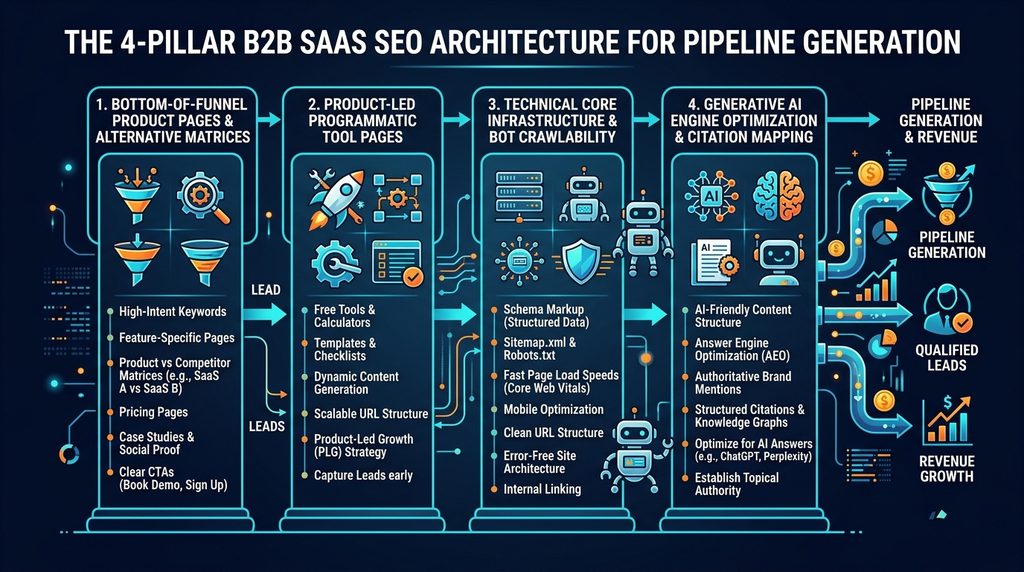
Pillar 1: Bottom-of-Funnel (BoFu) High-Intent Conversion Pages
The highest-converting search queries in software are Bottom-of-Funnel terms searched by buyers who already understand their problem and are actively comparing vendor solutions. These assets capture commercial intent at the exact moment of decision:
- Competitor Alternative Pages: (e.g.,
[Competitor] Alternatives) - Direct Head-to-Head Comparisons: (e.g.,
[Competitor A] vs [Competitor B]) - Feature Category Pages: (e.g.,
Enterprise Kubernetes Observability Software) - Industry Vertical Landing Pages: (e.g.,
HIPAA-Compliant Messaging API for Healthcare)
Pillar 2: Product-Led Programmatic SEO (PLG Assets)
Product-led search engines scale organic acquisition by indexing dynamic software assets, free diagnostic utilities, and template libraries. Instead of writing individual 2,000-word articles, growth teams build programmatic databases that generate thousands of indexable, high-utility pages (e.g., Zapier’s app integration pages or Figma’s design template library).
Pillar 3: Technical Core Infrastructure & Bot Crawlability
Modern software marketing sites are frequently built using complex JavaScript frameworks that inadvertently block search engine crawlers. Pillar 3 ensures that all body copy, comparison tables, and metadata render on the server within milliseconds, eliminating execution timeouts and indexing delays.
Pillar 4: Generative Engine Optimization (GEO) & AI Citation Mapping
Search discovery in 2026 extends beyond standard organic links. Buyers increasingly use Google AI Overviews, Perplexity, and ChatGPT Search to evaluate software stacks. Pillar 4 structures content into extractable data triples to maximize citation frequency inside generative answer engines.
How Do Bottom-of-Funnel Comparison Pages Generate Qualified SaaS Pipeline?
Direct Answer: Bottom-of-funnel comparison pages generate qualified SaaS pipeline by capturing active software buyers who are dissatisfied with incumbent providers and directly demonstrating your product superiority across pricing, features, and performance.
The most common strategic mistake software marketing teams make is prioritizing high-volume informational keywords (e.g., “what is cloud computing”) over low-volume, high-intent commercial keywords (e.g., “best cloud infrastructure monitoring tools for AWS”).
A search query with 150 monthly searches and an 8% demo conversion rate delivers substantially more ARR than a top-of-funnel query with 15,000 monthly searches and a 0.02% conversion rate.
The Anatomy of an Unbeatable SaaS Comparison Matrix
When software buyers search for [Competitor] vs [YourBrand], they do not want biased marketing fluff. They want an objective, detailed technical breakdown.
Markdown
<!-- Optimal BoFu Comparison Page Architecture -->
1. Objective Summary: Executive verdict explaining who should choose which tool.
2. Core Feature Matrix: Markdown table comparing latency, limits, and pricing tiers.
3. Migration Guide: Step-by-step documentation showing how to switch platforms in under 30 minutes.
4. Transparent Limitations: Honest disclosure of where your product is not the ideal fit.
5. Frictionless CTA: Instant sandbox or self-serve migration trial with zero sales friction.
High-Intent BoFu Keyword Clusters for SaaS
- Incumbent Alternative Queries: Target buyers actively looking to cancel expensive legacy software (e.g., Datadog alternatives).
- Feature-Specific Category Queries: Capture buyers seeking specific functional capabilities (e.g., SOC-2 compliant session replay tool).
- Integration-Driven Queries: Intercept users looking to connect existing tools in their stack (e.g., Salesforce to Snowflake automated pipeline connector).
- Pricing and ROI Evaluation Queries: Address budget decision-makers evaluating total cost of ownership (e.g., Snowflake compute cost optimization software).
Organizations seeking to dominate these high-converting keyword clusters should explore our enterprise technical SEO services to design and deploy high-converting commercial landing pages.
How Does Product-Led SEO Drive Massive Organic Acquisition for B2B?
Direct Answer: Product-led SEO drives massive organic acquisition by turning core product capabilities, templates, and free developer tools into crawlable web pages that deliver immediate value before requesting user registration.
Product-led SEO is the ultimate competitive moat for software companies. Rather than relying solely on narrative content produced by copywriters, product-led companies leverage their engineering team to build scalable software assets that rank organically.
According to search intent research published in the Ahrefs Study on B2B SaaS Search Intent, programmatic and product-led pages generate over 60% of total organic traffic for leading SaaS unicorns.
3 High-Yield Product-Led SEO Playbooks for SaaS
1. Free Lightweight Developer & Diagnostic Tools
Build a browser-based, client-side utility that solves a minor technical headache.
Examples:
- An SSL certificate expiration checker built by a cybersecurity company.
- A website performance speed diagnostic tool built by an infrastructure optimization platform.
- A SQL query optimizer built by a database management company.
These interactive utilities earn thousands of organic backlinks naturally, rank for high-volume functional searches, and serve as frictionless entry points into your paid product, for b2b website speed optimization.
2. Programmatic Integration and Ecosystem Directories
If your software connects with external APIs or platforms, build dedicated programmatic landing pages for every possible connection.
Zapier perfected this model by generating landing pages for every combination of Connect [App A] with [App B]. A project management software company can programmatically generate hundreds of pages:
- GitHub integration for project management
- Jira integration for sprint tracking
- Slack notification bot for engineering tasks
3. Free Template and Workflow Libraries
Provide downloadable, pre-configured workflow templates that solve specific user problems.
A financial SaaS can publish hundreds of financial modeling spreadsheet templates; a developer tool can publish pre-built Docker compose templates. Each template page ranks for specific search intent and introduces your product as the natural execution environment.
Which Technical Infrastructure Decisions Impact B2B SaaS Search Crawlability?
Direct Answer: Server-Side Rendering (SSR) or Static Site Generation (SSG) is mandatory for B2B SaaS marketing sites to prevent search bot execution timeouts caused by client-side JavaScript Single-Page Applications.
Engineering teams often build corporate marketing websites using the same client-side Single-Page Application (SPA) frameworks they use for their core software product (such as React, Vue, or Angular).
This decision frequently cripples search performance. Search crawlers operate under strict execution time budgets, typically between 2 to 5 seconds per page request.
The Client-Side JavaScript Indexation Trap
When a search bot crawls a purely client-side rendered website, it encounters an empty HTML container:
HTML
<!-- DANGEROUS: Empty DOM container requiring secondary client-side rendering -->
<!DOCTYPE html>
<html>
  <head><title>B2B SaaS Platform</title></head>
  <body>
    <div id="root"></div>
    <script src="/static/bundle.js"></script>
  </body>
</html>
Search bots must queue the page for a secondary rendering pass through a headless browser. If your JavaScript bundle exceeds 500KB or makes multiple slow API requests, the crawler timeout expires before the content renders, resulting in blank or partial indexation.
The Solution: Hybrid Architecture with Server-Side Rendering
To achieve flawless search crawlability, B2B SaaS marketing sites must be decoupled from the authenticated application app and delivered via Server-Side Rendering (SSR) or Static Site Generation (SSG) using modern frameworks like Next.js, Nuxt, or Astro.
Ensure that all body typography, heading structures, comparison tables, and FAQ schemas are present in the initial raw HTML payload returned by the server.
Search Bot Governance Matrix for Modern SaaS Infrastructure
Ensure your edge reverse proxies and Web Application Firewalls (WAF) explicitly permit search discovery crawlers:
| Crawler User-Agent | Controlling Entity | Operational Function | Governance Policy |
| Googlebot | Powers organic search index and Google AI Overviews | Allow (Mandatory for core organic discovery) | |
| OAI-SearchBot | OpenAI | Live web indexation for ChatGPT Search | Allow (Essential for OpenAI generative recommendations) |
| PerplexityBot | Perplexity AI | Real-time retrieval and source verification for Perplexity | Allow (Required for AI answer engine citation equity) |
| Claude-SearchBot | Anthropic | Live search retrieval for Claude web queries | Allow (Required for Anthropic generative citations) |
| Google-Extended | Foundation model training scraper for Gemini/Vertex | Discretionary (Blocking does not affect search visibility) | |
| GPTBot | OpenAI | Foundation model training scraper for OpenAI | Discretionary (Blocking does not impact ChatGPT Search) |
To verify that your engineering stack delivers crawlable HTML and zero rendering latency, book an enterprise technical SEO audit to inspect your bot logs and server infrastructure.
How Do Generative AI Search Engines Change B2B SaaS Search Discovery?
Direct Answer: Generative AI search engines bypass traditional search result clicks by synthesizing answers directly from crawled web sources, requiring SaaS companies to optimize for passage extraction and source pill citations.
Search discovery is undergoing a structural transformation. Prospective software buyers increasingly ask complex architectural questions directly inside Google AI Overviews, Perplexity AI, and ChatGPT Search.
A prospective enterprise customer no longer searches for “best CRM software” and manually browses five websites. Instead, they prompt an AI engine: “Compare HubSpot, Salesforce, and Attio for an early-stage B2B FinTech startup with custom API requirements.”
If your software product is not structured for AI retrieval, generative models will omit your brand entirely from their synthesized recommendations.
Optimizing for the Multi-Engine AI Triad
To secure continuous brand citations across generative search engines, execute the strategic principles outlined in our Generative Engine Optimization (GEO) framework:
- Question-Based Inverted-Pyramid Headings: Format H2 and H3 subheadings as explicit buyer queries, followed immediately by a bold 1-to-2 sentence direct answer block.
- Sourced Data Triples: Replace vague marketing claims with verifiable technical parameters, pricing numbers, and latency benchmarks that AI engines can quote without hallucination risk.
- Multi-Channel Entity Footprint: Distribute technical documentation across YouTube video transcripts, Reddit discussions, and recognized industry trade publications to establish broad entity consensus.
To dive deeper into the mechanics of Google’s generative answer engine, study our complete technical guide on Google AI Overviews optimization to master Gemini RAG retrieval rules.
What Does an Enterprise B2B SaaS SEO Campaign Look Like in Practice?
Direct Answer: An enterprise B2B SaaS SEO campaign systematically audits technical rendering, refactors bottom-of-funnel comparison matrices, launches product-led diagnostic assets, and tracks closed-won revenue, scaling organic pipeline from five figures to multi-millions.
To examine how modern B2B SaaS SEO strategy operates in production, review this documented 180-day case study from an enterprise workflow automation platform.
Case Study: CloudFlow Automation Systems
CloudFlow provided enterprise API orchestration software competing against legacy incumbents like MuleSoft and Workato. Despite having an exceptional product, CloudFlow was spending $140,000 per month on Google Search Ads with an unsustainable $380 Cost Per Lead (CPL).
Their organic traffic was stagnant because their marketing team had spent two years publishing generic top-of-funnel blog posts that generated zero demo requests.
+-------------------------------------------------------------------+
|         CLOUDFLOW: 180-DAY B2B SAAS SEO TRANSFORMATION            |
+-------------------------------------------------------------------+
| Growth Metric                      | Baseline Day 0 | Day 180 End |
+------------------------------------+----------------+-------------+
| Monthly Organic Demo Requests      | 14 Demos       | 168 Demos   |
| Organic Inbound Pipeline Value     | $18,400 MRR    | $242,000 MRR|
| High-Intent BoFu Keyword Rankings  | 3 in Top 5     | 48 in Top 5 |
| Blended Customer Acquisition Cost  | $380.00        | $84.00      |
| AI Search Citations (AIO / Perpl.) | 2.1% Coverage  | 38.4% Cov.  |
+-------------------------------------------------------------------+
The 180-Day Execution Protocol
Phase 1: Technical Architecture & Headless Decoupling (Days 1 to 30)
- Problem: CloudFlow’s website was built as a heavy client-side React SPA. Key comparison tables took over 4.8 seconds to render, causing Googlebot execution timeouts.
- Remediation: Migrated the public marketing site to Next.js with Server-Side Rendering (SSR). Compressed assets to achieve a 98 Core Web Vitals score and sub-120ms Time to First Byte.
- Outcome: Googlebot crawled and indexed 100% of previously orphaned pages within three weeks.
Phase 2: BoFu Comparison & Competitor Matrix Deployment (Days 31 to 90)
- Problem: Zero search visibility for commercial evaluation terms.
- Remediation: Designed and published 18 comprehensive competitor alternative and head-to-head comparison pages. Included transparent pricing matrices, API latency benchmarks, and an instant migration calculator.
- Outcome: Within 60 days, CloudFlow ranked in the top 3 positions for 14 major competitor alternative queries, immediately generating 64 qualified enterprise demo bookings.
Phase 3: Product-Led Asset Engine & Generative AI Optimization (Days 91 to 180)
- Problem: High top-of-funnel acquisition costs and zero visibility inside AI search summaries.
- Remediation: Built a free programmatic “Webhook Latency Diagnostic Tool” that developers could use without signing up. Restructured all technical documentation with inverted-pyramid direct answer blocks to capture generative engine citations.
- Outcome: The free webhook utility earned 340+ natural developer backlinks. Total monthly demo requests surged from 14 to 168, and organic pipeline ARR jumped to $242,000 MRR. Blended acquisition costs collapsed from $380 to $84 per qualified lead.
What are the 7 Most Common Mistakes B2B SaaS Brands Make with SEO?
Direct Answer: The most common mistakes are prioritizing top-of-funnel vanity traffic, ignoring competitor comparison keywords, relying on client-side JavaScript, gating all valuable content behind lead forms, ignoring generative AI engines, publishing fluffy non-technical copy, and failing to track pipeline attribution in CRM software.
Avoiding these widespread pitfalls ensures that your search budget produces compounding ARR rather than empty traffic graphs.
1. Obsessing Over Top-of-Funnel Vanity Pageviews
Publishing beginner-level dictionary articles (e.g., “what is SaaS”) inflates Google Analytics traffic graphs but delivers zero sales pipeline.
B2B software executives do not search for basic definitions; they search for advanced architectural solutions. Focus 80% of your resources on bottom-of-funnel commercial intent.
2. Neglecting Competitor Comparison and Alternative Keywords
Many software founders refuse to mention competitors on their website out of corporate pride.
However, prospective buyers are already searching for competitor alternatives. If you do not publish a fair, well-researched comparison page, third-party review aggregators or competitors will control the narrative for you.
3. Rendering Marketing Pages Exclusively via Client-Side JavaScript
Building your marketing website as a client-side Single-Page Application (SPA) risks crawler execution timeouts and partial indexation.
Always deploy Server-Side Rendering (SSR) or Static Site Generation (SSG) for all public web pages.
4. Gating Every Valuable Piece of Technical Documentation
Forcing users to fill out an 8-field lead form to download a PDF whitepaper prevents search engines from indexing the text and drives high-intent technical buyers away.
Publish your best technical guides openly as indexable HTML to earn backlinks and capture organic search demand.
5. Ignoring Generative AI Search Engine Citations
Treating Google organic links as the sole search discovery channel leaves your brand vulnerable to answer engine displacement.
Structure content with modular direct answer blocks and clean data tables to earn citations in Google AI Overviews and Perplexity.
6. Delegating Content Creation to Non-Technical Writers
Technical B2B buyers (engineers, security directors, data architects) immediately detect generic content written by freelance generalists.
Content must be written or heavily reviewed by subject matter experts who understand code architecture, API workflows, and industry compliance standards.
7. Measuring Keyword Rankings Instead of Closed-Won Pipeline
Tracking position coordinates without tracking downstream CRM revenue is misleading.
Connect Google Analytics 4 with HubSpot or Salesforce to evaluate organic landing pages based on qualified pipeline, opportunity creation, and closed-won ARR.
How Do You Measure B2B SaaS SEO Pipeline Attribution in CRM Software?
Direct Answer: Measure B2B SaaS SEO pipeline attribution by capturing UTM parameters and organic landing page URLs in hidden CRM form fields, passing search data into HubSpot or Salesforce to track opportunity creation and closed-won ARR.
To demonstrate true return on investment to executive leadership and venture investors, marketing teams must move beyond vanity metrics like organic sessions and keyword rankings.
+-------------------------------------------------------------------+
|               B2B SAAS ORGANIC ATTRIBUTION ARCHITECTURE           |
+-------------------------------------------------------------------+
|  STEP 1: FIRST-TOUCH LANDING URL CAPTURE                          |
|  JavaScript snippet captures original landing URL & referrer.     |
|  Stored in first-party browser cookies for 90 days.               |
+-------------------------------------------------------------------+
                                  |
                                  v
+-------------------------------------------------------------------+
|  STEP 2: HIDDEN FORM FIELD PASS-THROUGH                           |
|  When user submits a demo or trial form, hidden fields populate:  |
|  'First_Touch_Landing_Page', 'Organic_Keyword', 'Referrer_Engine'.|
+-------------------------------------------------------------------+
                                  |
                                  v
+-------------------------------------------------------------------+
|  STEP 3: CRM PIPELINE MAPPING (Salesforce / HubSpot)              |
|  Form submission creates Contact & Opportunity record.            |
|  Tracks deal stage progression from Discovery -> Closed-Won ARR.  |
+-------------------------------------------------------------------+
Key Organic Revenue Metrics to Report to the Board
- Organic Pipeline Generated: Total dollar value of sales-accepted opportunities originating from organic search landing pages.
- Organic Customer Acquisition Cost (CAC): Total investment in technical SEO, content engineering, and agency retainers divided by new customers acquired.
- Pipeline Velocity: The average number of days required for an organic lead to progress from initial demo request to closed-won contract.
- Organic ARR Contribution: Percentage of total new Annual Recurring Revenue attributed to organic search touchpoints.
Key Takeaways for Dominating B2B SaaS SEO Strategy
- Focus on Pipeline, Not Vanity Traffic: Prioritize bottom-of-funnel comparison and feature category keywords that convert directly into demos.
- Deploy Product-Led Assets: Build free interactive diagnostic utilities and programmatic integration directories to earn natural backlinks.
- Enforce Server-Side Rendering: Eliminate crawler execution timeouts by delivering pre-rendered HTML across all public marketing pages.
- Capture Generative AI Citations: Structure pages with question-based headings and immediate bold direct answer blocks for AI Overviews.
- Own the Narrative on Competitor Terms: Publish honest, high-value alternative pages to intercept buyers evaluating incumbent software.
- Write for Technical Decision-Makers: Ensure content reflects genuine engineering depth rather than superficial marketing fluff.
- Permit Full Snippet Extraction: Maintain permissive meta robots directives (max-snippet:-1) across all indexable marketing properties.
- Track Attribution Inside Your CRM: Pass organic landing page parameters into Salesforce or HubSpot to prove ROI to executive leadership.
Frequently Asked Questions
What is the most effective B2B SaaS SEO strategy for early-stage software startups?
B2B SaaS SEO strategy for early-stage software startups should focus almost exclusively on bottom-of-funnel competitor alternative pages, product feature landing pages, and transparent pricing comparisons. Rather than spending months competing against high-authority incumbents for broad informational keywords, early-stage companies should capture high-intent buyers who are actively searching for alternatives to legacy market leaders. This approach delivers the fastest path to qualified sales demos and recurring pipeline.
How long does it take for a B2B SaaS SEO strategy to generate measurable pipeline?
B2B SaaS SEO strategy typically begins generating measurable sales pipeline within 90 to 120 days when focused on high-intent bottom-of-funnel comparison and programmatic pages. While top-of-funnel domain authority building takes 6 to 12 months to mature, optimizing existing technical crawlability and publishing high-intent alternative pages captures immediate buyer demand from existing search volume. Maintaining technical indexation speed accelerates this commercial timeline.
How does product-led SEO differ from traditional content marketing in B2B SaaS?
B2B SaaS SEO strategy powered by product-led SEO builds free software utilities, interactive calculators, and programmatic integration directories rather than relying solely on written blog articles. Traditional content marketing attempts to educate users through narrative text, whereas product-led assets allow prospective buyers to experience product value directly within the search experience before signing up. This architectural approach generates significantly higher conversion rates and natural organic backlinks.
