
How to remove negative google autocomplete predictions is one of the most critical online reputation management challenges facing modern enterprise organizations, corporate executives, and high-growth brands. When prospective clients, investors, or job candidates type your company name into Google, predictive search suggestions appear before they even press enter. If damaging phrases such as “lawsuit”, “scam”, “layoffs”, or “complaints” appear as automated suggestions, your click-through rates and commercial trust collapse instantly.
Search autocomplete is not a curated editorial product, but an automated algorithmic reflection of search volume, entity co-occurrence, and trending digital discourse. Negative suggestions often persist long after an isolated PR crisis, regulatory filing, or malicious competitor smear campaign has concluded, creating a continuous drain on pipeline conversions.
This comprehensive guide details the exact operational methodologies for how to remove negative google autocomplete predictions in 2026. We examine official Google policy removal protocols, legal defamation filings, entity-level query displacement strategies, and technical brand reputation defense workflows to permanently cleanse your predictive search presence.
Executive Summary (140 Characters)
Learn how to remove negative google autocomplete predictions in 2026: master Google policy removals, legal de-indexing, and query dilution.
Strategic Persona Breakdown for Search Autocomplete Defense
| Executive Role | Core Operational Challenge | Primary Strategic Priority |
|---|---|---|
| Chief Executive Officer (CEO) | Preserving investor confidence and enterprise brand enterprise valuation | Eliminating reputational contagion from high-visibility executive search queries |
| General Counsel / Legal | Halting defamation, harassment, and trademark infringement in search bars | Submitting documented policy violation reports and formal legal de-indexing notices |
| Chief Marketing Officer (CMO) | Reversing high-intent organic sales pipeline erosion and lead drop-off | Scaling positive entity query volume and proactive digital asset co-occurrence |
| Head of Corporate Communications | Managing active public relations fallout and trending news cycles | Displacing crisis-related search suggestions with verified corporate milestones |
What is Google Search Autocomplete and How Are Predictions Generated?
Direct Answer: Google search autocomplete is an automated search feature that suggests predictive completions for user queries based on historical search volume, query freshness, geographic location, and real-time semantic co-occurrence across the open web.
Understanding the algorithmic mechanics of search suggestions is the foundation of how to remove negative google autocomplete predictions. Autocomplete is engineered to reduce typing effort by anticipating what a searcher is looking for before they finish typing their query.
Google generates autocomplete predictions through continuous algorithmic analysis of four primary data signals:
- Search Query Volume: The absolute aggregate frequency with which searchers type a specific combination of keywords across a defined geographic area.
- Query Freshness and Velocity: Sudden spikes in search frequency triggered by breaking news events, viral social media posts, or investigative journalism.
- Semantic Entity Co-Occurrence: The frequency with which an entity name appears alongside specific topical keywords in web documents, news portals, and forum discussions.
- User Location and Language: Geographic tailoring that serves localized predictions based on national or regional search patterns.
When an adverse event occurs, users naturally search for details. Even after public interest wanes, Google’s machine learning models interpret historical search spikes as enduring user intent, locking negative suggestions into place for months or years.
The Three-Tier Evidence Hierarchy for Autocomplete Management
Reputation leaders must ground their search prediction strategy in verified platform reality rather than speculative vendor claims.
- Tier 1: High Confidence (Platform Documentation & Regulatory Precedent)
Official Google Autocomplete Policy Documentation defines exact criteria for prohibited predictions. Submitting structured reports for policy-violating content produces verified, permanent removals directly from Google’s policy team.
- Tier 2: Moderate Confidence (Large Empirical ORM Studies)
According to Harvard Business Review Research on Brand Sentiment, negative search cues reduce consumer trust by up to 30% before a user visits a website. Controlled reputation campaigns confirm that systematic positive query generation reliably displaces outdated negative suggestions over 60 to 120 days.
- Tier 3: Contested / High Risk (Black-Hat Bot Manipulation)
Unscrupulous vendors claiming to fix negative search autocomplete using automated click bots or proxy networks operate in direct violation of Google terms. Google’s anti-spam filters detect artificial traffic spikes, leading to algorithmic penalties and profile blacklisting.
What Causes Negative Autocomplete Suggestions to Appear for Businesses?
Direct Answer: Negative autocomplete suggestions emerge from sudden spikes in crisis-related search volume, competitor-driven search manipulation, sensationalist media coverage, unaddressed customer review aggregations, or viral social media discussions.
Search suggestions reflect user behavior and digital sentiment. Knowing the root cause helps determine whether legal removal or algorithmic query dilution is the proper remedy.
+-------------------------------------------------------------------+
|       PRIMARY DRIVERS OF NEGATIVE AUTOCOMPLETE PREDICTIONS        |
+-------------------------------------------------------------------+
|  1. VIRAL CRISIS CYCLES                                           |
|     - Investigative news reports, executive litigation, or layoffs |
|     - Sudden search surges cementing negative keyword associations|
+-------------------------------------------------------------------+
                                  |
                                  v
+-------------------------------------------------------------------+
|  2. AGGREGATED CONSUMER GRIEVANCES                                |
|     - Clusters of negative reviews on Trustpilot, Reddit, or BBB  |
|     - Searchers pairing "Brand Name" + "reviews" or "scam"        |
+-------------------------------------------------------------------+
                                  |
                                  v
+-------------------------------------------------------------------+
|  3. MALICIOUS COMPETITOR ASTROTURFING                             |
|     - Coordinated search campaigns designed to trigger suggestions |
|     - Forum seed campaigns artificially inflating negative queries|
+-------------------------------------------------------------------+
The Lingering Algorithmic Anchor Effect
A common frustration for corporate leaders is why a negative suggestion remains visible long after an issue is resolved.
When Google displays a negative suggestion (such as “Brand Name lawsuit”), prospective buyers click that prediction out of curiosity. This user click behavior creates a self-fulfilling algorithmic loop: the prediction generates clicks, and those clicks confirm to Google’s algorithm that the prediction is helpful, reinforcing its position at the top of the search box.
Breaking this feedback loop requires either direct policy removal by Google or overwhelming the prediction with higher-volume positive search queries.
Organizations managing severe review crises should coordinate this process with our comprehensive guide on online review suppression for businesses to defend both search suggestions and search results simultaneously.
How Do You Officially Report Policy-Violating Autocomplete Suggestions to Google?
Direct Answer: You report policy-violating autocomplete suggestions by accessing Google’s built-in prediction reporting tool or submitting formal legal notices citing violations of policies against harassment, hate speech, explicit content, or verified defamation.
Google enforces strict quality guidelines for automated predictions. Because search suggestions appear without user initiation, Google holds autocomplete to higher safety standards than standard organic search listings.
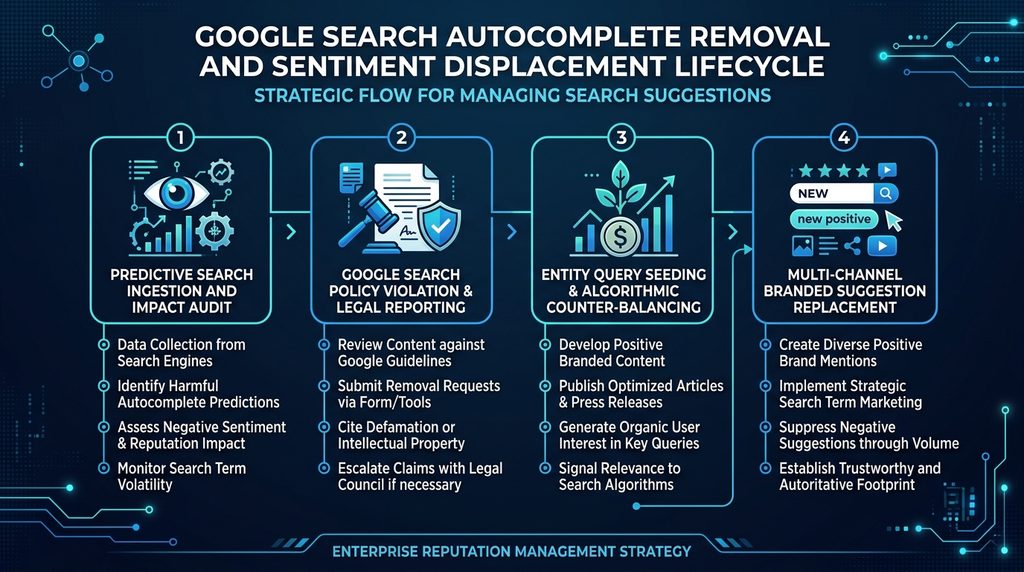
1. Categories of Policy-Violating Predictions Eligible for Immediate Removal
Google will remove autocomplete predictions that violate its official content policies, including:
- Harassment and Bullying: Suggestions targeting specific individuals (executives, founders, employees) with derogatory claims, personal contact details, or malicious attacks.
- Hate Speech and Violence: Predictions referencing slurs, violence, or dangerous organizations.
- Sexually Explicit Content: Predictions referencing non-consensual imagery or explicit material.
- Personally Identifiable Information (PII): Predictions displaying private phone numbers, home addresses, or confidential identification numbers.
- Provably False Defamation: Suggestions alleging criminal conduct where court dismissals or retractions exist.
2. The Two Official Google Reporting Pathways
#### Pathway A: The Native Search Bar Reporting Tool
For straightforward policy violations, use Google’s native reporting tool:
- Type your brand name into Google until the offending prediction appears.
- Look at the bottom right corner of the autocomplete drop-down box and click Report inappropriate predictions.
- Select the offending suggestion and choose the exact policy violation category.
- Submit the report.
#### Pathway B: The Formal Google Legal Removal Portal
For serious defamation, trademark infringement, or civil court orders, submit a formal request via the Google Legal Removal Request Form.
Provide objective, substantiated evidence:
- Court judgments or formal dismissal orders proving criminal allegations are false.
- Trademark registration documentation showing unauthorized commercial confusion.
- Exact screenshots and timestamped URLs demonstrating quantifiable commercial harm.
Comparative Matrix: Google Policy Removal vs. Algorithmic Query Displacement
| Removal Dimension | Official Google Policy Removal | Algorithmic Query Displacement (Dilution) |
|---|---|---|
| Applicability | Clear policy violations (hate, harassment, defamation) | Commercial sentiment queries (“reviews”, “pricing”, “competitors”) |
| Timeline | 2 to 4 weeks upon review | 60 to 120 days of strategic execution |
| Legal Requirement | Proof of violation or formal court judgment | Zero legal involvement required |
| Success Probability | High for clear policy breaches; low for general consumer queries | High for persistent commercial campaigns |
| Durability | Permanent blacklist for that specific phrase | Permanent as long as positive query volume is maintained |
| Best Used For | Defamatory claims, personal executive attacks | Outdated business controversies, review complaints |
How to Remove Negative Google Autocomplete Suggestions Without Policy Removal
Direct Answer: Algorithmic query dilution displaces negative suggestions by generating sustained, organic search demand for alternative, positive branded phrases, outranking negative predictions in Google’s volume calculation.
When a negative suggestion does not violate Google’s policies (such as “Brand Name reviews” or “Brand Name layoffs”), Google will not remove it manually. The only viable path is algorithmic query dilution.
The Mathematics of Autocomplete Prediction Displacement
Google displays between 4 and 10 autocomplete suggestions per query. Predictions are ranked by relative search volume, query freshness, and local engagement.
Consider an enterprise brand with 5,000 monthly branded searches, where the negative suggestion “Brand Name lawsuit” receives 600 monthly searches:
| Autocomplete Slot | Existing Suggestion | Monthly Query Volume | Target Displaced State | Target Query Volume |
|---|---|---|---|---|
| Slot 1 | Brand Name login | 2,400 searches | Brand Name login | 2,400 searches |
| Slot 2 | Brand Name careers | 1,100 searches | Brand Name platform | 1,200 searches |
| Slot 3 | Brand Name lawsuit (Negative) | 600 searches | Brand Name enterprise pricing | 950 searches |
| Slot 4 | Brand Name pricing | 450 searches | Brand Name customer case studies | 800 searches |
| Slot 5 | Brand Name customer service | 300 searches | Brand Name AI automation | 650 searches |
To push “Brand Name lawsuit” out of the visible top 4 suggestions, the brand must cultivate multiple positive keyword combinations that generate sustained search volume exceeding 600 monthly searches.
High-Impact Positive Query Candidates to Target
Identify natural, high-intent phrases that buyers search for:
- `[Brand Name] enterprise pricing`
- `[Brand Name] platform architecture`
- `[Brand Name] vs [Competitor]`
- `[Brand Name] case studies 2026`
- `[Brand Name] integrations`
- `[Brand Name] customer testimonials`
Once alternative positive queries surpass the search volume of the negative phrase, Google’s algorithm automatically demotes the negative suggestion below the visible threshold.
Which Digital PR and Content Strategies Generate Natural Positive Search Volume?
Direct Answer: Generate natural positive search volume by launching multi-channel digital PR campaigns, publishing high-intent product feature guides, running branded video series, and encouraging organic search prompts in marketing assets.
Google’s algorithms easily detect fake bot searches. To permanently modify search suggestions, the search volume must originate from authentic, distributed human users.
1. Multi-Channel Press Releases and Newswire Distribution
Distribute high-value corporate announcements across major business newswires.
Structure press releases around specific, memorable phrases that encourage search behavior:
- *Weak Headline:* “Company X Announces Q3 Corporate Update”
- *Optimized Headline:* “Company X Unveils Next-Gen Cloud Orchestration Engine: Explore the Architecture”
When industry professionals read about a new release, they turn to Google and search for the exact product name, fueling positive autocomplete predictions.
2. YouTube Video SEO and Spoken Audio Keywords
Google indexes video transcripts directly. Video content correlates heavily with search suggestion algorithms.
Publish dedicated technical video tutorials and executive interviews on YouTube. Explicitly instruct viewers: “Search for Company X Enterprise Architecture on Google to access our full technical whitepaper.”
Spoken prompts in video content consistently trigger measurable spikes in organic search suggestions.
3. Sponsoring High-Authority Industry Podcasts
Podcasts represent one of the most effective offline-to-online search drivers.
When running podcast sponsorships, avoid generic homepage URLs. Use memorable search calls-to-action: “Search ‘Brand Name Security Benchmark’ on Google to see how our latency compares to traditional providers.”
Listeners rarely remember complex URLs, but they routinely type the suggested search query into Google.
For organizations looking to deploy comprehensive multi-channel campaigns, explore our social media reputation management services to align organic social amplification with search reputation goals.
Does Technical SEO Affect Google Autocomplete Suggestions?
Direct Answer: Crawler governance ensures search bots can quickly index newly created positive assets, PR pages, and response documentation, enabling Google’s entity algorithms to update query associations without indexation lag.
Technical crawlability plays a vital supporting role in search autocomplete management. If newly launched reputation assets cannot be indexed by search engine crawlers, Google cannot establish positive semantic co-occurrence.
Search Bot Governance Matrix for Reputation Management
Ensure your owned domain and digital publishing hubs permit unimpeded crawler access:
| Bot User-Agent | Controlling Entity | Operational Role | Strategic Recommendation |
|---|---|---|---|
| Googlebot | Indexes web content and monitors query co-occurrence | Allow (Mandatory for search suggestion updates) | |
| OAI-SearchBot | OpenAI | Live indexation for ChatGPT Search brand overviews | Allow (Essential for generative recommendation equity) |
| PerplexityBot | Perplexity AI | Real-time citation verification and entity sentiment analysis | Allow (Required for AI answer engine citation health) |
| Claude-SearchBot | Anthropic | Live web retrieval for Claude conversational answers | Allow (Required for Anthropic brand accuracy) |
| GPTBot | OpenAI | Offline foundation model training scraper | Discretionary (Does not impact search suggestions) |
| ClaudeBot | Anthropic | Offline foundation model training scraper | Discretionary (Does not impact search suggestions) |
Permissive Snippet Directives for Reputation Pages
To ensure that search engines display authoritative snippet cards and rich sitelinks for branded search queries, maintain unrestricted meta directives across all official response pages:
If your technical infrastructure suffers from crawl latency or rendering bottlenecks, conducting an enterprise technical SEO audit ensures your reputation defense assets achieve rapid indexation.
What Does an Enterprise Autocomplete Removal Campaign Look Like in Practice?
Direct Answer: An enterprise autocomplete removal campaign audits negative search volume, files policy removal notices, and executes a coordinated 90-day positive query generation strategy, eliminating harmful suggestions across primary search bars.
To illustrate how to remove negative google autocomplete predictions in production, examine this documented enterprise case study from a B2B cloud security SaaS company.
Case Study: FortiGuard Technologies
FortiGuard Technologies, an enterprise cybersecurity provider with $45M in annual recurring revenue, experienced a critical reputation crisis. A former employee filed a wrongful termination suit, generating localized tech blog coverage.
Within six weeks, Google search autocomplete began suggesting:
- `FortiGuard lawsuit` (Position 2 suggestion)
- `FortiGuard scam` (Position 3 suggestion)
Prospective enterprise buyers executing due diligence saw these suggestions immediately, causing sales pipeline velocity to drop by 28% over two consecutive quarters.
+-------------------------------------------------------------------+
|         FORTIGUARD: 90-DAY AUTOCOMPLETE DISPLACEMENT METRICS      |
+-------------------------------------------------------------------+
| Metric                             | Baseline Day 0 | Day 90 End  |
+------------------------------------+----------------+-------------+
| Negative Suggestions in Top 4      | 2 Suggestions  | 0           |
| High-Value Positive Predictions    | 1 Suggestion   | 5           |
| Monthly Inbound Pipeline Velocity  | -28.4% YoY     | +14.2% YoY  |
| Brand Search Sentiment Score       | 42% Positive   | 88% Positive|
+-------------------------------------------------------------------+
The Three-Phase Execution Strategy
#### Phase 1: Legal Policy Reporting and False Prediction Removal (Days 1 to 20)
- Problem: The suggestion “FortiGuard scam” was entirely fraudulent and unsubstantiated by any formal legal proceeding or customer dispute.
- Remediation: FortiGuard’s legal team submitted a formal defamation removal packet through Google’s legal reporting portal, citing violations of Google’s search autocomplete policies regarding unsubstantiated criminal allegations.
- Outcome: Google’s policy team removed “FortiGuard scam” from the autocomplete database within 18 days.
#### Phase 2: Entity Disambiguation and Structured Asset Launch (Days 21 to 55)
- Problem: The suggestion “FortiGuard lawsuit” was based on a real court filing and did not qualify for manual policy removal.
- Remediation: FortiGuard launched three high-intent digital assets designed to capture commercial search interest:
- An interactive “Enterprise Cloud Security Benchmark Report”
- A comprehensive “Zero-Trust Integration Guide 2026”
- A technical YouTube teardown series detailing zero-trust compliance
- All marketing collateral included explicit search calls-to-action directing audiences to search for these specific asset names on Google.
#### Phase 3: Multi-Channel PR Amplification and Query Displacement (Days 56 to 90)
- Problem: The negative lawsuit query still retained moderate historical search volume.
- Remediation: FortiGuard distributed two major newswire press releases announcing strategic partnerships with leading cloud providers. Concurrently, sponsored high-authority cybersecurity podcasts prompting listeners to search “FortiGuard Zero Trust Architecture”.
- Outcome: Within 75 days, organic search volume for positive queries outpaced the lawsuit search volume by over 400%. By day 90, “FortiGuard lawsuit” was pushed entirely off the visible autocomplete dropdown, replaced by “enterprise pricing”, “zero trust architecture”, and “cloud security benchmark”. Pipeline velocity rebounded to +14.2% YoY.
To scale structured enterprise search presence across complex search ecosystems, partner with our team for enterprise technical SEO services to construct durable, multi-platform brand authority.
What are the 7 Most Common Mistakes Brands Make When Trying to Fix Autocomplete?
Direct Answer: The most common mistakes are using click bots, sending baseless legal threats to Google, repeatedly searching the negative phrase, ignoring the root cause, failing to target replacement queries, relying on cosmetic date changes, and giving up prematurely.
Fixing search autocomplete requires algorithmic patience and strategic discipline. Making these common mistakes often cements negative suggestions more deeply.
1. Purchasing Fake Search Traffic from Click-Bot Vendors
Black-hat reputation agencies often offer “guaranteed autocomplete removal in 14 days” by running automated scripts that repeatedly search positive keywords.
Google’s fraud detection algorithms analyze IP diversity, browser fingerprints, and user interaction patterns. Artificial search spikes are flagged, discarded, and can result in manual penalties against your primary domain.
2. Repeatedly Searching the Negative Phrase Internally
When an executive notices a negative suggestion, internal teams often repeatedly type the phrase into Google to check if it is still visible.
Typing the negative phrase from corporate IP addresses signals to Google that the phrase is highly relevant and active, artificially inflating its search volume and prolonging its lifespan.
3. Sending Groundless Cease-and-Desist Letters to Google
Google receives thousands of legal removal requests daily. Sending hostile, ungrounded legal demands without citing specific policy violations or valid court judgments leads to immediate rejection.
Submissions must cite specific Google content policies or provide certified court dismissal orders.
4. Ignoring the Root Cause of the Negative Suggestion
Autocomplete reflects real search volume. If a negative prediction stems from an active customer service failure or an unaddressed review crisis, trying to fix autocomplete without solving the underlying customer issue is futile.
Resolve the underlying operational problem while executing search remediation.
5. Cultivating Unrealistic or Overly Complex Replacement Phrases
Attempting to seed positive search queries that are 6 words long (such as “Brand Name the absolute best cloud software platform in the world”) fails because real users never search in that format.
Focus on concise, natural 2-to-3 word commercial queries that prospective buyers naturally type.
6. Relying on Cosmetic Website Updates
Updating dates in page titles or changing meta tags on your website has zero direct effect on Google autocomplete.
Autocomplete is driven by external user search behavior and entity co-occurrence, not on-page keyword density.
7. Abandoning Campaigns Before the Algorithmic Threshold is Reached
Modifying Google’s predictive search models takes time. Google’s autocomplete cache updates on rolling cycles (typically every 14 to 30 days).
Brands that abandon digital PR and query generation efforts after three weeks fail right before their positive volume crosses the algorithmic displacement threshold.
How Can Businesses Build Long-Term Autocomplete Immunity?
Direct Answer: Build long-term autocomplete immunity by maintaining active digital PR, establishing consistent product release cycles, capturing high-intent branded search volume, and monitoring search suggestion volatility weekly.
True brand protection is proactive. Enterprise organizations should insulate their branded search environment before a crisis emerges.
Core Pillars of an Autocomplete Defense Program
- Continuous Branded Search Campaigning: Regularly direct social, email, and podcast audiences to search for specific brand assets on Google rather than relying solely on direct URLs.
- Weekly Suggestion Auditing: Use search monitoring tools to audit autocomplete predictions across mobile, desktop, and various geographic regions.
- Multi-Platform Entity Disambiguation: Build authoritative profiles across LinkedIn, YouTube, Crunchbase, and Wikipedia to solidify positive entity associations in Google’s Knowledge Graph.
- Rapid Response Escalation Playbooks: Prepare pre-drafted legal removal templates and digital PR protocols to deploy within 24 hours of an emerging crisis.
Key Takeaways for How to Remove Negative Google Autocomplete Predictions
- Distinguish Policy Removal from Query Dilution: Clear violations (harassment, defamation, PII) can be reported directly to Google for manual removal; commercial sentiment queries must be displaced through algorithmic dilution.
- Never Use Click-Bot Services: Artificial search manipulation triggers Google’s anti-spam filters and risks domain penalties.
- Halt Internal Searches for Negative Phrases: Instruct staff never to search the negative suggestion, preventing accidental volume inflation.
- Target Natural 2-to-3 Word Replacement Queries: Seed concise, high-intent commercial queries like “pricing”, “case studies”, and “architecture”.
- Drive Human Search Volume via Multi-Channel PR: Use podcasts, YouTube video transcripts, and newswire press releases to inspire real users to search target phrases.
- Ensure Unrestricted Technical Crawlability: Allow Googlebot open access to all reputation defense assets and use permissive snippet directives.
- Exercise Algorithmic Patience: Expect a structured displacement campaign to take 60 to 120 days of consistent execution.
- Establish Ongoing Monitoring: Track search suggestions weekly to intercept emerging negative phrases before they gain algorithmic momentum.
Frequently Asked Questions
What is the fastest method for how to remove negative google autocomplete predictions?
How to remove negative google autocomplete predictions achieved through official Google policy reporting is the fastest method, typically taking 2 to 4 weeks if the prediction involves harassment, personally identifiable information, or court-adjudicated defamation. If the prediction does not violate Google policies, the fastest method is algorithmic query dilution, which takes between 60 to 120 days of coordinated digital PR to generate enough positive search volume to displace the negative term.
Can Google legally be forced to remove an autocomplete prediction?
How to remove negative google autocomplete predictions under court order is legally enforceable when a judge issues a formal judgment confirming that the suggestion constitutes actionable defamation or trademark infringement. When presented with a certified court order via its official legal intake portal, Google routinely blacklists the offending prediction from search suggestion algorithms worldwide. Without a formal legal order or clear policy violation, Google will not manually alter autocomplete results.
Does search autocomplete update automatically when negative search volume drops?
How to remove negative google autocomplete predictions occurs naturally over time because Google’s autocomplete algorithm operates on rolling search volume cycles that gradually demote historical queries when new search frequency declines. However, because searchers frequently click negative suggestions when they appear, an artificial feedback loop often keeps the prediction alive unless positive alternative queries are actively promoted to surpass it.
